Sugar and Its Hidden Ethanol Potential
- 4 min read
- 1,016
- Published 13 Mar 2026
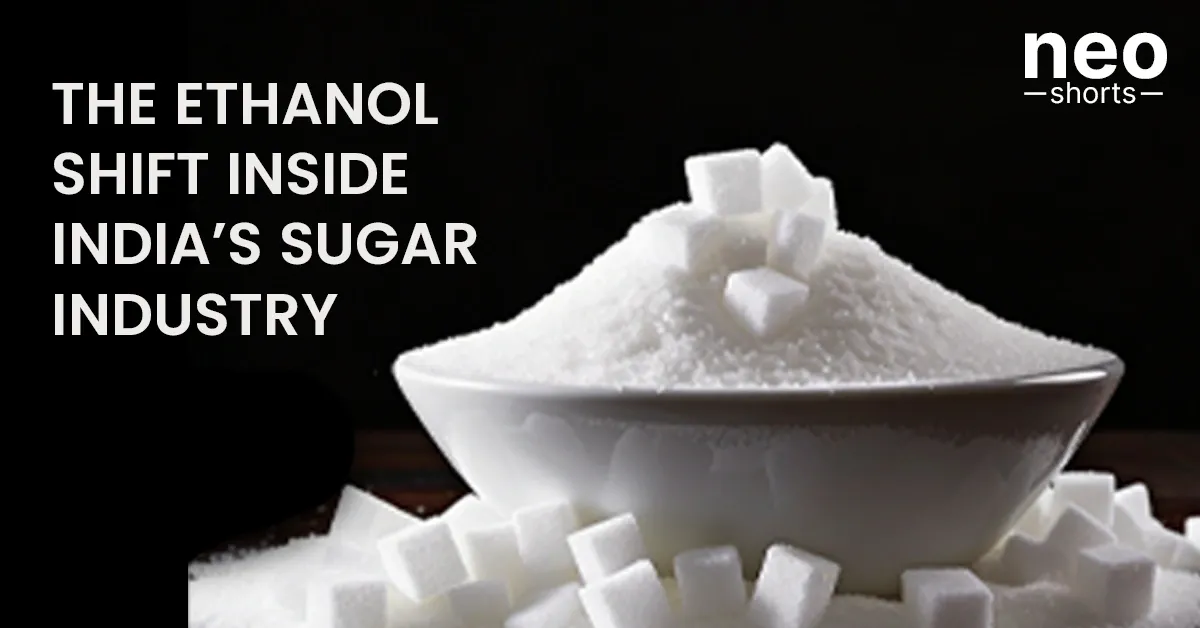
India’s sugar mills are not just about sugar anymore.
Sugar mills are now also producing ethanol, thereby directly contributing to the country’s fuel supply.
Rising government targets for ethanol blending have accelerated this change.
What was once a single-product industry is now playing a meaningful role in India’s clean energy future.

And the scale of this transformation is significant.
India is the world’s largest sugar consumer and the second-largest producer.
For the 2025-26 season, sugar production is projected at around 29 million tonnes. On the trade side, exports have reached about 0.201 million tonnes so far, while imports stand at roughly 2.8 million tonnes.
But the industry today is no longer just about producing sugar.
Most companies operate integrated business models that generate revenue from multiple sources.
Refined sugar is sold in domestic markets and exported, ethanol is supplied to Oil Marketing Companies (OMCs), and many mills also run co-generation plants that supply electricity to state grids.
By-products such as molasses and bio-compost provide additional income streams.
Within this structure, ethanol has emerged as the most significant structural shift for the industry.
But what is ethanol?
Ethanol, produced from sugarcane derivatives or grains, is blended with petrol to reduce fossil fuel dependence.
For India, the fuel is strategic rather than optional.
It lowers crude oil imports, strengthens energy security, reduces emissions, and creates a structured demand channel for cane.
That’s why India launched the Ethanol Blending Programme (EBP).
Blending levels were just 1.5% in 2013-14. They rose to 2.5% in 2014-15. By 2019-20, the figure reached 5%. It accelerated to 8.1% in 2020-21, touched 10% in 2021-22, climbed to 15% in 2023-24 and reached 19% in 2024-25.
The increase from 1.5% to nearly 20% in a little over a decade reflects strong policy execution.
The next milestone is E30 by 2030.
Behind this policy push lies a significant change in how sugar output is used.
Currently, around 9% of India’s sugar production is diverted to ethanol, and this share could rise to 22% by 2034 as blending levels increase.
Ethanol production itself has expanded sharply, from 38 crore litres in Ethanol Supply Year (ESY) 2014 to over 700 crore litres in ESY 2024.
To support this growth, India now has 263 molasses-based distilleries with a combined ethanol production capacity of about 620 crore litres.
However, the transition has not been entirely smooth. FY25 turned out to be a challenging year for the industry.
Weak monsoons tightened cane availability. The government capped sugar diversion for ethanol at 4 million tonnes. Ethanol feedstock availability declined roughly 20% year-on-year.
Distillery utilisation slipped, compressing EBITDA across the sector.
But in November 2025, quantitative restrictions on ethanol production were lifted.
Diversion from cane juice, syrup and all molasses grades was permitted again. Additionally, 1.5 million tonnes of sugar exports were approved for 2025-26.
The long-term roadmap remained intact.
The impact of ethanol is visible in the revenue mix of major sugar companies.
For instance, Triveni Engineering earns about 37.2% of its revenue from distillery operations, highlighting the growing role of ethanol alongside sugar.
Looking ahead, the ethanol story is still evolving.
Industry bodies are already pushing for E27 blending, and current supply numbers suggest the sector may be ready for higher targets.
For Ethanol Supply Year 2025-26, ethanol supply is estimated at 17,760 million litres, while the requirement from Oil Marketing Companies is around 10,500 million litres.
This indicates surplus capacity and readiness for higher blending levels.
As blending targets rise and policy support continues, ethanol is steadily reshaping the economics of India’s sugar industry.
What was once primarily a commodity business is gradually becoming linked to the country’s broader energy transition.
Sources:
PIB
The Hindu Business
USDA Foreign Agricultural Service
India Express
Times of India
BSE India
Financial Express
0 people liked this article.