How Dark Stores Are Reshaping India’s Cities & Real Estate
- 4 min read
- 1,084
- Published 14 Jan 2026
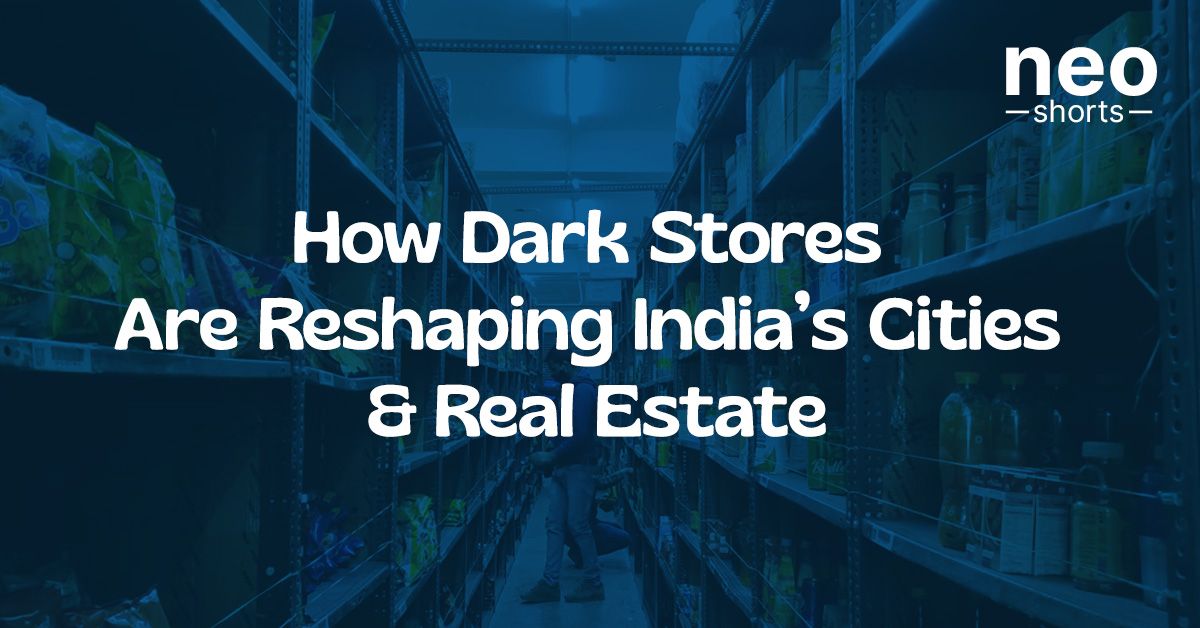
Dark stores are transforming the way Indian cities operate.
You might never have walked into one, but you likely depend on one every time you order groceries online.
A dark store is a small warehouse made only for online orders. It does not serve walk-in customers.
It is designed for quick picking and fast delivery within a one to three-kilometre radius. Every location is chosen only for how fast it can deliver.
This model is growing rapidly.
India’s quick commerce economy crossed ₹64,000 crore in FY25 after growing at a pace of 142 per cent between FY22 and FY25.
By FY26, the country is expected to host nearly 5,500 dark stores.
By FY28, the total order value is projected to touch ₹2 lakh crore.
This is not just a trend, but it is a structural shift.
Dark stores are not opening in malls or business parks.
They are taking over ground floors in residential neighbourhoods, small retail blocks, and older commercial properties.
In 2023, dark stores occupied about 24 million square feet across India. By 2027, this is expected to rise to nearly 38 million square feet.
That is a growth rate of about 12 per cent each year, driven entirely by delivery demand and network expansion.
With dark stores, what matters most is the location.
Quick commerce works only when products are stored close to where people live.
Delivery speed drops sharply even with small increases in distance.
That is why demand is highest for ground-floor spaces of 1,000 to 4,000 square feet in dense residential zones.
According to brokers and developers, enquiries for such units have jumped by around 40 per cent in the past year alone.
Rents have adjusted accordingly.
In high-demand localities, rentals have gone up by 20 to 25 per cent.
Landlords in major cities now earn 30 to 40 per cent higher returns by leasing to quick-commerce companies instead of traditional retailers.
The reason is simple.
Dark stores sign longer leases, pay on time, and expand aggressively. For property owners, they offer stable income with fewer vacancy risks.
In Delhi, dark-store rents range between ₹150 and ₹250 per square foot each month.
In Mumbai, they typically lie between ₹80 and ₹150. Bengaluru sees rates of ₹60 to ₹100, while Chennai, Hyderabad, Pune, and Kolkata fall into the ₹40 to ₹80 band depending on the locality.
Areas once considered secondary are now premium delivery zones.
The players behind this growth are moving fast.
Blinkit operates more than 1,800 stores. Swiggy Instamart has crossed 1,100. Zepto has built a network of over 1,000 locations in just a few years. Reliance Retail has already operationalised more than 600 dark-store formats under JioMart.
Amazon has also entered the space with over 100 locations.
Each company is focused on coverage, speed, and neighbourhood penetration.
The expansion, however, is not without pressure. Rising rents are squeezing margins. Congested roads are affecting delivery reliability.
In many residential pockets, dark stores operate under unclear zoning rules, exposing companies to compliance risk.
Resident complaints about traffic and noise are becoming common in high-density areas.
At the same time, operators are pushing toward efficiency.
Automation is increasing, and artificial intelligence is being used to predict demand, manage inventory, and optimise routes.
The goal is to lower fulfilment costs while maintaining speed.
Over time, dark stores are starting to resemble compact, automated warehouses rather than simple storage rooms.
Property values are rising not because more people visit an area, but because more goods move through it.
Quick commerce may look like a tech business, but it is becoming a real estate story.
That is the strange future being built behind shuttered doors.
Sources:
Care Ratings
Economic Times
Business Standard
India Sea Trade News
Moneycontrol
Savills
Moneycontrol
Swiggy Press Release
The Arc
Economic Times
Moneycontrol
0 people liked this article.