What Are Stock Market Indices? Meaning & Importance
- Updated: 22 May 2026, 5:10 PM IST
- | 5 min read
- 3,598
 Add Preferred News Source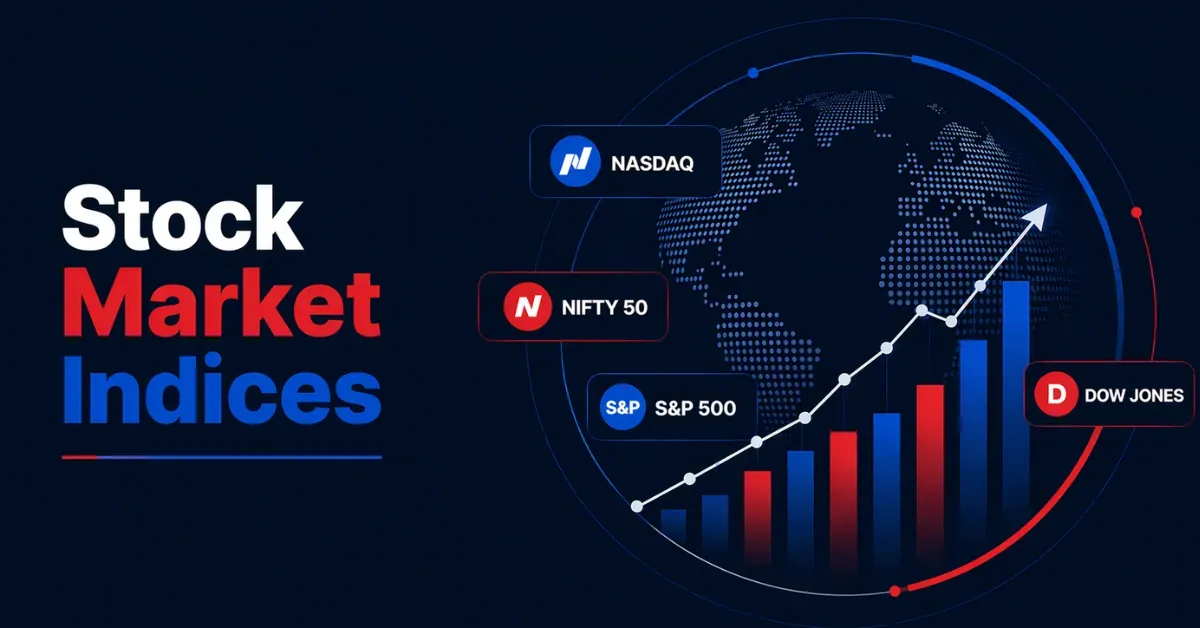
If you’ve ever checked market news, you’ve probably heard people say the market is “up” or “down.” But they’re usually not talking about a single stock, they’re referring to an index.
So, what are stock market indices? Think of them as a small group of selected companies used to represent a larger market. Instead of tracking hundreds of stocks, you follow a single value that reflects how that group is doing. This makes it easier to get a sense of the overall direction without going into too much detail.
Examples Of Stock Market Indices
In India, two indices are followed more than others. The first is Sensex. It tracks 30 well-known companies listed on the Bombay Stock Exchange (BSE). The other one is the Nifty 50. It covers the top 50 companies (by market capitalisation) listed on the National Stock Exchange (NSE).
These companies come from different sectors like banking, IT, and consumer goods. Because of this mix, the index gives a fair idea of how major parts of the market are performing.
Besides, there are many other indices that target a few specific segments or sectors. Take Bank Nifty as an example; It is a stock market index that contains only banking stocks. Nifty Pharma is another sectoral index that tracks the performance of leading pharmaceutical companies listed on NSE.
Types Of Stock Market Indices
There are different types of stock market indices, and each one looks at the market from a different angle.
-
Broad market indices: These represent big companies and serve as a common point of reference for how the market’s doing. People call these benchmark indices. For instance, there’s the Nifty 50 and Sensex.
-
Sectoral indices: These focus on a single industry, such as banking or technology. They help you see how that particular sector is doing. For example, Nifty Metal and Nifty Pharma.
-
Market-cap-based indices: Some indices group companies by size. Some track large-cap firms, while others include small-cap companies. The examples of these indices include Nifty Next 50, Nifty Midcap 100 and Nifty Smallcap 100.
How To Invest In Stock Market Indices?
You cannot buy an index directly because it is not a physical asset. It is only a calculated number. Still, there are multiple ways to invest in these indices:
Index Mutual Funds
Index mutual funds follow a specific index. They put their money into exactly the same companies as the ones in the index.
For instance, a Nifty 50 Index Fund invests in exactly those companies and in pretty much the same proportions as the Nifty 50. The idea is to keep the fund performance in line with the index.
Exchange-Traded Funds (ETFs)
ETFs also track indices. Still, they're listed and traded on the stock exchange just like shares. So you can buy or sell them during market hours.
They're pretty flexible and usually cost less than actively managed funds. However, you need a Demat account to invest in them.
With index funds and ETFs, you can easily invest in a portfolio of stocks collectively through a single purchase. Besides, they might even minimise the risk that results from relying solely on the performance of one company.
Conclusion
Stock market indices simplify how we understand market movements by capturing the performance of a group of companies in a single number. Investors can also invest in them through index funds and ETFs.
Source:
Cleartax
FAQs on Stock Market Indices
An index is just a brief overview of how a group of stocks perform. It shows the main trends of the market to investors without them having to check every stock separately.
Most people check out the Sensex and Nifty 50 indices. These include major companies from different industries.
You can’t invest in an index directly. But you can use index mutual funds or ETFs that follow it.
The Sensex tracks the top 30 companies listed on the BSE. The Nifty 50 tracks the top 50 companies (by market capitalisation) listed on the NSE.
The content in this blog is intended purely for educational purposes. Any securities or mutual funds referenced are illustrative in nature and do not constitute a recommendation or endorsement by Kotak Neo. Investors are encouraged to assess their own financial situation and seek professional advice before making any investment decisions. For compliance T&C and disclaimers, Visit https://www.kotakneo.com/disclaimer/
0 people liked this article.

Kotak Neo (Kotak Neo) is India's venerable stockbroking company with a rich legacy. It offers comprehensive investment services across asset classes, prioritising a technology-first approach for a seamless experience. Trusted by 5 million+ customers, it guides you toward financial success with ease of investment and speed of trade.
Note: The opinions expressed in this blog are personal viewpoints and should not be construed as recommendations.