What Is OCO Order? Meaning, Benefits & How It Works
- Updated: 24 Aug 2026, 1:38 PM IST
- | 9 min read
- 1,085
 Add Preferred News Source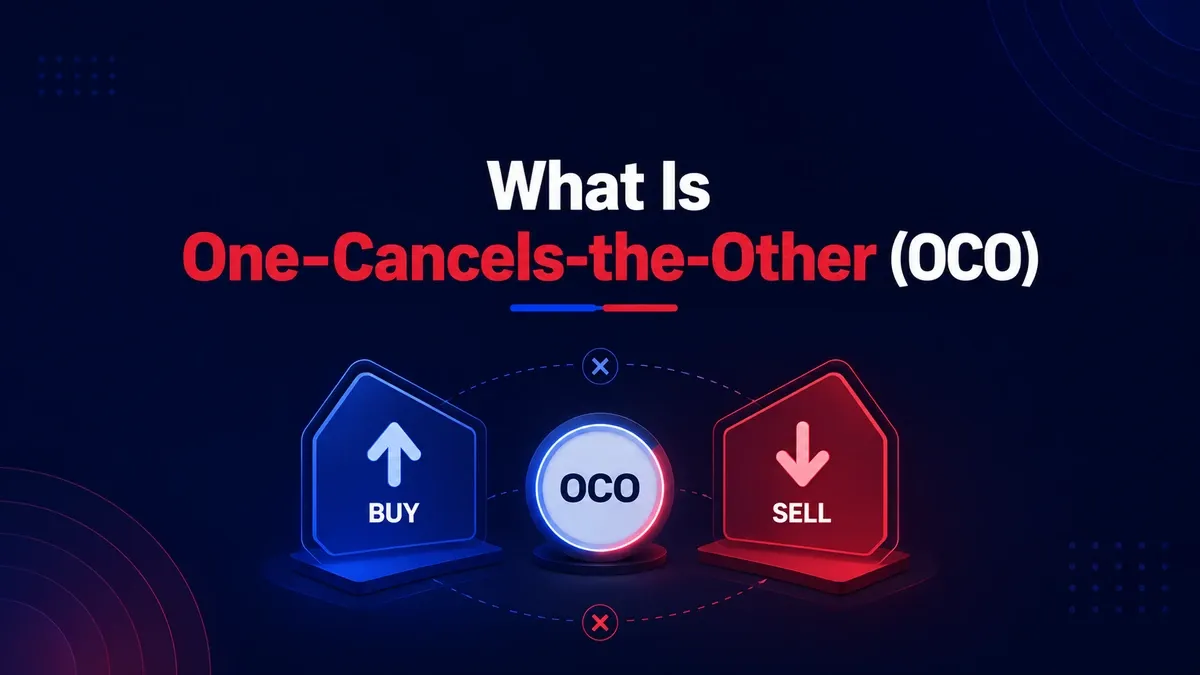
An OCO order, short for 'One Cancels the Other Order', links two conditional orders, typically a profit target and a stop-loss, against the same position. Whichever price level is reached first is sent for execution, and the other is cancelled automatically, subject to the specific broker’s execution process. Traders use it to plan an exit in advance instead of watching a live chart all day. On Indian exchanges, this is generally offered as a broker-side feature rather than a standing order type recognised by the National Stock Exchange (NSE) or the Bombay Stock Exchange (BSE). The distinctions are explained in more detail below.
OCO Order Meaning And Definition
OCO stands for One Cancels the Other. In practice, it is one trading instruction that bundles two separate orders for the same stock and the same quantity, usually a profit target on one side and a stop-loss on the other. When the price of the underlying reaches either level, that order is triggered for execution, and the platform withdraws the second order without requiring the trader to act. There is no manual clean-up step to remember. The concept is used across equity, Futures and Options (F&O), and commodity markets globally. However, how it is implemented as a native exchange order, a broker’s algorithmic feature, or a trading platform tool varies significantly by market and broker.
How Does An OCO Order Work?
The logic is fairly mechanical once you break it down. A trader picks two price points before placing anything: one above the current price and one below it, or one that books profit and one that limits damage. Both remain active within the OCO setup, with the platform monitoring two conditions.
A rough walkthrough of what happens next:
-
Two trigger levels are set at the time of placing the order, an upper and a lower.
-
Both stay pending, but only one is meant to execute; the other is withdrawn once the first is triggered.
-
If the price touches either level, that order is triggered for execution.
-
The platform cancels whatever is left, no confirmation needed from the trader.
A trigger price is not the same as the execution price. In a fast-moving or gapping market, an order that is triggered may execute at a price different from the trigger level, particularly if it is released as a limit order and the market has already moved past that limit. This means an OCO order reduces the need for constant monitoring but does not by itself guarantee the exact price at which a position will be exited.
Example Of An OCO Order In Stock Trading
Say a trader buys a stock at ₹500 (before brokerage, taxes and other applicable charges). Wanting to protect the position without staring at it all session, they set an OCO order: sell at ₹550 if it rallies, or sell at ₹480 if it drops. The stock climbs to ₹550 first; that leg is triggered, working out to a gross profit of ₹50 per share, or roughly 10% on the entry price, before brokerage, Securities Transaction Tax (STT) and other charges. The ₹480 stop-loss is withdrawn without the trader doing anything.
Had the stock fallen to ₹480 instead, the reverse would have happened: a loss of ₹20 per share, or about 4% of the entry price, and the target order would be withdrawn. Only one leg is meant to execute.
Why Do Traders Use OCO Orders?
Markets move fast, and a trader glued to their desk for eight hours is the exception rather than the rule. An OCO order is essentially a way to prepare for two opposite scenarios in advance and hand the decision-making to the system instead of a rushed, in-the-moment call.
A few reasons this appeals to active traders:
-
No need to keep refreshing a price chart just to catch the exit level.
-
Less room for panic-selling or greed-driven holding once the trade is live.
-
One order does the job of two: profit booking and loss protection together.
Useful discipline before earnings or major announcements, when prices can gap sharply in either direction.
The appeal is less about sophistication and more about not having to choose under pressure, while still requiring the trader to set sensible price levels and accept that execution is not guaranteed at those exact levels.
Key Features Of OCO Orders
A few traits set an OCO order apart from a plain single-leg order.
-
Two orders, linked, for identical quantity and the same instrument, usually a target and a stop-loss pairing.
-
Automatic cancellation of whichever leg does not execute, with the OCO functionality typically implemented by the broker or trading platform rather than as a standalone OCO order type on NSE or BSE.
-
It can be built using different underlying order types, such as a limit order paired with a stop-loss (SL) or stop-loss market (SL-M) order.
-
Available for both intraday trades and delivery-based positions on most modern platforms.
None of this is complicated once set up, which is arguably the point.
Types Of OCO Orders
Not every OCO order looks the same. The pairing changes depending on what the trader is trying to achieve, entering a fresh position versus protecting one already held.
Broadly, traders tend to use:
-
Target-plus-stop-loss pairing, for an open position where the goal is booking gains while capping the downside.
-
Buy-side OCO, placing a buy limit above resistance and a buy stop below support to catch a breakout regardless of which way it goes.
-
Sell-side OCO, geared toward exiting, either through a profit target or a protective stop, whichever comes first.
-
Bracket order setups, where some platforms fold an OCO structure into the initial entry order for a full trade in one go.
Which one fits depends entirely on whether the trader is getting in or getting out.
Benefits Of Using OCO Orders
There is a reason this order type has stuck around across trading platforms.
The practical upside, in short:
-
Saves time, since there is no need to sit and cancel a redundant order manually.
-
Sharper risk control, with the stop-loss level fixed well before the trade turns against the position.
-
Fewer impulsive decisions, because the exit plan was set calmly, not in the middle of a price swing.
-
A tidier order book, given only one leg of the pair, stays live at any point.
None of these benefits require any special skill to access, just the discipline to set the levels sensibly.
OCO Order Vs Stop-Loss Order
People often confuse the two, but they solve different problems. A stop-loss order only guards against losses. An OCO order does that too, while also setting up the profit-booking side in the same instruction. Here is how they stack up against each other.
Parameter | OCO Order | Stop-Loss Order |
|---|---|---|
Structure | Two linked orders, target and stop-loss | One standalone order |
Purpose | Combines profit booking and loss containment in a single instruction | Limits downside risk only; does not book profit |
Execution | Only one leg is meant to execute; the other is cancelled once the first is triggered, subject to the platform’s execution logic | The order executes only if the trigger price is reached; there is no second leg to cancel |
Availability on Indian exchanges | Not a native NSE/BSE order type; typically offered as a broker-side feature | Exchange-supported order type, subject to the applicable trading rules |
Monitoring required | Minimal after placement | Minimal, but no upside coverage |
Best suited for | A more complete, hands-off exit plan | Pure downside protection on a position, without an automated profit-booking leg |
When Should You Use An OCO Order?
There are certain moments where an OCO order earns its keep more than others, mostly when a trader wants both outcomes covered but cannot act on either in real time.
A few situations worth flagging:
-
Around quarterly results or major announcements, when a stock could jump either way without warning.
-
Multi-day positions where checking in constantly is not realistic, but protection still matters.
-
Breakout setups, where nobody quite knows which direction the move will go until it does.
-
Managing several trades at once, where a systematic exit rule across each position beats reacting individually.
Get the levels right, and an OCO order lets a trading plan hold up even when the trader is not watching.
An OCO order, short for One Cancels the Other, links two orders, typically a profit target and a stop-loss, against the same position. Whichever price level is reached first gets executed, and the platform cancels the other automatically.
It can work well for beginners, mainly because it takes manual exit decisions out of the equation. That said, a new trader should understand exactly what both legs of the order do before relying on it.
The moment one leg fills, the platform withdraws the other pending order without requiring any action from the trader. Only one transaction goes through for that quantity, never both.
Several trading platforms extend OCO functionality to options contracts, letting traders set a target and stop-loss on an options position. Whether it is available depends on the specific broker or app in use.
A GTT, or Good Till Triggered order, tracks a single condition and stays active until it is met, sometimes for weeks. An OCO order pairs two conditions instead, and triggering one immediately cancels the other.
Generally, yes. You can change the target or stop-loss while neither order has been triggered. Once one executes, the other is cancelled automatically.
No, one of the set levels still needs to be reached. During a sharp move, the order may also get filled at a slightly different price.
Yes, many Indian trading platforms offer OCO orders, though the available options can vary between brokers and market segments.
Slippage can affect the final execution price. A short-lived price move can also trigger the stop-loss, even when the stock later moves back up.
The content in this blog is intended purely for educational purposes. Any securities or mutual funds referenced are illustrative in nature and do not constitute a recommendation or endorsement by Kotak Neo. Investors are encouraged to assess their own financial situation and seek professional advice before making any investment decisions. For compliance T&C and disclaimers, Visit https://www.kotakneo.com/disclaimer
0 people liked this article.

Vishwa has spent 10+ years across fintech and FMCG doing what most people miss, connecting the dots, catching trends before they trend, and finding the angle nobody else thought to ask about.
At Kotak Neo, she drives content strategy for neoshorts, Kotak News Desk, and Investing Guide, turning market noise into something worth reading.
When she's not decoding markets, she trades charts for canvases, chasing art, painting, and architecture across cities she's yet to explore.