Difference Between Investment and Speculation
- Updated: 12 Oct 2026, 6:28 PM IST
- | 8 min
- 1,052
 Add Preferred News Source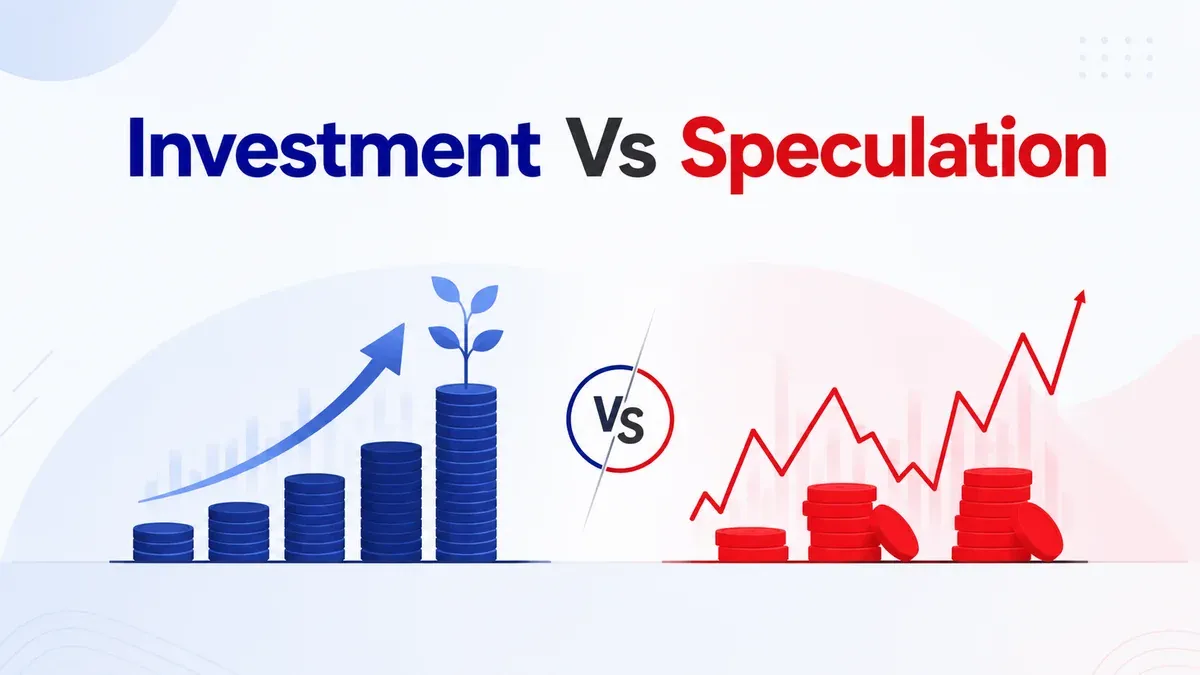
The difference between investment and speculation serves as the true baseline for structural financial planning and long-term capital wealth creation. While both actions involve putting cash to work within public financial markets to generate a positive financial return, their core operating philosophies, internal risk tolerances, and baseline strategies are miles apart. Mixing up these two paths is a major reason why retail traders suffer sudden, crippling financial hits in the stock, commodity, and crypto markets. This direct guide dismantles the exact mechanics of both approaches, making it simpler for you to see where your money actually belongs.
What is Investment?
An investment means putting capital into an asset with a clear underlying fundamental value, targeting steady income distributions or multi-year capital growth. Investors rely on in-depth research, financial analysis and economic indicators to make sure that their main investment is safe.
What is Speculation?
Speculation is the purchase of a financial asset with the hope that its price will change in the desired direction so that a profit can be made by selling the asset. Speculators focus almost entirely on immediate chart momentum and market psychology rather than digging into the actual business performance of the asset.
Difference Between Investment and Speculation
Delineating the precise boundaries of the investment and speculation difference requires looking past superficial actions. Too many market participants assume that simply buying a stock makes them an investor, but your actual motive and research style define the trade. An investor treats a stock like an active ownership stake in a functional business enterprise. On the flip side, a speculator sees that exact same asset as a moving vehicle to capture a fast price tick.
The analytical frameworks, execution speeds, and psychological hurdles look entirely different across these two paths. The table below outlines the core parameters that define the investment vs speculation matrix.
Features | Investment | Speculation |
|---|---|---|
Main Target | Slow wealth compounding, passive cash flows, and protecting capital. | Fast, outsized financial gains from capturing sudden market swings. |
Time Horizon | Long-term view, usually measured in multiple years or decades. | Short to ultra-short term, lasting from minutes to a few months. |
Risk Handling | Low to moderate; risk parameters are carefully measured and capped. | High to extreme; willingness to accept total loss for big payouts. |
Decision Roots | Fundamental data, audited corporate earnings, and industry health. | Technical chart patterns, immediate volume, and market news trends. |
Profit Origin | Organic corporate expansion, dividend payouts, and interest compounding. | Pure price imbalances driven by shifting supply and demand forces. |
Use of Leverage | Cash-backed transactions; avoids borrowed margin capital. | Heavy reliance on derivative leverage, options, and margin accounts. |
Key Characteristics of Investment
An authentic investment strategy leans heavily on the safety of the original principal and mathematical calculations of future asset values. The real investors do not get distracted by the daily stock market rumours and instead wait for the power of compounding to work its magic over longer periods of time.
-
Fact-based allocations: Actual financial filings, corporate governance quality, and economic competitive advantages shape every investment decision.
-
Long holding periods: Years can pass before any changes are made. That helps investors ride out standard macroeconomic recessions.
-
Regular income streams: Some investments provide regular income in the form of solid dividends or bond coupons. That kind of consistency makes it easier to predict income.
-
Diversified allocation plans: Putting all your eggs in one company increases your risk. Having a broader mix diversifies investments across a range of industries. If one company goes under, it is less of a hit.
Real-Life Example: A conservative investor purchased stocks of a large international utility company, growing its net earnings by 10% each year. The asset was intended to be held for fifteen years with the reinvestment of quarterly cash dividends.
Key Characteristics of Speculation
Speculation is characterised by quick execution, high emotional pressure, and binary results where you either win big or lose. The odds are volatile but speed is a trade-off speculators are willing to accept.
-
Short holding periods: Minutes, hours, or days. That is all an active position is held before it is exited to book quick profits.
-
Exploiting sentiment swings: Making rapid trades based on social media trends, chatroom hype, or early news leaks.
-
Magnified position power: Using margin loans to trade massive block positions with very little personal capital down.
-
Pure technical filtering: The focus remains on candlestick bars, moving average breaks and order flow metrics rather than company fundamentals.
Real-Life Example: A day trader buys out-of-the-money weekly options on a highly volatile technology stock an hour before the closing bell, betting that a surprise product announcement will double their premium value by tomorrow morning.
Similarities Between Investment and Speculation
While their strategic goals are entirely different, these two market behaviours share identical tools and operational arenas.
-
Identical platforms: Both pathways use the exact same public exchanges, retail brokerages, and electronic execution software.
-
Profit incentives: The underlying motivation for both participants is exactly the same: growing their deployed capital.
-
Unavoidable market risks: Neither discipline can completely eliminate economic variables, unexpected black swan events, or sudden liquidity shocks.
-
Market vitality factors: The combined transaction volume of both groups induces deep market liquidity. That is why each is essential to a healthy financial system.
Advantages of Investment
Investment is a very stable and dependable source of income. Besides, there is much less stress involved when achieving major life milestones with the help of investing. No need to keep gazing at the stock ticker all day.
-
Reinvesting annual returns creates a snowball effect that builds real wealth over time.
-
Helps you stay away from the emotional fatigue of checking your portfolio constantly.
-
Long-term capital gains are subject to taxes at lower tax brackets than short-term trading gains.
-
Requires only occasional portfolio rebalancing rather than continuous manual oversight.
Advantages of Speculation
Speculation is a chance for those who have deep technical knowledge and cutting-edge trading software to access an unparalleled level of capital speed.
-
Capturing a sharp derivative or equity move can yield massive returns in a single afternoon.
-
Capital is never tied up for decades, meaning money can be moved instantly to wherever volatility strikes.
-
Short-selling tools allow speculators to book significant returns even when the broader economy is crashing.
-
Provides an engaging, data-focused professional path for independent analytical minds.
Risk of Investment
Long-term investing is usually seen as a safer harbour. However, it has its own unique risks that can slowly erode your wealth without you noticing them.
-
Fixed-income assets or slow-growth yields run the risk of falling behind rising inflation rates.
-
Keeping capital trapped in slow, safe industries means missing massive bull runs in emerging tech fields.
-
Sudden industrial shifts or regulatory overhauls can permanently destroy historically stable legacy firms.
Risk of Speculation
Speculating is such a dangerous activity that one bad trading session may even erase the entire trading account balance.
-
Trading on high margin means a minor price tick in the wrong direction forces automatic liquidation.
-
Frequent trading racks up massive broker commissions, clearing charges, and short-term taxes.
-
Fast losses hit hard mentally. That pressure often leads to emotional bets, and trading discipline falls apart.
Investment vs Speculation: Which is Better?
Deciding which option fits you best requires an honest look at your net worth, your psychological discipline, and how much time you can give to the markets. Neither path is universally better; they simply serve completely different financial setups.
If you are saving for your children's future education or building a retirement corpus, you must stick almost completely to a strict investment philosophy. However, if you have ample disposable income and love tracking fast-moving data feeds, speculation can be a great way to generate active short-term side income.
The baseline matrix below shows how these paths align with different personal situations.
Choosing the Right Path | Investment Model | Speculation Model |
|---|---|---|
Perfect User Profile | Best for people with long-term savings targets and a stable job. | Best for experienced traders using dedicated risk capital that they can lose. |
Daily Time Demands | Very low; requires just quarterly tracking and minor balance tweaks. | Very high; demands strict focus on active charts during market hours. |
Mindset Demands | Requires long-term patience and the ability to ignore paper drops. | Requires clinical emotional control and the ability to cut losses instantly. |
When Should you Invest?
Investing needs to act as the main foundation of your personal wealth setup. You should route your capital into long-term investments whenever your core goal is preserving what you have while outpacing the cost of living.
-
Planning for retirement: Your end goal is some years off, between ten and thirty years, so the key is to allow time to grow your money through the power of compound interest.
-
Working with emergency funds: The cash you have planned for home buying, medical contingency, or school fees should never be taken to the risky market.
-
Seeking true passive income: When you want your money working quietly in the background while you focus on your career.
-
During broad market panics: You can accumulate major corporate stocks when retail panic drives valuations down below their actual worth.
When can Speculation be Considered?
Speculation should only enter your plans once your foundational financial walls are completely solid.
-
Use your extra money: Never put money into the market that your daily life depends on. If losing it would force you to change how you live or meet your obligations, the position is too large.
-
After funding the basics: Make sure your liquid emergency cash, medical insurance, and retirement plans are fully taken care of first.
-
When volatility breaks out: Trading specific earnings weeks or major policy shifts where clear price velocity is virtually guaranteed.
-
After proving your system: Before risking real capital, spend months testing a clear, mechanical technical strategy on historical data.
Common Mistakes to Avoid
Most market participants encounter financial distress because they muddy the lines between these two distinct areas.
-
Labelling hype as quality: Buying a highly volatile penny stock based on a viral video and pretending it is a long-term investment.
-
Turning a trade into a forced hold: Refusing to take a small loss on a speculation play, then holding it for years as it sinks.
-
Maxing out your margin lines: Chasing massive wins with high leverage, which almost always ends in a devastating margin call.
-
Trading with critical cash: Putting your rent or grocery budget into active trades, forcing you to sell your assets during market dips.
Tips to Balance Investing and Speculation
Keeping a hard wall between your long-term wealth and your short-term active cash is the ultimate trick to surviving in the financial markets over a lifetime.
Implement the Core-Satellite Approach
A great framework used by institutional traders is the core-satellite model. This structural system lets you capture fast trends without risking your family’s safety.
-
The 85% Core Engine: Keep the lion’s share of your money invested in low-risk, long-term vehicles, like index funds or high-quality bonds.
-
The 15% Satellite Tool: Put a small slice of your excess capital into a totally separate account for short-term trades.
-
Enforce Strict Firewalls: Never shift capital out of your core accounts to bail out a losing position in your satellite trading account.
Common Financial Terms you Should Know
To talk about these subjects like a professional, you need to understand a few basic vocabulary phrases used across the industry.
-
Fundamental analysis: Reviewing a company’s real-world financial data, like debt levels and profit margins, to find its true value.
-
Technical analysis: Analysing price action charts of the past along with volume trends to predict the movement of a stock.
-
Mark-to-market: A daily financial settlement procedure by which an exchange determines your exact gain or loss at the time of the closing bell.
-
Bid-ask spread: The cash difference between the maximum price a buyer is willing to offer and the minimum price a seller is willing to accept.
Conclusion
Understanding the difference between investment and speculation becomes important. Investing means being in the market for the long term, to let the wealth grow steadily with patience. Speculation is more concerned with market trends and short-term fluctuations with a view to earning quick profits. Both have their good and bad points. “Best” depends on your financial goals, knowledge of the market and risk tolerance.
The content in this blog is intended purely for educational purposes. Any securities or mutual funds referenced are illustrative in nature and do not constitute a recommendation or endorsement by Kotak Neo. Investors are encouraged to assess their own financial situation and seek professional advice before making any investment decisions. For compliance T&C and disclaimers, Visit https://www.kotakneo.com/disclaimer
0 people liked this article.

Vishwa has spent 10+ years across fintech and FMCG doing what most people miss, connecting the dots, catching trends before they trend, and finding the angle nobody else thought to ask about.
At Kotak Neo, she drives content strategy for neoshorts, Kotak News Desk, and Investing Guide, turning market noise into something worth reading.
When she's not decoding markets, she trades charts for canvases, chasing art, painting, and architecture across cities she's yet to explore.