Your Credit Card Is Turning Into a UPI QR Code
- Posted: 23 Oct 2026, 4:49 PM IST
- | 9 min read
- 1,025
 Add Preferred News Source

The most consequential thing in your wallet may soon be the thing you no longer need to take out of it.
A credit card used to announce itself with a tap at a terminal, a satisfying beep and the promise that next month’s salary would deal with today’s enthusiasm.
Now, certain credit cards can sit quietly inside a UPI app while you scan the same QR code you use at the vegetable vendor’s cart.
The borrowing has not disappeared. It has changed its costume.
For India’s banks and payment networks, with the festive season approaching, that costume change may say more than the number of shiny new cards being issued.
The card is still there, but the shopping basket has changed
Source: CNBC TV18
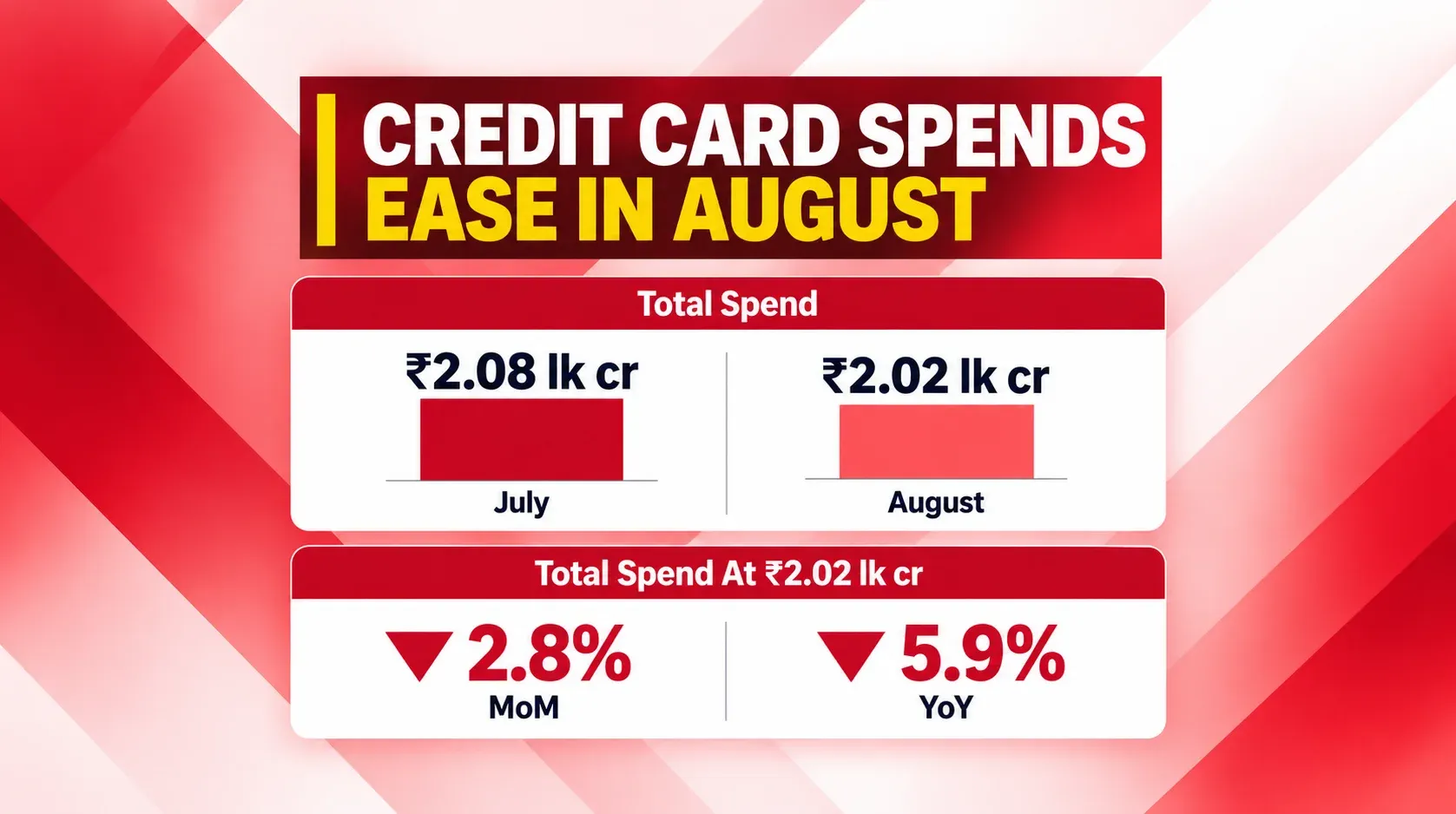
India had 12.41 crore credit cards in circulation at the end of August 2026, up from 11.25 crore a year earlier, a rise of roughly 10%.
Yet monthly spending slipped 2.8% to ₹2.02 lakh crore from ₹2.08 lakh crore in July, even as it remained 5.9% higher than in August 2025.
The number of cards is marching upwards, while the monthly spending line has decided to take a breather.
Source: CNBC TV18
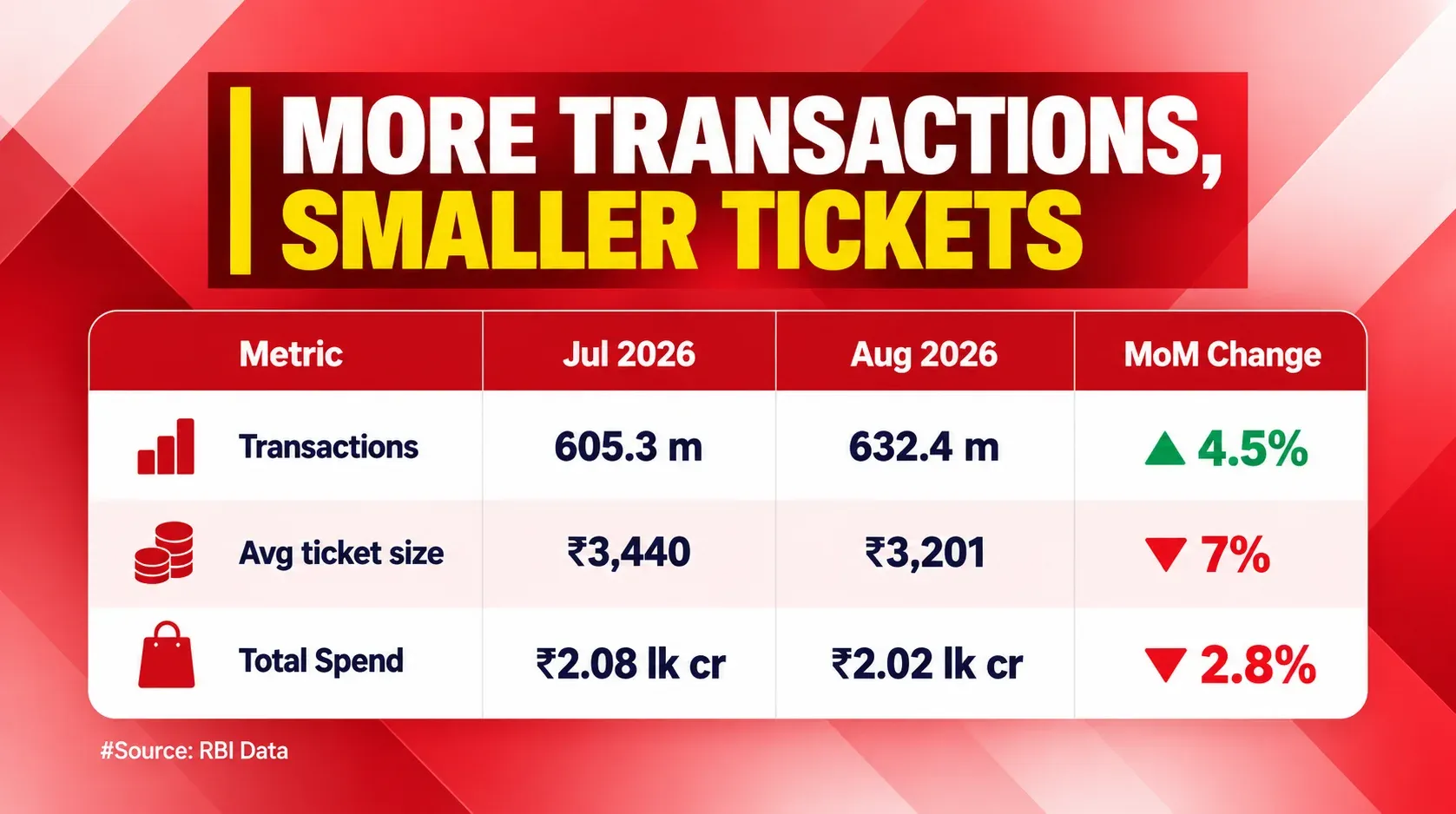
Average transaction value (the typical size of a single card purchase) fell from ₹3,440 in July to about ₹3,200 in August, a decline of around 7%.
More cards, smaller shopping baskets.
This is not quite the dramatic retreat from credit that a headline about lower spending might suggest.
It looks more like a change in the occasions on which credit gets used, and the machinery through which those purchases travel.
Consider the QR code at a neighbourhood shop.
It has spent years making payments from a bank account feel almost too easy to notice. Scan, enter the PIN, leave with the groceries.
Now RuPay, India’s home-grown card network run by the National Payments Corporation of India (NPCI), has found a way to bring credit into that same ritual.
Link an eligible RuPay credit card to a UPI app, scan the merchant’s QR code and authorise the payment with a UPI PIN.
The purchase is charged to the credit card account rather than deducted from the bank balance.
The customer gets the familiar QR experience, but the money comes from a credit limit.
The payment looks the same; just the plumbing underneath is different.
The checkout has moved to UPI, and credit is following it
In July 2026, UPI accounted for 77.3% of the value of digital payments made to merchants, up from 74.9% a year earlier, according to Equirus Securities data.
Credit cards’ share moved the other way, slipping from 19.8% to 17.7%.
The QR code is becoming one of the main gateways through which everyday spending happens.
RuPay has a structural distinction: it is currently the only credit card network whose cards can be linked to UPI in this way.
Visa and Mastercard do not have the same access.
RuPay can therefore reach the small, everyday purchases where UPI has become second nature, rather than leaving credit cards to compete mainly through conventional terminals and online checkouts.
For banks, it offers another way to put existing credit limits to work.
For merchants, it gives customers another payment option without requiring every shop to install a conventional card terminal.
For investors, it introduces a competitive wrinkle into a market where the payment network and the source of funds no longer have to be the same thing.
The economics are not identical, though. Most digital payments carry a merchant discount rate, or MDR (the small fee a shop pays to have a payment processed).
Ordinary UPI payments have largely been free for merchants, while credit card payments typically carry a noticeably higher fee.
A framework announced in September would introduce a 0.4% MDR on specified UPI merchant payments above ₹2,000, capped at ₹300, with smaller payments staying free.
It was due to begin on 15 October, but two days earlier NPCI deferred it until after Diwali, with a fresh date still to be announced.
Credit-linked UPI payments sit under separate rules in any case.
Once larger UPI payments do carry a fee, the price gap between UPI and cards narrows slightly.
That does not mean card issuers will automatically regain the share of merchant payments that have moved to UPI.
The outcome depends on transaction mix, merchant acceptance and the applicable fee arrangements.
But counting card transactions without asking how they are routed may show only half the payment.
There is another clue in the July data.
The number of credit card transactions rose about 24% year-on-year, while the average purchase shrank by roughly 14%, to around ₹3,440.
Analysts have linked part of this pattern to RuPay credit cards moving onto UPI, allowing credit to be used for everyday QR purchases.
Part of it may simply be arithmetic.
Industry analysis suggests RuPay purchases are far smaller than the average card payment, so as their share grows, the average falls even if no cardholder changes a single habit.
The data do not prove a single cause, and seasonal shopping patterns could also be playing a part.
Still, the pattern is worth watching.
Credit may be spreading across more occasions rather than simply funding larger splurges.
The festive season will put the shift to the test
India’s credit card market has already lost some of the breakneck pace it enjoyed a couple of years ago.
Card growth moderated to around 8% in FY26, compared with approximately 19% in March 2024, after the Reserve Bank of India required banks, in late 2023, to set aside more capital against unsecured loans such as credit card balances.
Yet credit card spending reached ₹23.62 lakh crore during FY26, up 12% over the year.
Slower card issuance did not stop spending from growing.
The distinction matters because a growing market does not necessarily need the same acceleration in new cards to generate more transactions.
The festive calendar adds a quieter complication.
Last year, Diwali fell on 20 October and lower GST rates arrived in late September, which helped push September 2025 card spending to a then-record ₹2.17 lakh crore.
This year, Diwali falls on 8 November, so much of the festive spending lands a few weeks later.
Comparisons with last year may look weak in September and unusually strong in November, without households having changed very much at all.
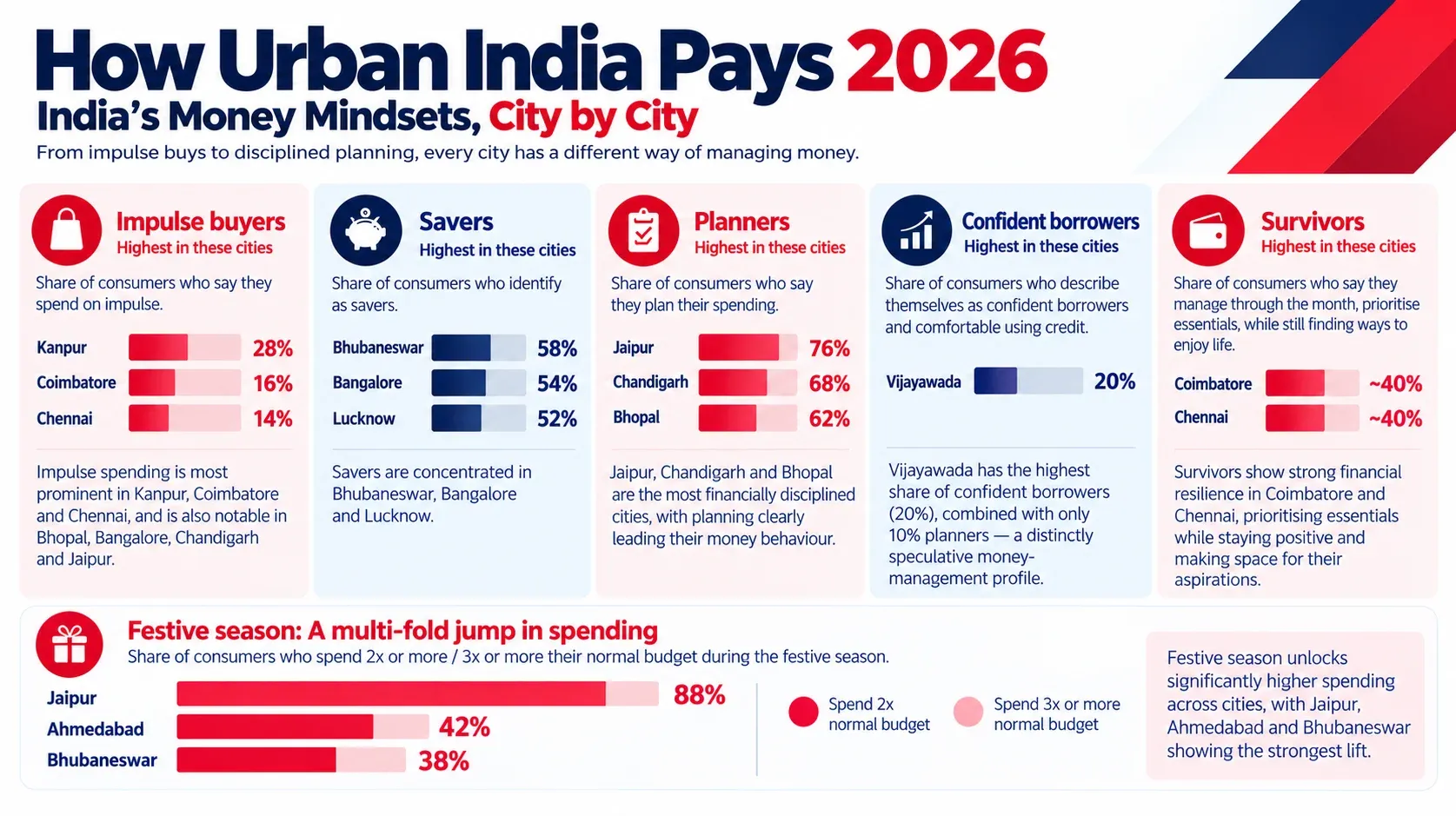
A recent survey of over 5,000 urban consumers, published by Pahlé India Foundation with Amazon Pay, found that 77% of respondents spend at least 50% more than usual during the festive season.
Use of buy now, pay later was highest in tier-2 cities, at 60% of respondents there.
Source: How Urban India Pays Report 2026
That makes the festive picture broader than a story about metropolitan shoppers buying expensive phones or booking holidays on credit.
Smaller purchases, QR-based payments and buy now, pay later services could all be part of the seasonal spending mix, including beyond the biggest cities.
The caveat is worth keeping in view: survey responses describe reported behaviour, not a guarantee of higher card spending or better repayment performance.
A busy festive checkout can raise transaction volumes.
Still, the value of each purchase, the type of credit used and the quality of the borrower determine what that activity ultimately means for a lender.
Banks are discovering that not every swipe is worth keeping
A credit limit is useful only if the borrower can repay it.
The RBI’s June 2026 Financial Stability Report (its half-yearly health check of the financial system) offers a reminder of where the risk sits.
An RBI study of large banks found that borrowers earning under ₹10 lakh a year accounted for roughly three-fourths of new unsecured retail loans.
Household debt, meanwhile, had reached 45.5% of GDP by September 2025.
Banks want to capture more everyday spending, but they also need to be choosier about whom they lend to.
A QR code may make it easier to use credit for a ₹300 purchase, but it does not make the outstanding balance any easier to repay.
ICICI Bank offers a useful example of this balancing act, although its experience should not be mistaken for an industry-wide retreat.
In results announced on 19 October, the bank reported its credit card portfolio (the balances its cardholders owe) at ₹53,091 crore at the end of September, down 9.7% year-on-year and 0.2% from the previous quarter.
It attributed the annual decline partly to last year’s higher festive base, the same calendar effect described earlier, and partly to a decision to exit customer segments it considered risky or uneconomical.
Around 85% of its card book sits with salaried customers, whose incomes tend to be steadier.
Yes Bank, meanwhile, reported 17.1% year-on-year credit card growth in its October 2026 disclosure.
One bank’s book is contracting as it prunes risk; another is expanding.
The contrast is a useful warning against treating one portfolio movement as a verdict on the entire industry.
The broader shift is towards credit quality, not simply credit quantity.
Banks want to participate in the festive rush without turning a larger customer base into a larger pile of repayment problems.
What investors may watch after the fireworks
With Diwali in November, the October to December data will say more than September’s numbers can.
It will show whether festive demand, frequent small purchases and credit-linked QR payments settle into lasting habits, and whether those habits are matched by repayment.
Transaction counts and average ticket sizes will help separate everyday spending from larger one-off purchases, while asset quality (how much of what has been lent is actually being repaid) will show whether that credit is being extended with care.
Somewhere this Diwali, a shopper will scan a QR code for a box of sweets, and the payment will look exactly like every other UPI payment that day.
The money, though, may come from a credit limit rather than a bank balance.
For the shopper, borrowing has rarely felt less noticeable.
For the bank, that is precisely what makes it harder to read.
As the way we pay tells us less about where the money comes from, card counts and spending totals tell only part of the story.
The more useful questions are quieter ones: how often credit is being used, for what, and whether it comes back.
The borrowing has changed its costume. The obligation underneath has not.
Sources and References:
- CNBCTV18
- ECONOMICTIMES
- NPCI
- FINANCIALSERVICES
- ABOUTAMAZON
- RBI
- EQUIRUS SECURITIES
- BUSINESSSTANDARD
_This article is for informational purposes only and does not constitute financial advice. It is not produced by the desk of the Kotak Securities Limited Research Team, nor is it a report published by the Kotak Securities Limited Research Team. The information presented is compiled from several secondary sources available on the internet and may change over time. Investors should conduct their own research and consult with financial professionals before making any investment decisions. The above images were generated using AI. _
Investments in securities market are subject to market risks, read all the related documents carefully before investing. Brokerage will not exceed SEBI prescribed limit. The securities are quoted as an example and not as a recommendation. Registered Office: 27 BKC, C 27, G Block, Bandra Kurla Complex, Bandra (E), Mumbai 400051. Kotak Securities Limited; SEBI Registration No. INZ000200137(Member of NSE, BSE, MSE, MCX & NCDEX), Member Id: NSE-08081; BSE-673; MSE-1024; MCX-56285; NCDEX-1262. For compliance T&C and disclaimers, Visit bit.ly/ksecdisc.
0 people liked this article.

Shreyas is a capital markets enthusiast and content strategist at Kotak Neo, driving content for Kotak Stockshaala and Kotak Insights. His work sits at the intersection of market analysis and financial literacy, turning what's moving the market into content people can actually act on.
Outside the 9-to-5, he's usually chasing his next sneaker drop, planning his next vacation, or elbow-deep in a crossword.