Delta Hedging - Meaning, Application, Pros and Cons
- Updated: 22 May 2026, 5:12 PM IST
- | 9 min read
- 1,727
 Add Preferred News Source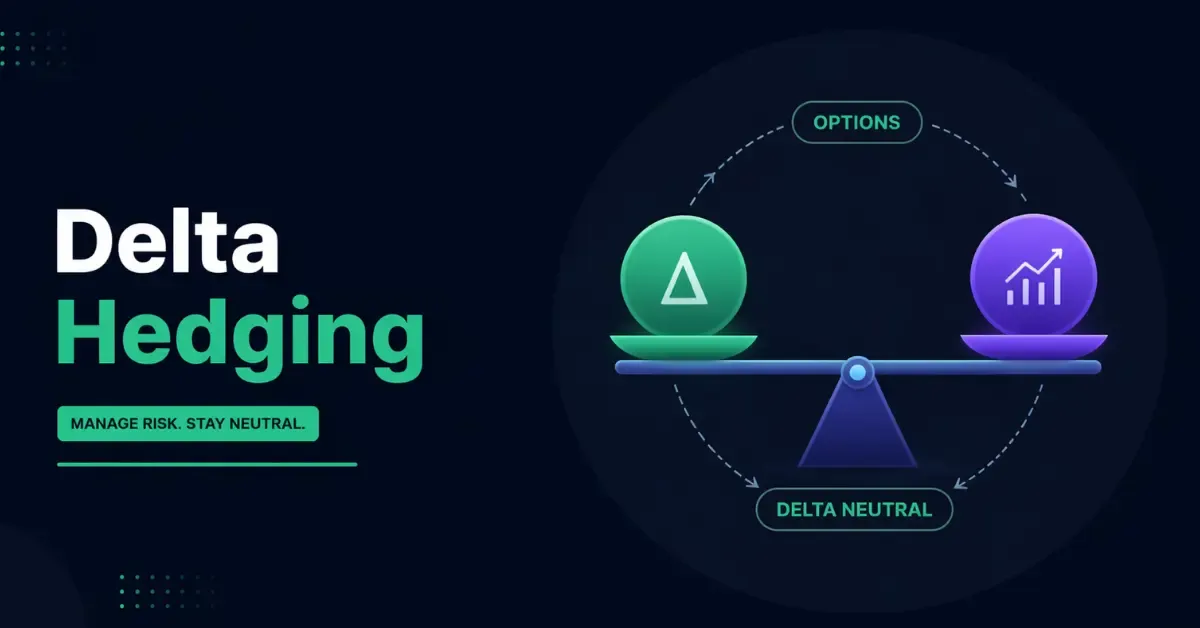
With options, risk cannot really be ignored it shows whether one plans for it or not. Delta hedging is how many traders deal with that. It’s less about predicting the market and more about not being overly exposed to it.
What Is Delta Hedging?
Delta hedging is a way to reduce directional risk. It involves adjusting positions so that price changes in the underlying asset have a reduced impact. When the balance is close enough, the position is said to be delta neutral.
The delta follows a range. For call options, it moves between 0 and +1. For put options, it sits between −1 and 0. This tells you how much the option price is likely to change for a ₹1 move in stock.
Assume you hold a call option on a stock that has a delta of 0.5. Here, for every ₹1 movement in the stock's price, the option's price would change by ₹0.5.
To balance this, one does not merely take a short position in abstract terms one short the underlying stock. That way, if the stock rises and the option gains, the short stock position loses, helping offset the impact.
You can make your position delta-neutral by balancing out the 0.5 delta. One way to do this is to take a short position. This means that any gain in the option is canceled out by a loss in the stock (and the other way around). This reduces the overall impact of price changes.
How Does Delta Hedging Work?
Delta hedging involves the following steps:
Calculate Delta
To make delta hedging work, the first step is to calculate delta. Delta is the ratio of change in the options contract value relative to the change in the underlying asset price.
Adjust Positions
Once you know the delta, the position must be adjusted to neutralise It and bring it close to zero. When this is done as a stock price rises, gains in the options position offset losses in the stock position. This helps create a hedge.
Keep Adjusting Regularly
Delta does not stay fixed. As the stock price changes, the delta shifts too. This means the hedge that worked earlier may not hold; the position will need periodic adjustment to remain close to neutral.
Delta Hedging Formula
At a basic level, delta hedging comes down to matching your exposure using the delta value. In National Stock Exchange (NSE) F&O, contracts come with a fixed lot size (for example, Nifty 50 has 65 units per lot as of 2026). The calculation is as follows: Shares to Hedge = Δ × Number of Contracts × Lot Size
If the total delta is +50, a −50 position in the underlying would be taken to neutralise it. So, if the market moves slightly, movements on one side are likely to offset losses on the other, keeping the position relatively stable.
Applications Of Delta Hedging
Delta hedging is applied in situations where price movements can quickly affect an existing position. It is not limited to one use case; traders apply it wherever controlling exposure is a priority.
Mitigate Risks In Options Trading
One common use is to reduce the effect of price swings on the underlying asset. For instance, if one is holding call options on a stock that tends to move sharply, adding a hedge can prevent those fluctuations from fully reflecting in the overall position.
Guard Against Unexpected Losses
Delta hedging can protect a portfolio against unexpected stock movements by implementing a delta-neutral position.
Types Of Delta Hedging
In practice, delta hedging does not follow a single fixed style. How it is applied often depends on how closely one wishes to track the position and how much time one is willing to spend on adjustments. Some prefer keeping things simple. Others stay far more hands-on.
Static Delta Hedging
This is the most passive approach.
The hedge is set at the outset, based on the existing delta, and then left unchanged for a period. There is no constant rebalancing, even as market conditions shift. It is effective, to an extent. But over time, as prices shift and delta change with them, the hedge can drift away from where it started. While it’s easier to manage, it’s rarely precise for long.
Dynamic Delta Hedging
This approach demands considerably more effort.
There is no “set it and forget it” here. As delta shifts, you keep adjusting your position. Sometimes small tweaks suffice; at other times, more frequent rebalancing is required when markets turn volatile. Why does delta keep moving in the first place? That’s where gamma comes in. It tracks how sensitive delta is to changes in the underlying price. When gamma is high, adjustments tend to be more frequent.
The goal is to stay as close to neutral as possible. But that precision has a cost more trades, closer monitoring, and, in many cases, higher transaction expenses. It is not complicated, but it does require consistency.
Pros Of Delta Hedging Strategies In Options
Some potential benefits of delta hedging strategies in options are as follows:
Avoid Large Losses
In uncertain or volatile markets, delta hedging can act as a buffer. Should the market swing sharply, it can help absorb some of the hit.
Highly Adaptable
A lot of traders like this strategy simply because it isn’t rigid. Positions can be adjusted as market conditions change, rather than adhering to a fixed setup. If risk tolerance shifts or the market outlook changes, adjustments can be made accordingly.
Cons Of Delta Hedging
That said, it is not without trade-offs. There are a few trade-offs to delta-hedging that are worth keeping in mind, which include:
Requirement For Frequent Adjustments
Maintaining a delta-neutral option trading position warrants frequent adjustments. This can be quite time-consuming and complex to execute.
Higher Transaction Costs
Every adjustment to maintain a delta-neutral position involves a certain transaction cost. Left unchecked, these costs can accumulate and erode returns.
Example Of Delta Hedging
Take a simple case. A trader holds 1 lot of Nifty call options with a delta of +0.5 and a lot size of 65 units (current as of 2026). That works out to a total delta of +32.5 (0.5 × 65).
To nudge the position closer to neutral, the trader would short around 32–33 units of the index.
At that point, the gains or losses from the option and the underlying largely offset each other. If the trader leaves it there without making further changes, that's static hedging.
But things rarely stay that neat. As the index moves, the option's delta also changes. If it goes from +0.5 to +0.6, the total delta goes up to +39 (0.6 × 65). To keep things in balance, the trader would need to short 6–7 more units. This is what dynamic hedging looks like in practice: adjusting the hedge as delta changes.
Conclusion
Delta hedging is not exactly beginner territory. It can certainly help manage risk, but it comes down to knowing the trade objective, the expected market behaviour, and the level of risk one is comfortable taking on. For those comfortable managing multiple variables and staying actively involved, it can be a useful strategy. For others, simpler hedging approaches may be more practical.

Delta Hedging Kya Hota Hai?
Kotak Neo
•1m 26s
FAQs on Delta Hedging
When one wishes to stay in a position but cannot afford a sharp adverse move especially before the Reserve Bank Of India (RBI) policy, Budget Day, or expiry week. This is more critical for short options sellers than for long option holders.
Market makers, institutional desks, and algo traders all manage large options books. Retail traders can use it as well, though the protection may be offset by the costs of frequent rebalancing.
No. Theta, vega, gamma, and gap risk remain exposed. Near-the-money positions close to expiry are especially vulnerable. Delta can shift faster than a hedge can be adjusted. Overnight circuits breakers compound the risk. How often should delta hedging be adjusted?
Adjust when delta drifts past a set threshold, not on every tick. Tighten the threshold during expiry week and periods of elevated volatility. The trade-off is always precision versus Securities Transaction Tax (STT) and transaction costs.
The content in this blog is intended purely for educational purposes. Any securities or mutual funds referenced are illustrative in nature and do not constitute a recommendation or endorsement by Kotak Neo. Investors are encouraged to assess their own financial situation and seek professional advice before making any investment decisions. For compliance T&C and disclaimers, Visit https://www.kotakneo.com/disclaimer/
0 people liked this article.

Kotak Neo (Kotak Neo) is India's venerable stockbroking company with a rich legacy. It offers comprehensive investment services across asset classes, prioritising a technology-first approach for a seamless experience. Trusted by 5 million+ customers, it guides you toward financial success with ease of investment and speed of trade.
Note: The opinions expressed in this blog are personal viewpoints and should not be construed as recommendations.