Advanced Option Chain: Analysis, Strategies, Indicators & Insights
- Updated: 11 Jun 2026, 4:23 PM IST
- | 4m
- 1,326
 Add Preferred News Source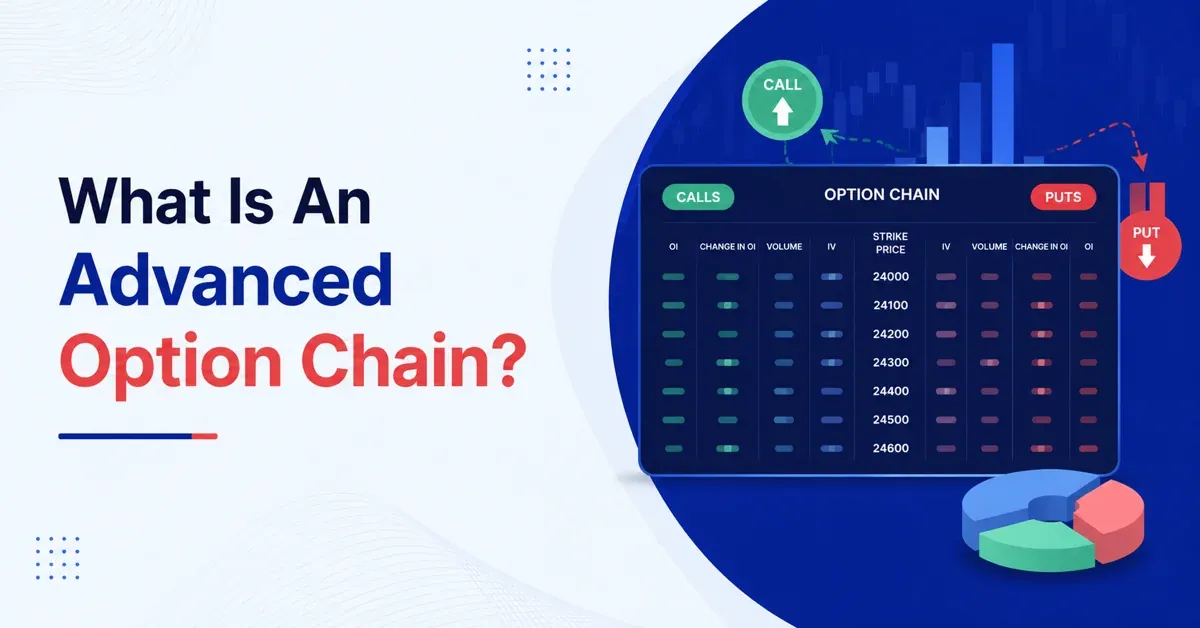
What Is An Advanced Option Chain?
Reading an option chain for the first time can be overwhelming. Premiums keep moving in real time, strike prices run across multiple rows, and terms like OI, PCR, IV, and Greeks are all over the screen. While it can seem complex for beginners, experienced traders use the same screen to gain valuable clues about the market.
That is where the advanced option chain comes in.
Instead of looking only at option prices, traders use advanced option chain analysis to study positioning, support and resistance zones, and changes in market activity. This article breaks down the main elements of advanced option chain analysis and explains how to read option chain data in a more practical way.
Option Chain Meaning
An option chain is a live table of all the option contracts available for stock or index. It brings together all the available strike prices and option contracts for different expiries in a single view. Traders can also track premium movement, open interest, and market activity from the same screen.
Every row represents a specific strike price where trading activity is happening. Some strikes attract far more attention than others. By tracking where positions are building up, traders try to figure out which price levels the market is focusing on and where momentum may be shifting.
What Makes An Option Chain “Advanced”?
A regular option chain mostly shows raw market data. An advanced option chain helps traders make more sense of that data.
Here, the focus is not limited to option premiums alone. Traders usually watch how open interest, volume, implied volatility, and Greeks change through the session because those shifts can reveal where activity is suddenly increasing. One strike price may start attracting aggressive call writing, while another sees fresh put buildup within minutes.
Traders usually track these patterns to understand where momentum may be picking up in the market. They also use these factors to identify support and resistance price levels.
Key Components Of Advanced Option Chain
An advanced option chain combines different market indicators that traders use while analysing price movement and participation.
Open Interest (OI)
Open interest, or OI, refers to the total number of option contracts that are still active in the market. When OI starts climbing, it usually means fresh positions are coming in. If it begins falling, some traders may be closing their trades.
You will often notice certain strike prices carrying unusually high OI. Those levels tend to draw attention because the market reacts around them more frequently.
Change In Open Interest
This shows how much OI has changed during the trading session. Traders look at it closely because it gives more context than OI alone.
Suppose prices are moving up and OI is rising at the same time. That can point towards fresh long positions entering the market. If prices slip but OI keeps increasing, traders may read it as a fresh short buildup instead.
Volume
Volume simply tells traders how many option contracts were traded during the day.
At times, one strike suddenly sees a sharp jump in volume while nearby strikes stay quiet. When volume increases sharply at a particular strike, it generally points towards stronger participation there. Since liquidity increases, trades also tend to get executed more easily.
Put Call Ratio (PCR)
PCR compares put activity with call activity in the market. Traders mainly use it to get a rough sense of overall sentiment.
When PCR starts rising, it usually points towards stronger put activity in the market. A lower PCR can indicate more activity on the call side. Most traders, however, prefer combining PCR with other indicators before drawing conclusions since market sentiments change quickly.
Option Greeks
Greeks measure how option prices react to different market changes.
-
Delta analyses the price sensitivity of an options contract. It is usually watched to see how the premium option reacts when the underlying asset starts moving.
-
Theta is more about what happens to premiums as time passes. It measures how premiums change as expiry approaches.
-
Vega is linked to volatility. It measures how much premiums react during such phases.
-
Gamma is slightly more advanced and is mainly tracked to understand how quickly Delta can start changing during fast price movement.
Strike Price
The strike price is the level at which an option contract can be exercised. Every option in the chain is organised around these price levels.
Most traders spend more time watching strikes closer to the current market price because that is usually where activity remains concentrated.
LTP (Last Traded Price)
LTP is the latest premium at which that option contract was traded.
Since premiums move constantly during market hours, LTP keeps changing throughout the session. This helps traders understand how quickly sentiment is shifting.
Implied Volatility
Implied Volatility (IV) is the market's expectation of future volatility. IV tends to rise when traders prepare for sharper movement in prices.
IV often rises before major events such as earnings results or policy decisions. This is because uncertainty in the market is beginning to increase.
How To Read Advanced Option Chain
Reading an advanced option chain becomes easier once traders know which data points to focus on.
Identify Support (High Put OI)
High put OI at a strike price is usually seen as a sign of support in the market. That often means traders are actively selling puts there and are not expecting the market to fall below that level easily.
When OI continues increasing at that strike, support is generally considered more significant at that level.
Identify Resistance (High Call OI)
High call OI is commonly associated with resistance levels. When traders aggressively write calls at a particular strike, it usually suggests expectations that the market may not move much above it.
When a call OI continues building at the same strike, resistance is generally considered stronger.
Track OI Changes
Many traders focus not only on total OI but also on how OI changes through the day. Sudden increases in OI can indicate fresh positions entering the market.
Sometimes the market moves up and OI rises alongside it, which can indicate fresh participation coming into the trade. In other situations, prices may start falling even as OI keeps building. That is often where traders begin looking for possible short buildup.
Combine With Price Action
Very few traders depend only on the option chain while taking trades. Most of the time, they compare it with what the chart is already showing.
Say stock keeps approaching a strike price where call OI is unusually high. If the move starts slowing near that zone or sellers repeatedly step in there, traders may start viewing that level as resistance.
Benefits And Limitations
Advanced option chain analysis can give traders a lot of useful market context. At the same time, it is not something traders blindly depend on for every trade.
Benefits
-
Makes support and resistance levels easier to spot
-
Helps traders understand where market activity is building
-
Gives a better sense of overall market sentiment
-
Useful while tracking volatility expectations
-
Helps identify shifts in trader positioning during the session
-
Adds another layer of analysis beyond charts alone
Limitations
-
Market behaviour can change very quickly
-
Strong OI levels may fail during sharp moves
-
Data can become noisy in highly volatile sessions
-
Reading the option chain takes practice
-
Greeks and IV may feel confusing initially
-
The data may not be very accurate without chart confirmation
Examples And Interpretation Techniques
Consider NIFTY is currently trading at 24,176. An options contract has a strike price of 21,500, expiring in 4 days. The other details are as below:
Call Side: OI: 5, Change in OI: -3, Volume: 5, IV: 58.31, LTP: 2,713.55, Price Change: -257.80
Put Side: OI: 34,923, Change in OI: -7,373, Volume: 31,172, IV: 38.61, LTP: 0.45, Price Change: -0.35
The put side is seeing far more activity here than the call side, both in terms of OI and trading volume. That usually tells traders where participation is concentrated at this strike price.
At the same time, the large drop in put OI indicates some positions may have been closed during the session. Traders sometimes read this as weakening support or profit booking around that level.
The difference in premiums here is mainly because of where the strike price stands compared to the current NIFTY level.
Since the market is already trading far above 21,500, the 21,500-call option already holds a large intrinsic value. That is why its premium remains very high at 2,713.55.
The put side works differently here. A 21,500- option only becomes valuable if NIFTY falls below that strike price. But with the market trading nearly 2,600 points higher, traders currently see very little probability of that happening before expiry. Because of that, the premium stays extremely low at 0.45.
This is also why deep out-of-the-money options often trade at very small premiums, while deep-in-the-money options carry much larger premiums.
Volume also tells an important story here. The put side recorded over 31,000 contracts in volume, while the call side saw almost no activity. That difference often signals where trade interest is concentrated during the session.
Conclusion
An advanced option chain gives traders much more than just option prices. They often use it to understand participation in the market, shifting sentiment, volatility expectations, and possible support or resistance levels.
However, option chain data alone does not guarantee accuracy in every market condition. It works better when used with other indicators. Still, when used properly, it can offer a clearer view of how the market is positioning itself around important price levels.
Sources:
Moneycontrol
The Economic Times
Business Standard
FAQs On Advanced Option Chain
Most traders begin by tracking open interest, change in OI, volume, and implied volatility across important strike prices. High put OI is often viewed as support, while high call OI may indicate resistance. Traders also compare these levels with price action before making decisions.
Traders usually begin with OI and volume because those two quickly show where activity is being built. After that, they often look at IV, PCR, LTP, and Greeks like Delta or Theta to understand how the market is reacting around certain strike prices.
The option chain can reveal where traders are becoming more active. Many traders use it to track support and resistance zones, changing sentiment, volatility expectations, and areas where fresh positions are entering the market.
It can help beginners, although the screen may look confusing initially because there is a lot of data moving at once. Most traders start by understanding basic things like strike prices, OI, and volume first. They then gradually move towards advanced data IV, PCR, and Greeks later on.
The content in this blog is intended purely for educational purposes. Any securities or mutual funds referenced are illustrative in nature and do not constitute a recommendation or endorsement by Kotak Neo. Investors are encouraged to assess their own financial situation and seek professional advice before making any investment decisions. For compliance T&C and disclaimers, visit https://www.kotakneo.com/disclaimer/
0 people liked this article.

Kotak Neo (Kotak Neo) is India's venerable stockbroking company with a rich legacy. It offers comprehensive investment services across asset classes, prioritising a technology-first approach for a seamless experience. Trusted by 5 million+ customers, it guides you toward financial success with ease of investment and speed of trade.
Note: The opinions expressed in this blog are personal viewpoints and should not be construed as recommendations.