SEBI May Brings Back Exchange Buybacks One Year After Banning Them
 Add Preferred News Source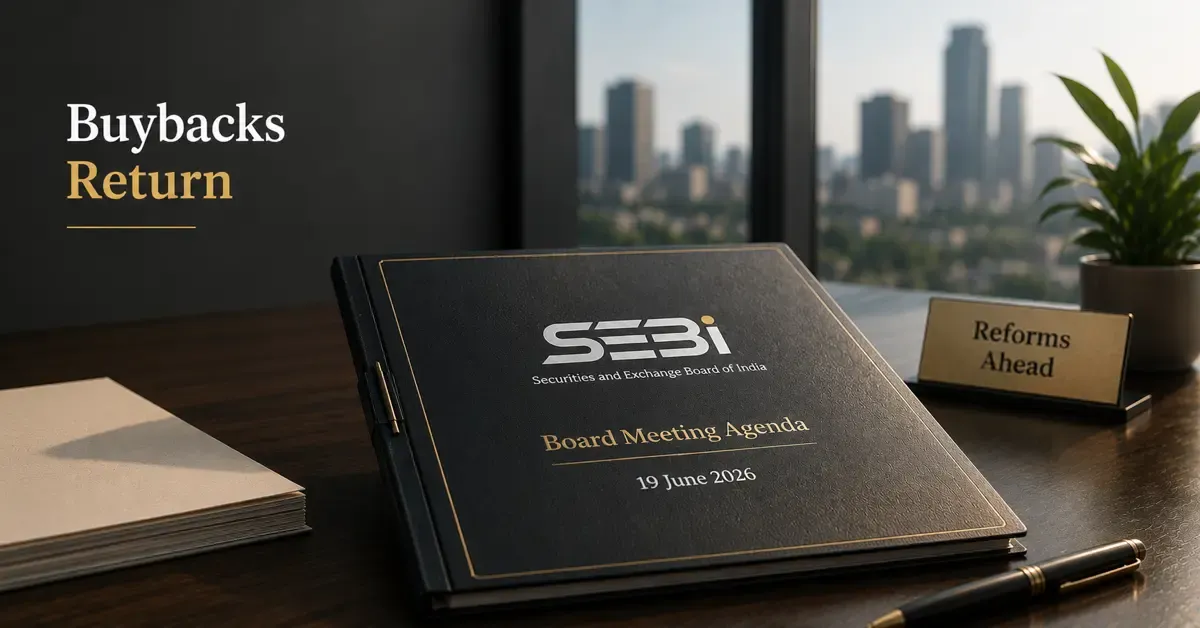
Securities and Exchange Board of India is set to reintroduce open market share buybacks at its 19 June board meeting alongside mutual fund borrowing rule changes and agricultural commodity reforms.
One year after pulling the plug on open market share buybacks, the Securities and Exchange Board of India (SEBI) looks set to bring them back. The regulator's board meets on 19 June and the agenda is packed, with the buyback reversal headlining a set of reforms that also touches mutual fund borrowing, agricultural commodity derivatives and alternative investment fund approvals.
Buybacks Through Exchanges Return
The stock exchange route for share repurchases was phased out in April 2025 over two concerns:
-
The price-time matching mechanism on exchanges let certain shareholders corner buyback benefits while others missed out entirely.
-
The tax structure made things worse, companies bore the buyback tax while participating shareholders exited without paying any.
Both issues have been fixed. From 01 April 2026, buyback proceeds are taxed as capital gains in shareholders' hands rather than at the company level. SEBI said in its consultation paper that this removes the distortions that justified discontinuing the route.
What to expect under the new framework:
-
Open market buybacks through stock exchanges reinstated.
-
Maximum completion window of 66 working days from offer opening.
-
Promoter shareholdings frozen during the buyback period.
-
Mandatory electronic communication to shareholders.
-
Merchant banker appointment likely to be made optional, reducing cost for smaller repurchases.
Buyback activity has shrunk since the route went away. Fourteen companies bought back ₹19,711 crore worth of shares last year, against a record ₹55,273 crore across 50 companies in 2017.
Mutual Fund Borrowing Gets Flexibility
Intraday borrowing for mutual funds is currently limited to bridging redemption timing gaps against guaranteed receivables. The board is expected to expand that significantly, allowing fund houses to use the facility for trade settlements, foreign exchange transactions, derivative obligations, debt repayment and general cash management.
Also Read - TCS Hit With $70 Million Exceptional Charge After US Supreme Court Rejects DXC Appeal
Other Items
Agricultural commodity position limits are set to double, with select contracts permitted to launch as financially settled before moving to physical delivery. Transmission norms for deceased investor accounts are being simplified, with thresholds doubled.
A faster approval mechanism for alternative investment fund private placement memoranda is also on the table, along with revised conflict of interest guidelines for whole-time members.
Sources:
Business Standard
The Economic Times
This article is for informational purposes only and should not be considered investment advice from Kotak Neo. For compliance T&C and disclaimers, Visit www.kotakneo.com/disclaimer
Right Tools, Rich Insights