 Add Preferred News Source
1,056 Views| 25 Oct 2026
India Waives Excise Duty On Higher Ethanol Petrol Blends; Sugar Stocks In Focus
Summary
India has withdrawn central excise duty on petrol blended with higher levels of ethanol, including E22, E25, E27 and E30 fuel grades, to cut crude oil imports and boost domestic ethanol production. Sugar stocks jumped up to 5% on the news as the move is seen boosting ethanol demand. Read ahead to know more.
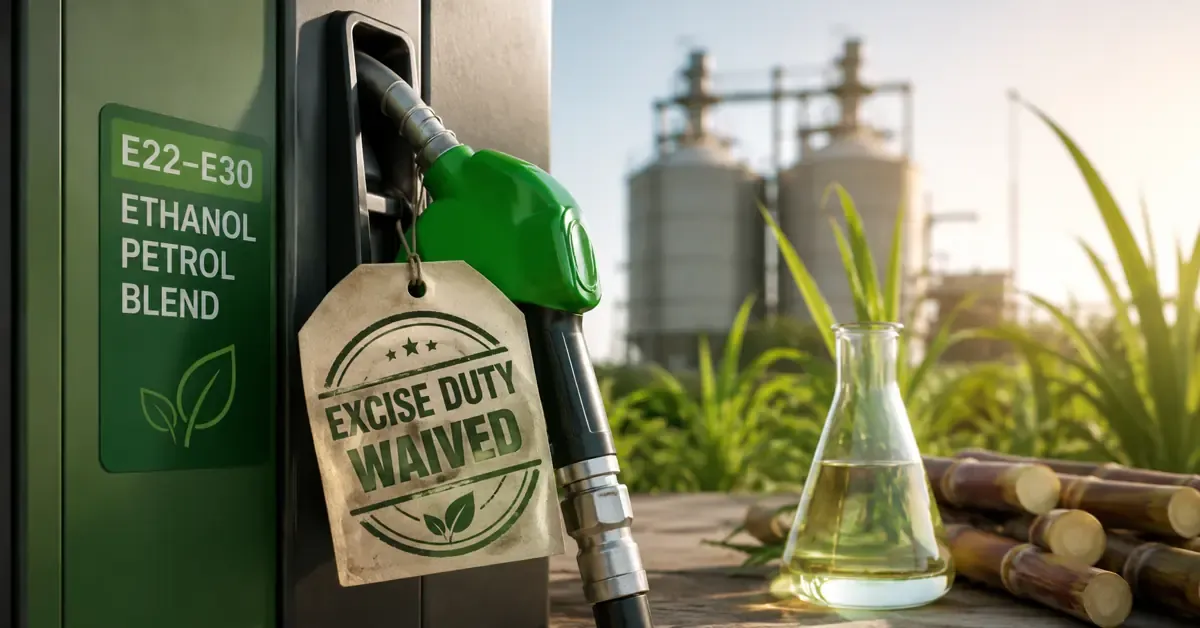
India has waived central excise duty on petrol blended with higher proportions of ethanol, covering fuel grades containing 22%, 25%, 27% and 30% ethanol.
A notification issued by the Ministry of Finance on Wednesday inserted four new categories into the existing central excise exemption framework, marking the first significant tax incentive for ethanol blends above the current E20 standard.
The move is part of India's broader effort to reduce dependence on imported crude oil, cut emissions and create commercial demand for domestically produced ethanol.
What The New Blends Look Like
The four new fuel grades covered under the exemption are E22, which contains 22% ethanol and 78% petrol; E25, with 25% ethanol and 75% petrol; E27, with 27% ethanol and 73% petrol; and E30, with 30% ethanol and 70% petrol.
All four will attract a nil rate of excise duty, provided they meet Bureau of Indian Standards specification IS 19850 and that the applicable taxes on both the petrol and ethanol components have already been paid.
The notification amends an earlier government order from 30 June 2017, and adds entries 5E, 5F, 5G and 5H to the existing table under that order.
Sugar Stocks In Focus
After the government announced excise-duty exemptions on higher ethanol-blended petrol, sugar stocks moved higher.
Dhampur Bio Organics and SBEC Sugar each gained 5% to hit their upper price bands at ₹112.42 and ₹66.32 respectively. Other sugar companies also moved higher, with Dwarikesh Sugar Industries, Triveni Engineering and Industries and Dhampur Sugar Mills trading up between 2% and 4% at ₹45, ₹381.50 and ₹144.45 respectively.
Investors expect the decision to support ethanol demand going forward.
Why This Matters
India is the world's third-largest oil importer and consumer, and reducing petrol consumption through higher ethanol blending directly lowers the crude import bill. This is especially so now with global energy markets under stress from the West Asia conflict and higher crude prices.
India’s ethanol production capacity has grown rapidly in recent years to an estimated 20-21 billion litres per year. Current demand for the E20 blending programme stands at around 10 to 12 billion litres annually, leaving significant surplus capacity that higher blending targets could absorb. The excise exemption creates a clear commercial incentive for the distilling industry to deploy that surplus toward the new higher-blend fuel grades.
Also Read - Zee Entertainment Approves ₹2,300 Crore Fundraising Plan
According to industry representatives, the move sends a strong demand-side signal and reinforces India's energy security at a time when global fuel markets remain volatile. They have also called on state governments to align their own tax structures with the central exemption so that the full benefit reaches consumers at the pump.
Sources:
The Economic Times
Business Standard
This article is for informational purposes only and should not be considered investment advice from Kotak Neo. For compliance T&C and disclaimers, Visit www.kotakneo.com/disclaimer
Right Tools, Rich Insights

Latest News
- 1,089 Views| 25 Oct 2026
- 1,025 Views| 25 Oct 2026
- 1,092 Views| 25 Oct 2026
- 1,085 Views| 25 Oct 2026
- 1,059 Views| 24 Oct 2026
- 1,005 Views| 24 Oct 2026
- 1,097 Views| 24 Oct 2026
- 1,093 Views| 24 Oct 2026
- 1,011 Views| 24 Oct 2026