What Is A Golden Cross In Stocks?
- Updated: 22 May 2026, 5:11 PM IST
- | 6 min read
- 3,875
 Add Preferred News Source
The golden cross is one of the most closely watched technical indicators in the stock market, often considered a signal of great potential for growth. Traders and investors alike look for this pattern as a positive sign, indicating that an asset is entering a bullish phase. Understanding how this pattern forms and what it represents can give you valuable insight into potential market movements and help refine your investment strategies. But, like any technical tool, the golden cross is not without its nuances. This article delves deeper into the concept of golden cross, its significance, and how you can utilise it.
Key Highlights
-
A technical chart pattern showing a potential upward trend in a stock.
-
When a stock's short-term moving average crosses over its long-term moving average, the golden cross appears on the chart.
-
A golden cross can be compared to a death cross, indicating a downward price trend.
Understanding What Is Golden Cross
A golden cross is a technical indicator that shows up in the market when an asset's 50-day short-term moving average rises above its 200-day long-term moving average. Traders see the occurrence of a golden cross on a chart as a sign of a bullish market. However, some analysts question whether the cross pattern is always reliable.
The death cross is a second opposite indicator. It is the inverse of the Golden Cross. The death cross occurs when the 50-day moving average of a security crosses from above to below its 200-day moving average. The death cross signals to the markets that there will be a bear market.
Golden Cross Vs Death Cross: Understanding The Differences
The golden cross and death cross are two significant chart patterns that traders frequently use to predict market trends, but they represent opposite signals and have distinct implications for investors.
The golden cross occurs when the 50-day moving average (MA) crosses above the 200-day moving average. This is often interpreted as a sign of a potential bull market and signals that short-term momentum is rising above long-term momentum. Investors typically see the golden cross as an opportunity to buy, anticipating a sustained upward trend in stock prices. This pattern suggests strong buying interest and increasing investor confidence in the asset’s future prospects.
In contrast, the death cross occurs when the 50-day MA crosses below the 200-day MA, signalling a shift from a bullish to a bearish market. This pattern is typically viewed as a warning sign of potential declines in the asset’s price, as it indicates that short-term momentum is falling below long-term momentum. Traders might interpret the death cross as a signal to sell or avoid buying, as it suggests the possibility of a prolonged downward trend.
Both patterns are valuable in technical analysis, but they must be used alongside other indicators and market conditions to make informed investment decisions. Understanding the dynamics between the golden cross and death cross can provide a strategic edge in navigating market cycles.
The Three Stages Of A Golden Cross
The phases of the Golden Cross in the stock market are as follows.
-
In the first phase, there is a decline, but it is nearing its end since increased purchasing interest exceeds selling interest.
-
A new rise is taking place in the second phase. When the short-term average crosses from below to above the long-term average, forming the Golden Cross, the breakout of the new uptrend is marked.
-
The new trend continues, with continuing gains confirming the bull market at the end of this phase. During this phase, if corrective downside retracement occurs, the two moving averages should act as support levels. The bull market is deemed to be in place as long as both the price and the 50-day moving average remain above the 200-day moving average.
How To Use The Golden Cross?
Various uses of the golden cross are as follows.
-
In order to make informed trading decisions, the golden cross can be an important tool. You can spot potential opportunities much sooner if you keep a close eye on this pattern in your charts instead of relying only on basic indicators such as volume and price movements.
-
Furthermore, traders typically combine the golden cross with other indicators, such as trend lines and support and resistance levels, to confirm signals and improve decision-making.
-
Thirdly, you should also consider macroeconomic factors such as economic news. It will assist you in deciding whether or not to take advantage of the pattern.
-
The Golden Cross can be used by traders who sell short in order to signal that the bear market has come to an end and it is time for them to exit their positions.
-
Some traders will opt to use a different moving average in order to indicate the Golden Cross. For example, a trader might take the 100-day average as opposed to the 200-day. Shorter time frames, such as the hour chart, can also be used to examine this pattern.
Benefits Of Investing In Indian Golden Cross Stocks
The benefits of golden cross stocks are as follows.
1. Less risk
Since it is a periodic trend signal, the Golden Cross stock is less prone to sudden drops. As a result, it could be an investment with relatively low risk.
2. Timing
The golden cross indicates that the stock has strong upward momentum, which can be used as a signal to enter a position in a company at the right time.
3. Possibility of sustained growth
A golden cross signal that the stock is capable of sustainable growth because it shows that both short-term and long-term trends are converging in the same direction.
4. Major returns
Stocks showing a golden cross can sometimes offer solid returns over time, as they usually move in sync with the overall upward trend.
5. Diversification
Investment in golden cross stocks can be used as a portfolio diversification technique.
Drawbacks Of Golden Cross
The limitations of the Golden Cross are as follows.
A golden cross often signals a strong bull market. However, it is not always reliable. The trend may fail to sustain, and short-term setbacks can still occur. Therefore, before a trade position is taken, the golden cross needs to be reinforced by similar trends in other indicators and filters.
Understanding The Golden Cross Stocks Phase
The Golden Cross is a widely followed technical pattern that marks a shift in a stock’s trend from bearish or neutral to bullish.
At an early stage, a stock’s price may have been in a downward or sideways phase, with the short-term average below the long-term average.
As buying interest builds and prices rise, the short-term average begins to narrow the gap. When it finally crosses above the long-term average, the technical setup observed on the chart is called the Golden Cross.
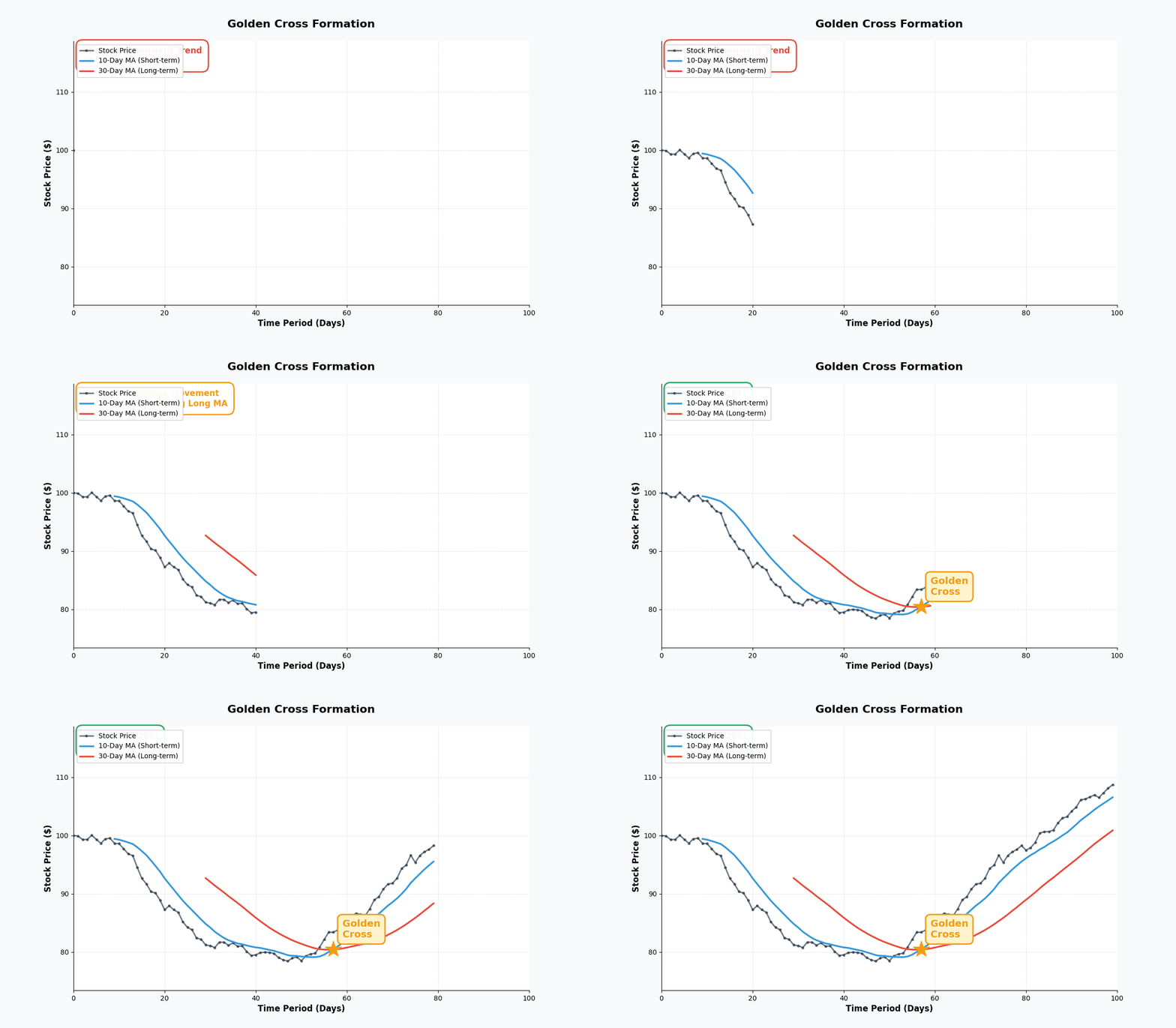
Traders take it as the emergence of a sustained uptrend, especially if price action remains above both moving averages after the crossover.
Example Of A Golden Cross
Hindustan Copper shares were trading close to ₹562 on April 16, 2026, at around 3 PM. The 50-day average stood at ₹546.48. The 200-day was far lower at ₹391.63.
Now, when the shorter-term average moves above the longer-term one, it points to a golden cross structure. That is what we are seeing here.
Since moving averages are calculated over a period, the actual intersection would have taken place earlier, when the recent price trend started picking up pace.
This is typically read as a bullish signal. And in this case, you can already see that strength. The stock is trading above both averages, which suggests that buying interest has been building for a while.
At the same time, it is not a signal to act blindly on. Since moving averages are lagging indicators, they reflect what has already happened. So, most investors usually pair them with other indicators before making a decision.
Why Does A Golden Cross Indicate Bullishness?
The reason a Golden Cross is seen as bullish lies in what it says about price movement. When a short-term moving average climbs above a long-term moving average, it means recent prices are consistently higher than earlier ones.
This is because moving averages smooth out daily price fluctuations. A Golden Cross shows not just a momentary rise in price but a sustained shift over weeks or months.
Many traders and investors watch these crossovers because they can reflect growing confidence in a stock’s price trend. When the Golden Cross forms, it often attracts additional buying, which can reinforce the upward move.
Common Myths To Be Aware Of
The golden cross is often considered a strong indicator of a bull market, but there are several myths surrounding this technical pattern that can mislead traders. Here are some common myths to be aware of:
-
The golden cross always signals a strong bull market: While a golden cross suggests a potential upward trend, it does not guarantee that the market will continue to rise indefinitely. False signals can occur, and the market can experience short-term pullbacks even after the cross. It is essential to consider other factors, such as market sentiment and economic conditions, before acting on a golden cross alone.
-
It works in every market condition: The golden cross is often more reliable in trending markets. In sideways or choppy markets, the cross can lead to false breakouts, resulting in losses. It is crucial to apply the golden cross only when the broader market shows clear directional momentum.
-
It is a perfect buy signal: Many traders mistakenly treat the golden cross as a perfect buy signal. However, it is important to verify the pattern with other technical indicators. Relying solely on the golden cross may expose you to risk if other signals contradict its message.
-
The 50-day MA and 200-day MA are the only moving averages to use: While the 50-day and 200-day moving averages are standard, traders sometimes adapt the Golden Cross strategy with shorter or longer timeframes depending on the market and their trading style.
Conclusion
A golden cross can suggest a shift in trend, especially after the market has been down for a while. While that is helpful, it is not a standalone signal. Most traders wait for confirmation before acting. They also look at other indicators alongside. This helps in making the signal more reliable and decisions more informed.
FAQs on Golden Cross in Stocks
A golden cross can signal a potential uptrend. Hence, it is usually taken as a positive sign. That said, it is not always reliable. Because it is based on historical data, investors usually combine it with other indicators instead of depending on it alone.
When the price reverses course immediately after the crossover and the Golden Cross fails to maintain its upward momentum, it is a misleading signal. Without considering additional supporting factors, this could result in losses for traders who rely exclusively on the Golden Cross.
The basic principle of the golden cross strategy is to enter or hold a position when the short-term moving average crosses above the long-term moving average. You can help increase the profitability of the Golden Cross strategy by specifying a stop loss and profit target.
The basic principle of the golden cross strategy is to enter or hold a position when the short-term moving average crosses above the long-term moving average. You can help increase the profitability of the Golden Cross strategy by specifying a stop loss and profit target.
When a security's short-term moving average (like the 50-day moving average) crosses over its long-term moving average (like the 200-day moving average) or resistance level, a bullish breakout pattern known as a golden cross is created.

Golden Crossover Strategy: How It Works? | The Bullish Signal You Must Know
Kotak Neo
•2m 17s
The content in this blog is intended purely for educational purposes. Any securities or mutual funds referenced are illustrative in nature and do not constitute a recommendation or endorsement by Kotak Neo. Investors are encouraged to assess their own financial situation and seek professional advice before making any investment decisions. For compliance T&C and disclaimers, Visit https://www.kotakneo.com/disclaimer/
0 people liked this article.

Kotak Neo (Kotak Neo) is India's venerable stockbroking company with a rich legacy. It offers comprehensive investment services across asset classes, prioritising a technology-first approach for a seamless experience. Trusted by 5 million+ customers, it guides you toward financial success with ease of investment and speed of trade.
Note: The opinions expressed in this blog are personal viewpoints and should not be construed as recommendations.