Difference Between Bonds And Stocks: Meaning, Features, Risks & Comparison
- Posted: 24 Jul 2026, 7:24 PM IST
- | 4m
- 1,071
 Add Preferred News Source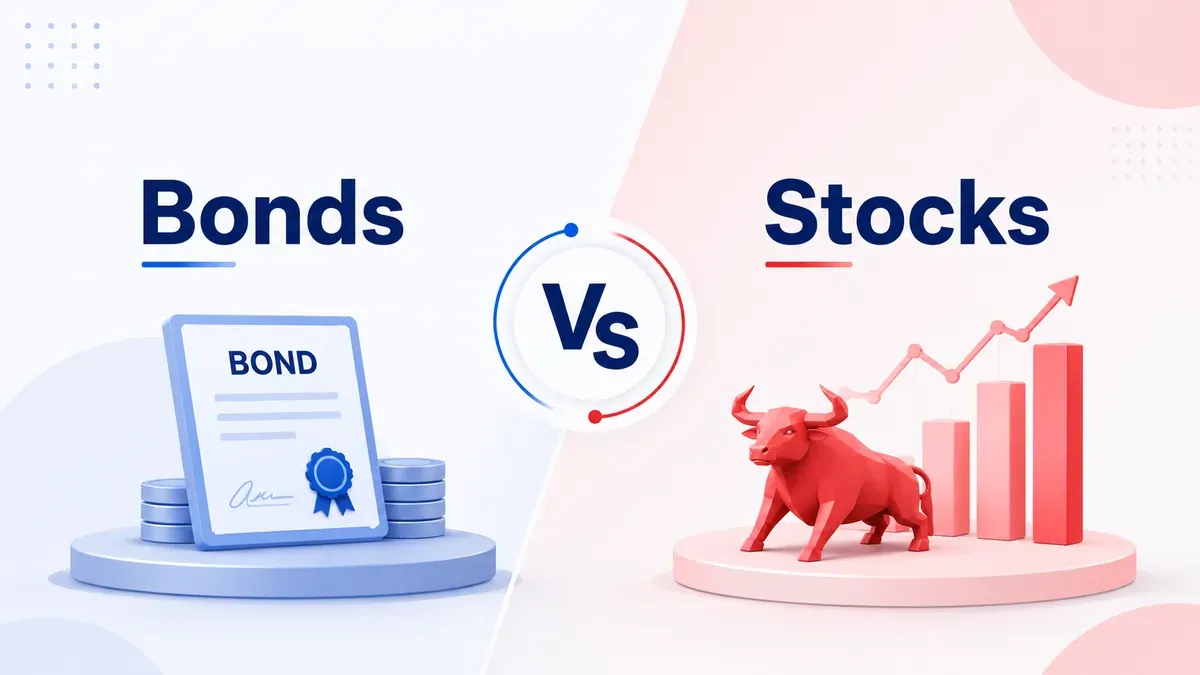
The first step to building a balanced investment portfolio is getting a clear understanding of asset options. When allocating capital, you will likely choose between stocks and bonds as your two primary financial instruments. While both help corporations and governments raise funds, they serve completely different roles for investors.
The core stocks and bonds difference lies in your relationship with the issuer. Investing in stocks means purchasing a fractional ownership stake in a company. A bond works like a loan from you to the issuer. Once you buy it, the issuer owes you interest. You receive those payments at regular, predetermined intervals.
What Are Stocks And Bonds?
One of the most popular ways of investing in a company is to buy stocks. Each share is a part of ownership. Investors can make money if the company’s shares go up in price or if it pays dividends. At the same time, there is a possibility that the investment could lose value.
Bonds are fixed-income debt securities in which the investor is the lender. A bond is a loan you give to a corporation or the government for a fixed amount of time. The issuer then pays interest at a fixed rate. This interest is called a coupon. Regular payments are made until the bond matures, at which point the original amount loaned is repaid.
Difference Between Stocks And Bonds
It is crucial to understand the difference between stocks and bonds in order to analyse risk and return profiles. This initial comparison shows differences in ownership, income structure and market characteristics for both asset classes:
Type of Ownership | Direct equity ownership stake in the issuer. | A debt contract: you are the lender. |
Issuer Type | Issued only by corporate enterprises. | Issued by companies and government agencies. |
Main source of income | Growth through dividends and capital gains. | Regular fixed interest (coupon payments). |
Returns Consistency | Variable and based on business success. | Fixed and predictable as per contract. |
Risk Profile | Very risky because of equity market fluctuations. | Comparatively less risk, but there is credit and interest risk. |
Maturity Period | Perpetual; no maturity date. | The maturity date is fixed. |
Voting Rights | Shareholders usually enjoy voting rights. | Lenders do not hold corporate voting privileges. |
Liquidity Level | Generally high on major public exchanges. | Varies; government bonds are highly liquid, corporate bonds less so. |
Capital Appreciation | Unlimited long-term compounding potential. | Minimal; returns are capped at the principal face value. |
Investor Objective | Wealth creation and long-term capital growth. | Capital preservation and steady, regular cash flow. |
How Do Stocks And Bonds Work?
Although stocks and bonds are both investment options, they work very differently. Here's a simple look at what happens from the time you invest until you exit.
Issue and Purchase
A company raises capital from stocks, typically by floating an Initial Public Offering (IPO). Companies and governments can also issue bonds. The main reason is to borrow money and not to dilute ownership. Investors can buy these two securities whenever they are issued or later through stock exchanges or brokers.
Returns
Investors make money on stocks when the price of the shares goes up. Some companies choose to distribute part of their profits as dividends. For bond investors, coupon payments usually arrive at regular intervals. The initial investment is repaid when the bond reaches maturity.
Exiting the Investment
Stock investors can sell their stocks anytime and exit from the investment. Bond investors can either hold the bond until the repayment date or sell it before the term of the bond expires.
Key Features Of Stocks And Bonds
To understand the difference between stock and bond investments, it’s useful to examine the key features of each investment.
Ownership Rights | Yes | No |
Fixed regular income | No | Yes |
Corporate Voting Privileges | Yes | No |
Defined Maturity Horizon | No | Yes |
Market Volatility Exposure | High | Low to Moderate |
Long-Term Return Potential | High | Capped / Predefined |
Types Of Stocks
Companies issue more than one type of share. Investors usually decide between them by looking at their financial goals, how much risk they are comfortable taking, and the way they prefer to invest. These shares are generally grouped into the following categories.
Common vs Preferred Shares
Owning common shares means investors can vote on major company decisions. There is another benefit as well. They may receive dividend payments when the company grows. Preferred shares are different. Their holders have a stronger claim on company assets if liquidation happens. They do not receive voting rights. Instead, fixed dividends are provided.
Growth vs Value Stocks
Growth stocks come from companies growing at a rapid pace. Most of these businesses put their profits right back into expansion instead of paying dividends. Value stocks tell a different story. Established companies tend to make up this group. Their fundamentals are strong, and they have spent years paying dependable dividends.
Market Capitalisation Segments
Stocks are also grouped according to market value. The three categories are large-cap, mid-cap and small-cap.
-
Large-cap: Companies ranked 1 to 100 by market size, featuring a market capitalisation of ₹20,000 crore or more.
-
Mid-cap: Companies ranked 101 to 250, with a market capitalisation between ₹5,000 crore and ₹20,000 crore.
-
Small-cap: Companies ranked 251 and beyond, with a market capitalisation of less than ₹5,000 crore.
Types Of Bonds
Bonds are classified on the basis of issuer, structure and tax treatment into the following types:
-
Government Bonds (G-Secs): The sovereign government issues these bonds. Because they carry government backing, they are widely regarded as one of the safest investment choices. Credit risk and default risk remain very low in most cases.
-
Corporate Bonds: These bonds are issued by private and public companies when they need to raise money. These carry higher credit risk than Government Securities (G-Secs). Because of this extra risk, they usually pay a higher rate of interest.
-
Municipal Bonds: Municipalities or local governments issue these bonds to raise money. That money is then used for public infrastructure and a range of other development projects.
-
Tax Saving Bonds: These bonds may offer tax benefits under applicable tax laws. The benefit varies by bond. You may qualify for a deduction on your investment. You may also receive a tax exemption on the interest earned.
-
Zero-Coupon Bonds: These bonds don’t pay interest on a regular basis. They are issued at a discount from face value. They are redeemed at par value. The investor profits from the difference between the purchase price and the redemption value.
When Should You Invest In Stocks Vs Bonds?
Your asset allocation will depend on your financial goals, how soon you think you’ll need the money and how comfortable you are with market fluctuations. Here are the factors that can help you evaluate the right allocation:
Investment Horizon | Long-term (5+ years) to withstand market cycles. | Short to medium-term matching the bond's maturity. |
Financial Goal | Long-term wealth creation, compounding and beating inflation. | Preserve capital, create a steady income stream. |
Risk Tolerance | High; comfortable with short-term declines in portfolio price. | Low to moderate; prioritising stability and steady returns. |
Conclusion
Stocks and bonds serve different purposes. That’s why the decision isn’t about choosing a winner. It’s about identifying the one that works with your financial objectives, investment horizon and risk tolerance. Stocks are capable of supporting capital appreciation for long-term wealth creation. Bonds bring stability. They also provide predictable income. The key to a diversified portfolio is knowing how each investment works and the risks involved. One that gives you growth, with capital preservation as a side, depending on your financial needs
FAQs
Bonds are usually less volatile than equities and provide more structural income visibility. But they have their dangers too. Credit defaults, rising interest rates and inflation can still undermine bond returns.
Yes, you can invest in both stocks and bonds at the same time. Stocks can compound over the long run, but bonds tend to be more stable and can help soften the blow of a stock market decline.
Bonds tend to be more stable in price during market volatility in equity markets because of fixed income payouts by contract. But the ultimate performance will always be subject to the wider economic factors, changing interest rate cycles and the credit quality of the particular issuer.
No, bonds don't pay dividends. Interest is paid on bonds at regular intervals called coupons. Some equity shareholders receive variable dividends from a company.
Yes, some established companies offer regular income via dividends. However, these payments are fully voluntary, dependent on the current business performance and not guaranteed by law.
Bonds are inversely related to prevailing market interest rates. Higher interest rates mean that new bonds have higher coupons and old lower-coupon bonds are worth less in the secondary market. When rates fall, older bonds tend to increase in value.
Government bonds are seen as low risk for one simple reason. They are backed by the government. Even so, two risks remain. Interest rates can affect the bond's value if you sell before maturity. Inflation can also erode your return when it exceeds the bond's fixed rate.
There is no one right answer for new investors. You should select it according to your own goals, time horizon and risk tolerance. Most beginners start with a diversified mix or go for balanced mutual funds so that they can have exposure to both asset classes.
The content in this blog is intended purely for educational purposes. Any securities or mutual funds referenced are illustrative in nature and do not constitute a recommendation or endorsement by Kotak Neo. Investors are encouraged to assess their own financial situation and seek professional advice before making any investment decisions. For compliance T&C and disclaimers, Visit https://www.kotakneo.com/disclaimer
0 people liked this article.

Kotak Neo (Kotak Neo) is India's venerable stockbroking company with a rich legacy. It offers comprehensive investment services across asset classes, prioritising a technology-first approach for a seamless experience. Trusted by 5 million+ customers, it guides you toward financial success with ease of investment and speed of trade.
Note: The opinions expressed in this blog are personal viewpoints and should not be construed as recommendations.