Fair Value Gap (FVG) Explained: Types, Strategies, And Key Differences
- Updated: 08 Jun 2026, 5:20 PM IST
- | 4m
- 1,463
 Add Preferred News Source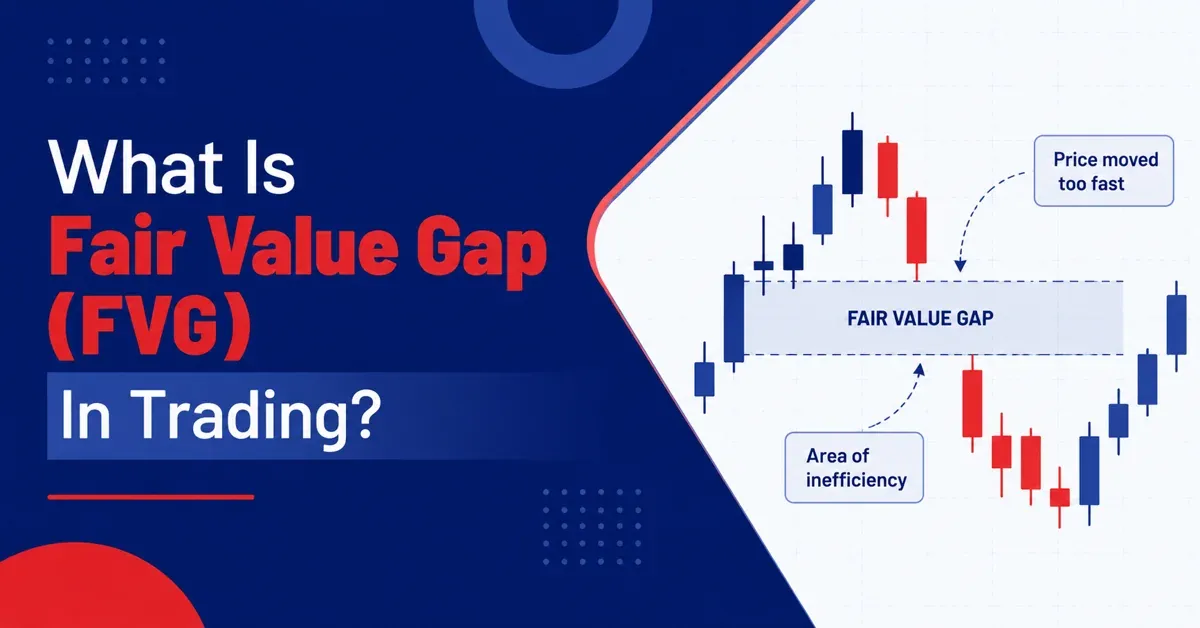
Markets rarely move in a perfectly straight line. If you have ever looked at a price chart and noticed a sudden aggressive spike leaving a visible "hole" or thin patch in the price action, you have likely encountered a Fair Value Gap (FVG). For traders following Price Action or Smart Money Concepts (SMC), understanding what is fair value gap in trading is often the difference between chasing a move and entering at the right institutional retest level.
In this guide, we break down the fair value gap meaning, how to spot these imbalances on your charts, and the fair value gap trading strategy used by professional market participants.
What Is Fair Value Gap (FVG) In Trading?
In a balanced market, you have an equal number of buy and sell orders at each price level. But if there’s a lot of buying pressure (or selling pressure) that comes in, often from high-impact news or the activity of large institutions, the price moves so fast that the market can’t stay balanced.
What is fair value gap in trading? It is an inefficiency or imbalance where price "jumps", leaving a zone where only one side of the market (buyers or sellers) was dominant. Because of the tendency of markets to seek efficiency, these gaps are magnets and often bring prices back to “fill” the void before resuming the original trend.
Fair Value Gap Meaning
At its core, the fair value gap meaning refers to a three-candle structure on a price chart. It is defined by the space between the wick of the first candle and the wick of the third candle in a sequence. If these wicks do not overlap, the "empty" space created by the large middle candle is the Fair Value Gap. It is like a trail left behind by big buyers. Large institutions cannot hide their orders when they move the market aggressively; the FVG is the evidence of their presence.
How Does Fair Value Gap Work?
Markets operate on the principle of liquidity. If a large buy order is filled, the price can jump so fast that it skips over all the sell orders at intermediate prices. That results in an 'unfair' price distribution. The concept of fair value gap trading is that the market will come back to these levels in order to give the “missing” liquidity. Once the gap is filled or “rebalanced”, the market becomes “fair” again, and the previous trend is likely to continue.
How To Identify Fair Value Gap On Charts
Identifying an FVG requires looking at a sequence of three consecutive candles. Here is the step-by-step process:
-
Find a Large Candle: Look for an expansive, "impulsive" candle (the middle candle).
-
Check the Surroundings: Look at the candle before (Candle 1) and the candle after (Candle 3).
-
Find the Gap: In a bullish move, check whether the high of Candle 1 and the low of Candle 3 overlap. If there is a gap between them (i.e., the low of Candle 3 is above the high of Candle 1), you have found an FVG. During a downward move, check if the low of Candle 1 and the high of Candle 3 meet.
Types Of Fair Value Gap
FVGs are categorised based on the direction of the impulsive move that created them.
Bullish Fair Value Gap
A Bullish FVG occurs during an uptrend. It is created when the price surges upward so quickly that the low of the third candle stays above the high of the first candle. Traders view this zone as a potential "Buy" area when the price retraces.
Bearish Fair Value Gap
A Bearish FVG, however, is formed in a downtrend. It occurs when the price drops sharply, creating a gap between the low of the first candle and the high of the third candle. This zone serves as a resistance zone where traders may look for “Sell” opportunities.
Fair Value Gap Example
Suppose Nifty 50 is trading at ₹22,000.
-
Candle 1 goes up to a high of ₹22,050.
-
Candle 2 is a huge green candle that rockets up to ₹22,200.
-
Candle 3 opens and moves up a bit, but its low (the wick) just touches ₹22,100.
The gap between ₹22,050 (High of Candle 1) and ₹22,100 (Low of Candle 3) is a ₹50 fair value gap. Traders will mark this ₹50 zone on their charts, expecting the price to come back to it before moving higher.
Fair Value Gap Trading Strategy
Just identifying a gap isn’t enough; you need a systematic FVG trading strategy to manage risk. Here is a professional approach:
-
Wait for Price Retracement: Don’t chase the initial “spike”. Patience is key. Wait for the price to come back to the FVG zone.
-
Buy Near The Gap: For Bullish FVGs buy near the top or middle of the gap. For Bearish FVGs sell near the bottom or middle of the FVG.
-
Stop-Loss Outside The Gap: To protect your capital put your stop-loss outside the wick of the first candle in the three-candle pattern.
-
Combine with Support / Resistance or Order Blocks: FVGs work best when they are combined with other technical levels. If an FVG overlaps with a previous resistance-turned-support or a known Order Block, the probability of a successful trade increases significantly.
-
Target the Next Liquidity Level: Once in the trade, don’t just randomly exit. Take profit at next swing highs (longs) or swing lows (shorts). This keeps your fair value gap trading structured without emotions.
Fair Value Gap vs Liquidity Gap
While they sound similar, they represent different market mechanics.
Visual | Seen as a three-candle sequence with non-overlapping wicks. | Seen as a physical “break” where no trading happened (e.g., overnight gaps). |
Cause | Intense buying/selling pressure during active hours. | Market closing or lack of orders at specific price points. |
Usage | Used to find high probability entry points in a trending market, especially on retracements. | Used to identify price targets and potential entry zones. Price often “fills” the gap prior to continuing direction. |
FAQs
It is a price imbalance where a sharp move leaves a void in the chart. That is, the price has moved too fast for the market to actually fill buyers and sellers at those price points.
Look for three candles where the wicks of the first and third candles do not touch or overlap. The empty space created by the middle candle is the gap.
FVGs are highly reliable when used in the direction of the higher-timeframe trend. But they are not “magic” levels and should be used along with other indicators such as volume and market structure.
The most common way is the "Return to Impulsive Move" strategy. Mark the gap on your chart and wait for the price to retrace into that zone. Once the price "fills" the gap, look for a reversal signal to enter in the direction of the original surge.
An FVG is a gap in continuous price action (when the wicks don't meet), whereas a liquidity gap (or "Gap Up/Down") is a complete break in price with no candles present and often occurs between market sessions.
The content in this blog is intended purely for educational purposes. Any securities or mutual funds referenced are illustrative in nature and do not constitute a recommendation or endorsement by Kotak Neo. Investors are encouraged to assess their own financial situation and seek professional advice before making any investment decisions. For compliance T&C and disclaimers, visit https://www.kotakneo.com/disclaimer/
0 people liked this article.