Banks May Have to Refund Scam Victims, but There’s a Catch
- Updated: 13 Nov 2026, 5:19 PM IST
- | 10 min read
- 6,170
 Add Preferred News Source

Almost every message from your bank now ends with the same warning.
Never share your OTP.
Do not click unknown links.
No bank or police officer will ask you to transfer money.
The responsibility is placed, politely and repeatedly, on you: recognise the fraudulent call, spot the suspicious link, question the unfamiliar voice.
Meanwhile, your bank knows the date your salary lands, the UPI IDs you pay every month and roughly what you spend at the chemist downstairs.
If a decade of quiet, predictable savings were suddenly emptied into an account you had never paid before, the bank would be among the first to see it.
For years, that has been the arrangement.
On 29 October 2026, the Supreme Court suggested that banks, too, may have some explaining and repaying to do.
Hearing a case on digital arrests (scams in which fraudsters pose as police or investigators on video calls and frighten victims into transferring their savings) and other cyber fraud, the Court said the Reserve Bank of India’s (RBI) forthcoming rules must require financial institutions to compensate victims with at least the amount lost when the fraud resulted from a failure of the institution’s own due diligence (the checks a bank is expected to carry out on its customers and their transactions).
But there is another side to the proposed framework.
Banks may also be allowed to temporarily freeze suspicious transactions, including money received by innocent account holders.
One rule asks banks to pay when their checks fail; the other asks them to stop money when something looks wrong.
Both would run on the same machinery, and both could change the ordinary experience of banking.
The bank can no longer simply point at the customer
The Supreme Court bench comprising Chief Justice Surya Kant and Justices Joymalya Bagchi and V Mohana was hearing a case it took up on its own (suo motu) on 17 October 2025, after a Haryana couple reported being targeted by fraudsters posing as officers of the Central Bureau of Investigation and the Enforcement Directorate.
The Court has directed that the RBI’s proposed Know Your Customer (KYC) Amendment Directions, 2026 (the rules that govern how banks verify customers and monitor their accounts) must provide for compensation of at least the amount lost where a bank or financial institution’s failure to exercise due diligence enabled the fraud.
This is not an automatic refund for every cyber-fraud victim.
The bank’s conduct will determine whether compensation is payable.
The bench also suggested that transactions departing sharply from an account’s established history should be suspended, the local police informed automatically and the transaction verified in person.
During the hearing, Justice Bagchi spoke of imposing “strict liability” on institutions, while the Chief Justice said the bank itself should be liable, leaving the victim’s account with no net debit.
These were oral remarks, not provisions expressly set out in the written order.
The Attorney General told the Court that the final KYC directions are expected to be notified by 30 November 2026 and put into operation by 31 December 2026.
The bench has said it will examine them first.
Frozen is not the same as returned
Source: Business Standard
The scale of the problem explains why the Court is looking beyond awareness campaigns.
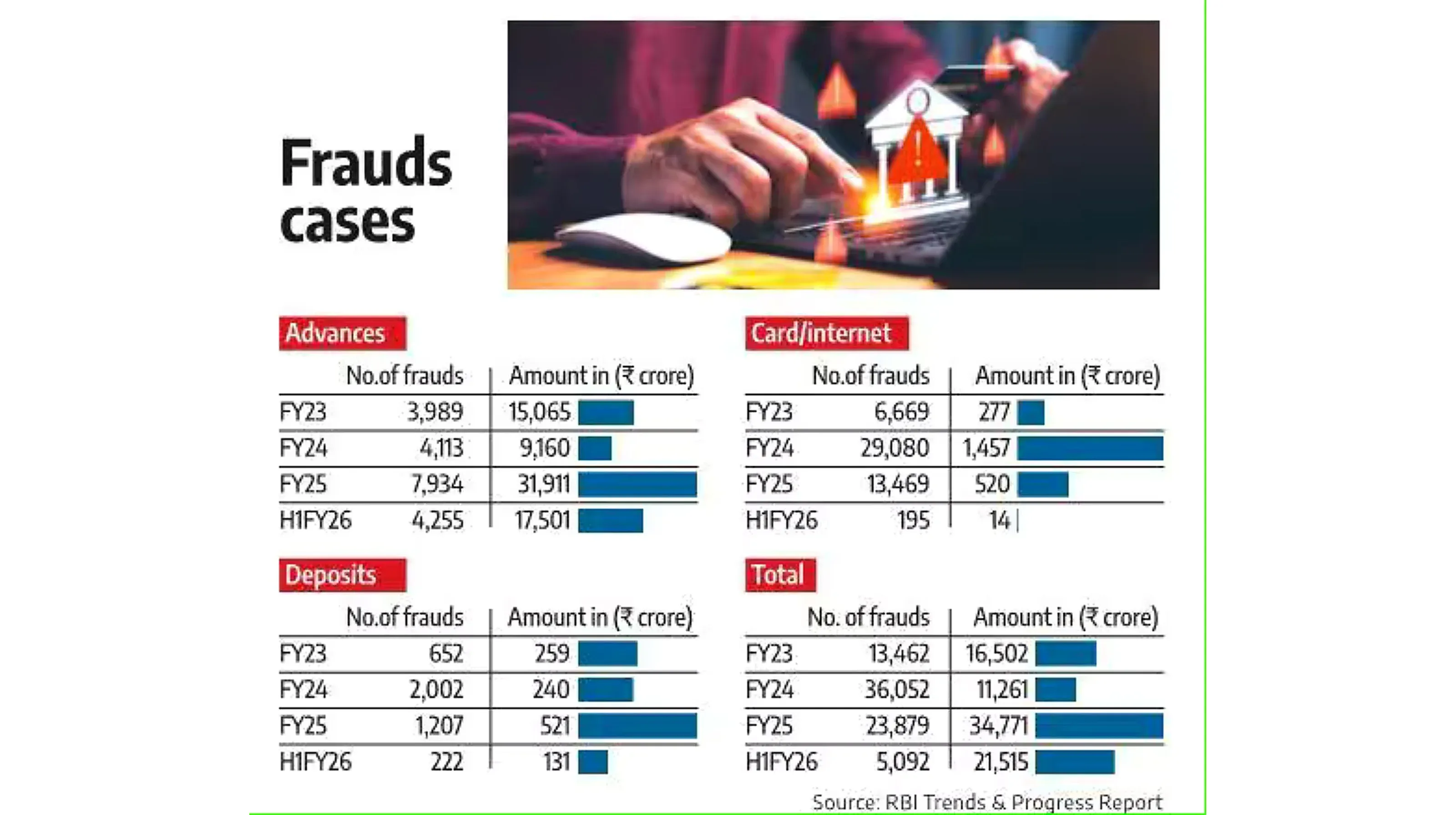
Digital-arrest complaints have fallen sharply, from 1,23,672 in 2024 to 58,239 in 2025, yet more than 21,900 complaints involving over ₹647 crore were still registered between January and August 2026.
Across all financial cyber fraud, Home Ministry data shows more than 12.71 lakh complaints in the first half of 2026 alone, with reported losses above ₹10,178 crore.
The more revealing numbers sit further down the pipeline.
Between 2021 and May 2026, people reported cyber-fraud losses of about ₹64,447 crore.
Around ₹10,718 crore of that was frozen in the receiving accounts.
Only about ₹323 crore had been refunded to victims.
Finding stolen money and giving it back, it turns out, are two very different problems.
A freeze can happen quickly if the complaint arrives in time.
Restoration usually waits on police verification, a court order and the bank’s own processes.
That gap is why the Court is now asking a different question: not only whether the money can be recovered, but whether the bank should have stopped it from leaving in the first place.
What counts as a bank’s failure?
The harder question is how a bank tells an unusual but legitimate payment from a fraudulent one.
Consider a retired schoolteacher in Pune whose savings account has looked the same for fifteen years: a pension credit on the first of the month, a few fixed deposits, the occasional transfer to a grandchild.
One afternoon, ₹18 lakh leaves the account in three instalments to a beneficiary added that morning. Nothing about this proves fraud. She may be buying a flat. But nothing about it resembles her.
This is the gap the Court wants banks to close.
Transaction size, frequency, how recently a beneficiary was added and how far a payment departs from an account’s usual pattern are all signals a bank already sees.
The Chief Justice referred to using artificial intelligence to read the transaction history of long-standing savers for exactly this purpose.
Some banks have already added friction of their own, such as disabling mobile banking during an active phone call, or letting customers report fraud from within the app and stop debits immediately.
Under the proposed approach, negligence would not follow simply from the fact that a fraud occurred.
It would turn on whether the bank saw the warning signs, raised an alert, acted on it promptly and can show the record.
The final directions will decide what that standard looks like in practice.
The other side of the freeze button
Source: MoneyControl (Data period: between 2013-14 and 2022-23)
Now for the part that may concern someone who has never been scammed.
A money-mule account receives or transfers fraud proceeds, sometimes without its holder fully understanding what is happening.
When stolen money is traced through a chain of accounts, the account where it lands may be frozen, even if its holder is innocent.
A Home Ministry procedure issued on 2 January 2026 envisaged placing a lien (a legal hold that stops the money from being withdrawn) only on the disputed amount.
In practice, entire accounts were often frozen without clear timelines.
The Bombay, Kerala and Delhi High Courts have each held that only the disputed sum should be restrained.
The RBI’s draft KYC Amendment Directions of 11 September attempt to bring more structure to the process.
Banks may place a temporary debit hold (money can still come in, but the flagged amount cannot be withdrawn or sent onward) on a suspected transaction of ₹1,000 or more flagged by their monitoring systems.
If the account itself is suspected to be a money-mule account, the hold may extend to the entire account, although this is intended as a last resort.
Under the draft, the account holder would have 20 days to explain the transaction, and the bank would generally have to decide within 10 days of hearing back.
Without instructions from law enforcement, no hold could last beyond 60 days.
The customer would have to be told about it by the end of the next day at the latest.
A large transfer into a modest account may be entirely legitimate, yet automated systems could flag it as suspicious.
Informal workers and small traders without formal invoices or ledgers may find the 20-day window particularly difficult.
Put the two proposals side by side and the incentives become clear.
A bank that misses a fraud may have to compensate the victim for the full loss.
A bank that misses a mule account without filing a Suspicious Transaction Report (a confidential alert to the Financial Intelligence Unit, the agency that tracks suspicious money flows) would, under the draft, be treated as non-compliant.
A bank that holds an innocent customer’s money for a few weeks has a grievance to resolve.
When the costs of error are this uneven, caution tends to prevail.
Legal commentators have also noted that the 60-day limit could lose its force if law enforcement directs a bank to continue the hold, and that account-wide holds sit uneasily with the High Courts’ view that only disputed funds should be restrained.
The intention is to stop stolen money moving through the system.
The challenge is to avoid making innocent account holders collateral damage.
When fast is no longer enough
For most of the digital-payments era, good banking operations meant speed and scale: more transactions, processed faster, at a lower cost each.
Instant transfers became the measure of a modern bank.
The proposed framework adds a second measure.
A bank may also have to show that it can recognise behaviour that does not fit, pause it, investigate it and document every step.
That means investment in transaction monitoring, AI-based alerts, audit trails (time-stamped records of who saw what, and when) and closer coordination with law enforcement.
It also changes where the cost of fraud sits.
Today, most of it falls on the victim.
If due-diligence failures carry a compensation floor equal to the full loss, part of that cost moves to the institution, alongside the quieter expense of handling more holds, complaints and investigations.
For investors tracking banking stocks, this moves fraud controls closer to the centre of operational risk (the risk of loss from failed internal processes or systems).
How much it matters will depend on the final rules, how regulators define negligence and how many claims qualify.
Banks with stronger monitoring may absorb the shift more easily, but the real picture will emerge only once the framework is in force.
Keep an eye on the calendar, and your bank alerts
Source: Bank of Maharashtra
The RBI’s September draft had proposed 1 April 2027 as its start date.
The timeline offered to the Court would bring that forward by three months, although the final text is still awaited.
Much of this depends on speed.
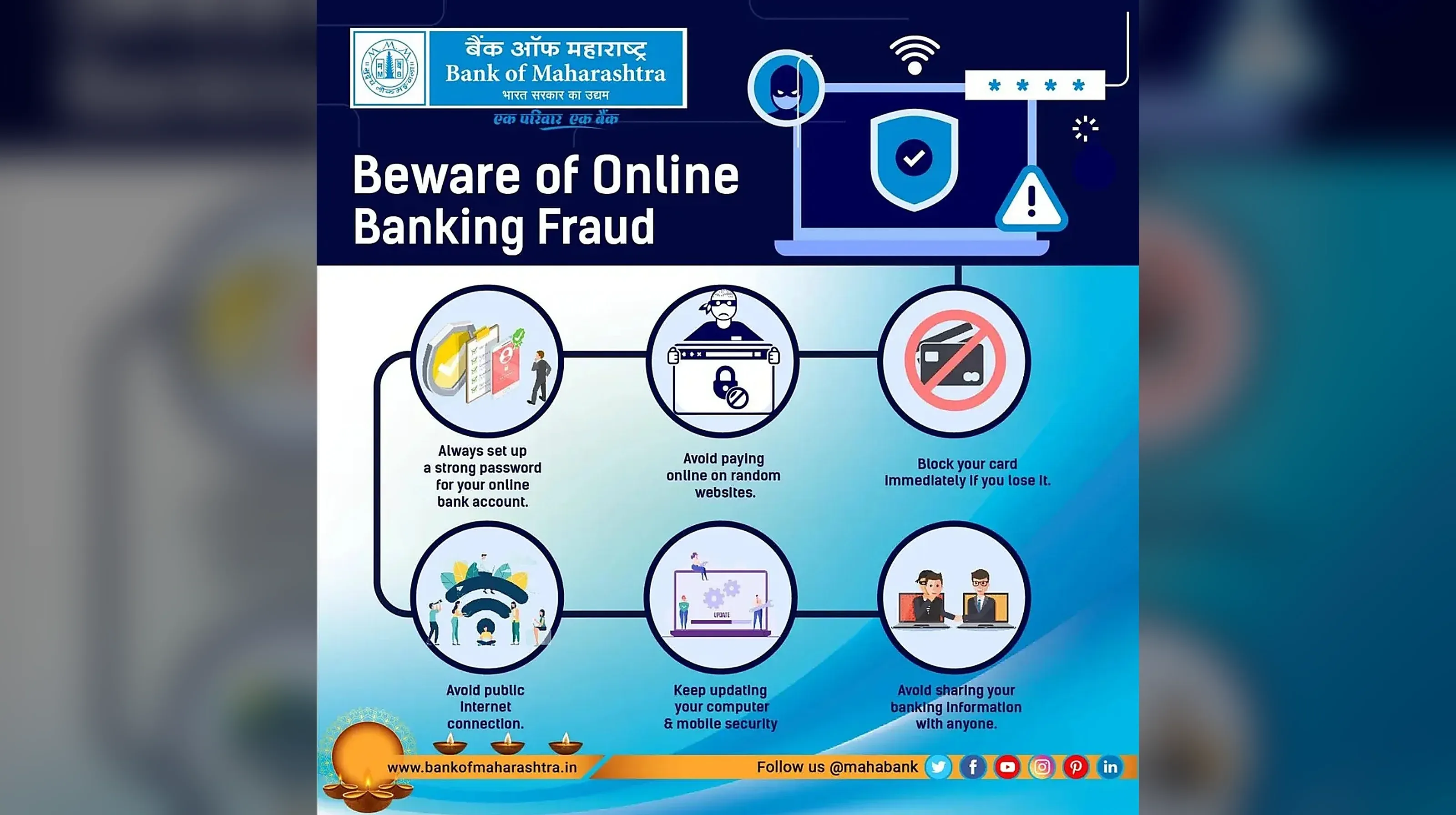
A hold notice helps only if the bank has a current mobile number, and most protections depend on fraud being reported quickly, to the bank and through helpline 1930 or cybercrime.gov.in.
Separate RBI rules, notified on 24 June 2026 and coming into force on 1 January 2027, already set out who bears the cost of digital fraud.
Where a fraud results from the bank’s own deficiency, the customer’s liability is zero.
Where the customer was tricked into sharing details or approving a payment, the safety net is smaller: for losses up to ₹50,000, 85% of the net loss or ₹25,000, whichever is lower, once in a lifetime, provided the fraud is reported to the bank and to 1930 or the cybercrime portal within five calendar days.
The RBI meets the larger share of that payout, not the bank.
This is where the Supreme Court’s direction becomes significant.
A digital-arrest victim usually makes the transfer themselves, under fear.
Under the June rules, that falls into the second, capped category.
The Court’s proposed floor would add a third possibility: where the bank’s own checks should have caught the transfer and did not, compensation of at least the full amount lost, paid by the institution.
The larger shift is in what we expect a bank to be.
For years, digital banking was built to make money move without friction, and customers were told to guard the door themselves.
Now banks are being asked to prove that they were watching too.
But a bank that questions too little lets fraud through, and a bank that questions too much stands between people and their own money.
The same systems that protect one customer’s savings may hold up another’s.
The real test will be whether the final rules can make banks quicker to stop fraud without making ordinary customers spend weeks explaining why their own money belongs to them.
Sources and References:
- THEHINDU
- VERDICTUM
- NDTV
- BUSINESSSTANDARD
- FREEPRESSJOURNAL
- EASEMYPREP
- THE420
- MONEYCONTROL
- DISPUTERESOLUTION
- CYBERPEACE
- CORPLAWUPDATES
- RBI
This article is for informational purposes only and does not constitute financial advice. It is not produced by the desk of the Kotak Securities Limited Research Team, nor is it a report published by the Kotak Securities Limited Research Team. The information presented is compiled from several secondary sources available on the internet and may change over time. Investors should conduct their own research and consult with financial professionals before making any investment decisions. The above images were generated using AI.
Investments in securities market are subject to market risks, read all the related documents carefully before investing. Brokerage will not exceed SEBI prescribed limit. The securities are quoted as an example and not as a recommendation. Registered Office: 27 BKC, C 27, G Block, Bandra Kurla Complex, Bandra (E), Mumbai 400051. Kotak Securities Limited; SEBI Registration No. INZ000200137(Member of NSE, BSE, MSE, MCX & NCDEX), Member Id: NSE-08081; BSE-673; MSE-1024; MCX-56285; NCDEX-1262. For compliance T&C and disclaimers, Visit bit.ly/ksecdisc
0 people liked this article.

Shreyas is a capital markets enthusiast and content strategist at Kotak Neo, driving content for Kotak Stockshaala and Kotak Insights. His work sits at the intersection of market analysis and financial literacy, turning what's moving the market into content people can actually act on.
Outside the 9-to-5, he's usually chasing his next sneaker drop, planning his next vacation, or elbow-deep in a crossword.