The Last 30 Minutes of Expiry Day Are Getting New Rules
- Posted: 20 Nov 2026, 4:11 PM IST
- | 7 min read
- 4,811
 Add Preferred News Source

It was a Thursday afternoon, 27 August.
Just after 3:15 pm, the Sensex on phone screens began to behave strangely.
Within a few minutes, the number on the screen fell by more than 2,000 points.
Then, almost as quickly, most of that fall was gone.
What had moved so sharply was not, strictly speaking, a traded price.
It was an estimate, shifting as orders arrived and vanished in the market’s new closing auction.
On a day when Sensex derivatives contracts were due to expire, that estimate carried real weight.
That distinction is at the heart of the Securities and Exchange Board of India’s (SEBI) latest changes to the market’s closing auction and derivatives settlement rules.
The regulator introduced the Closing Auction Session (CAS), a short window after regular trading in which buy and sell orders are pooled and matched at a single price, to make the closing price harder to move in the final seconds.
But on expiry days, the auction’s indicative numbers created another layer of uncertainty.
From 7 December 2026, SEBI is separating two jobs that had been sitting rather too close together: the auction will determine the official closing price, while actual trading during the final 30 minutes will determine the settlement price of expiring derivatives.
In effect, settlement goes back to the method used before August, and the auction keeps the job it was built for.
For a contract sitting close to its strike price (the level that decides whether it is worth anything at expiry), that is not a small distinction.
It can decide whether the contract settles with some value or none.
The auction was supposed to settle the argument
CAS was introduced in the equity cash market through SEBI’s circular of 16 January 2026, with implementation beginning on 3 August for stocks that also have futures and options contracts linked to them.
The complication was that the same circular made this auction price the basis for settling expiring derivatives, that is, for working out what each contract is finally worth.
During CAS, exchanges display an Indicative Equilibrium Price (IEP), which changes as orders are entered, modified or cancelled.
It represents a possible execution price, not necessarily a price at which an actual transaction has taken place.
On an ordinary trading day, that distinction may seem technical.
On expiry day, when contracts can be sensitive to small moves around their strike prices, it becomes rather more consequential.
On 13 August, a Sensex expiry day, SEBI’s surveillance flagged abnormal spikes in the index’s indicative price during the auction, and the regulator later issued an interim order alleging that orders had been placed to influence it.
SEBI’s own data showed how concentrated activity had become.
Before CAS, the price that decided expiry settlement took shape over 30 minutes, from 3:00 pm to 3:30 pm.
After CAS, the relevant stretch was much shorter.
In expiring benchmark index derivatives, the premium (the price paid for these contracts) traded per minute between 3:20 pm and 3:30 pm averaged ₹189.82 crore on the NSE and ₹288.94 crore on the BSE, against ₹126.31 crore and ₹141.48 crore in the old 30-minute window.
Per-minute activity was about 50% higher on the NSE and roughly double on the BSE.
The same expiry-day activity was being squeezed into a much narrower window.
SEBI released a consultation paper on 12 September 2026, considered market feedback and issued its final circular on 15 October.
The revised framework takes effect from 7 December, with changes to how pending orders carry into the auction following on 8 February 2027.
One market, two clocks, two prices
The central change is that the closing price of a stock and the settlement price of an expiring derivative will now be calculated differently.
For expiring index derivatives, settlement will use the volume-weighted average prices (VWAP) of the index’s constituent stocks during the last 30 minutes of continuous trading in the cash market, from 3:00 pm to 3:30 pm.
VWAP is not a simple average: prices at which more shares changed hands count for more.
The settlement value will therefore rest on executed trades in the underlying stocks, not on the auction.
For expiring stock derivatives, settlement will be based on the underlying stock’s VWAP over the same 30-minute period, calculated across all stock exchanges.
Through this half-hour, exchanges will display an indicative index value and indicative stock VWAPs in real time.
These figures show the settlement value as it takes shape.
Until 3:30 pm, they are a work in progress, not the final number.
The closing price and the settlement price can differ, particularly when the auction produces a closing price away from the VWAP recorded during regular trading.
That is the distinction worth holding on to.
The closing price tells you where the auction priced the stock.
The settlement price tells you what the expiring contract is worth.
The trading clock has acquired more appointments
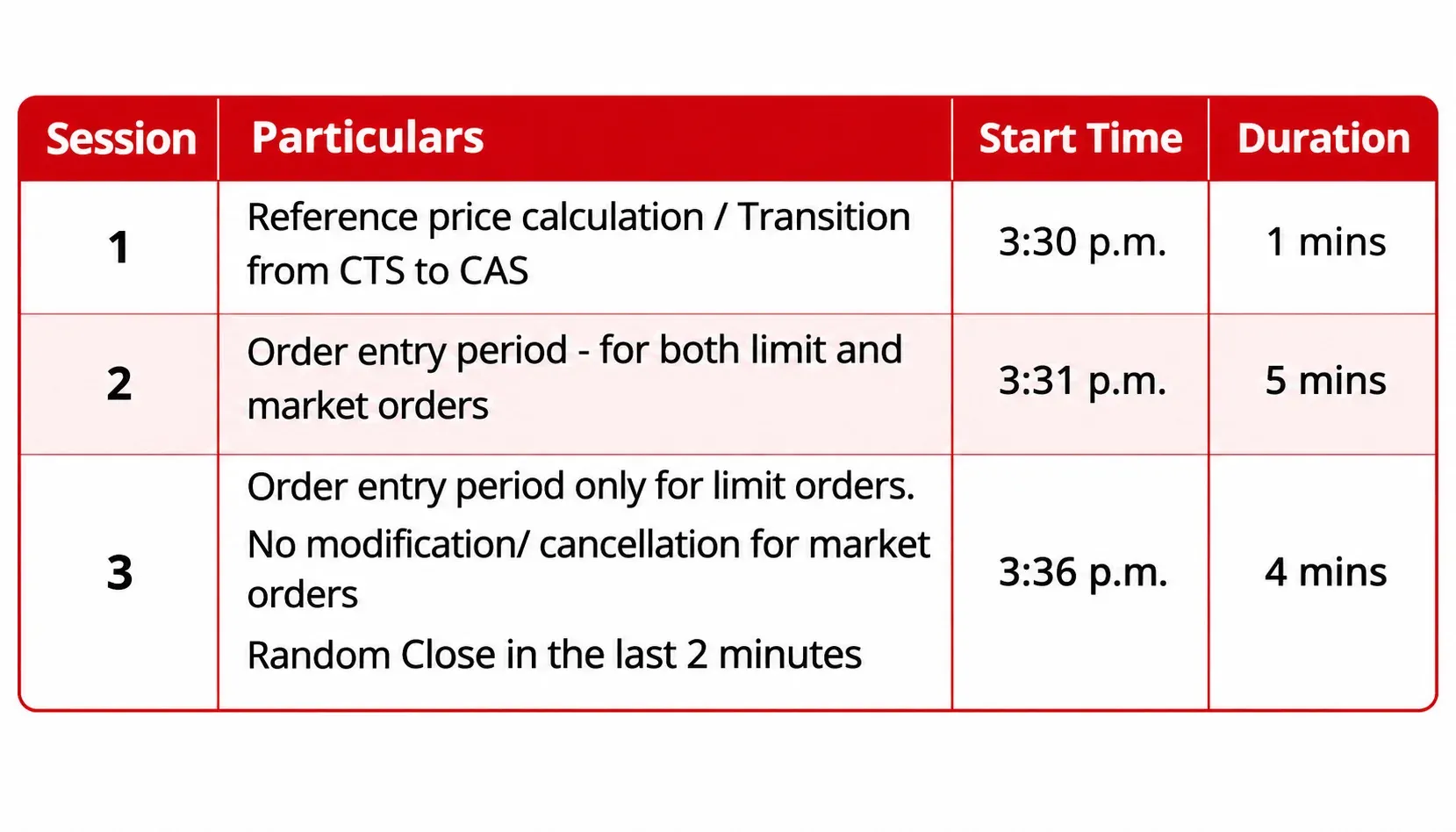
Source: SEBI
SEBI is also changing the auction window and several derivatives cut-offs.
From 7 December, CAS will run for 10 minutes, from 3:30 pm to 3:40 pm, on all trading days.
Market orders (instructions to trade at whatever price is available) are accepted until 3:36 pm, after which only orders with a fixed price are allowed.
Order entry then closes at a random moment between 3:38 pm and 3:40 pm.
The random close means no one knows exactly when the door will shut, which makes last-second positioning harder.
Expiry-day derivatives timings will follow a separate schedule:
- 3:00 pm: The 30-minute window used to calculate settlement VWAP begins.
- 3:30 pm: Continuous trading ends, and expiring index derivatives stop trading.
- 3:38 pm to 3:40 pm: CAS order entry closes at a random point, followed by matching.
- 3:45 pm: Non-expiring index derivatives, and all stock derivatives including those expiring that day, stop trading.
- 3:50 pm to 4:00 pm: The post-close session runs, a short window in which shares can be bought or sold at the official closing price set by CAS.
What the separation quietly changes
Under the August rules, expiring contracts kept trading while the auction was still running.
Their final value was decided by that auction, so for several minutes people were trading contracts whose value was still being worked out.
From 7 December, expiring index contracts stop trading at 3:30 pm, exactly when the half-hour that decides their value ends.
When trading stops, the number that matters has already been set.
The change also removes a temptation.
When the auction decided what a derivative was worth, anyone holding a large position had a reason to try to move the auction price.
Now that the two are separate, that reason largely disappears, and the auction can serve the people it was built for.
On 31 August, an index review day, nearly ₹40,000 crore passed through the NSE’s auction, much of it from funds that track an index.
For them, a single, visible closing price is the whole point.
This may not be the final arrangement.
In its consultation paper, SEBI described the 30-minute method as an interim arrangement, with a blend of regular trading and auction prices to be considered only after at least a year of experience with CAS.
For a long time, the closing price was a single number that answered every question about the end of the day.
From 7 December, it answers one: where eligible shares officially finished.
A separate calculation, built from the half-hour before it, answers another: what an expiring contract is finally worth.
The closing bell still rings once, but the market now reaches its final numbers by two routes, and the one flickering on the screen is not always the one that counts.
Sources and References:
- SEBI
- FORTUNEINDIA
This article is for informational purposes only and does not constitute financial advice. It is not produced by the desk of the Kotak Securities Limited Research Team, nor is it a report published by the Kotak Securities Limited Research Team. The information presented is compiled from several secondary sources available on the internet and may change over time. Investors should conduct their own research and consult with financial professionals before making any investment decisions. The above images were generated using AI.
Investments in securities market are subject to market risks, read all the related documents carefully before investing. Please read the SEBI prescribed Combined Risk Disclosure Document prior to investing. Brokerage will not exceed SEBI prescribed limit. These are not research backed stocks and investors should do their own due diligence before investing in these stocks. The securities are quoted as an example and not as a recommendation. The Kotak Neo brand represents the customer-facing retail business of Kotak Securities Limited. SEBI Registration Name: Kotak Securities Limited. CIN: U99999MH1994PLC134051. Registered Office: 27 BKC, C 27, G Block, Bandra Kurla Complex, Bandra (E), Mumbai 400051. SEBI Registration No INZ000200137 Member Id NSE-08081; BSE-673, NSE-1024, MCX-56285, NCDEX-1262. Compliance Officer Details: Mr. Hiren Thakkar. Call: 022 - 4285 8484, or Email: ks.compliance@kotak.com. For compliance T&C and disclaimers, Visit Terms & Conditions / Disclaimer | Kotak Securities Limited
0 people liked this article.

Shreyas is a capital markets enthusiast and content strategist at Kotak Neo, driving content for Kotak Stockshaala and Kotak Insights. His work sits at the intersection of market analysis and financial literacy, turning what's moving the market into content people can actually act on.
Outside the 9-to-5, he's usually chasing his next sneaker drop, planning his next vacation, or elbow-deep in a crossword.