Muhurat Trading Is a Ritual, Not a Signal
- Updated: 06 Nov 2026, 1:24 PM IST
- | 8 min read
- 1,029
 Add Preferred News Source

Diwali afternoon.
A family gathered around the trading terminal, someone checking the index, someone else adjusting the order.
The person nearest the keyboard places the customary trade.
There is the familiar click, the brief wait, the small collective attention that a market opening can command even in a house preparing for Lakshmi Puja.
At 3:30 pm, the terminal goes quiet.
Only then does the family move towards the puja room, where a red bahi-khata (the family’s account book) rests beside the idol.
The eldest opens it, another family member holds the pen, and the first entry finds its place.
Perhaps Shubh Labh is written on the page.
For the second year running, the trade has come before the evening puja.
The market has had its hour. The ledger is waiting for its year.
Two new years, one old habit
India has two financial beginnings, depending on which door you enter.
The Indian government and businesses begin their financial year on 1 April.
The trading community has its own calendar, turning to a new Samvat (the Hindu calendar year) at Diwali, when the old bahi-khata is closed and a fresh one opened.
The exchanges have made room for this older, traditional new year with a special session on Diwali.
Muhurat trading has been part of the BSE tradition since 1957, while the NSE, incorporated in 1992, also honours the occasion.
The 2026 session is scheduled for Sunday, 8 November, from 2:20 pm to 3:30 pm, according to NSE circular NSE/CMTR/76941 dated 19 October.
The previous year’s session ran from 1:45 pm to 2:45 pm on 21 October.
The ritual has never really been about predicting what the market will do next.
It is about beginning again, with a fresh account and the willingness to keep writing in it.
Muhurat was never a forecast; it was an act of continuity.
The green hour and the red year
Source: The Hindu Businessline
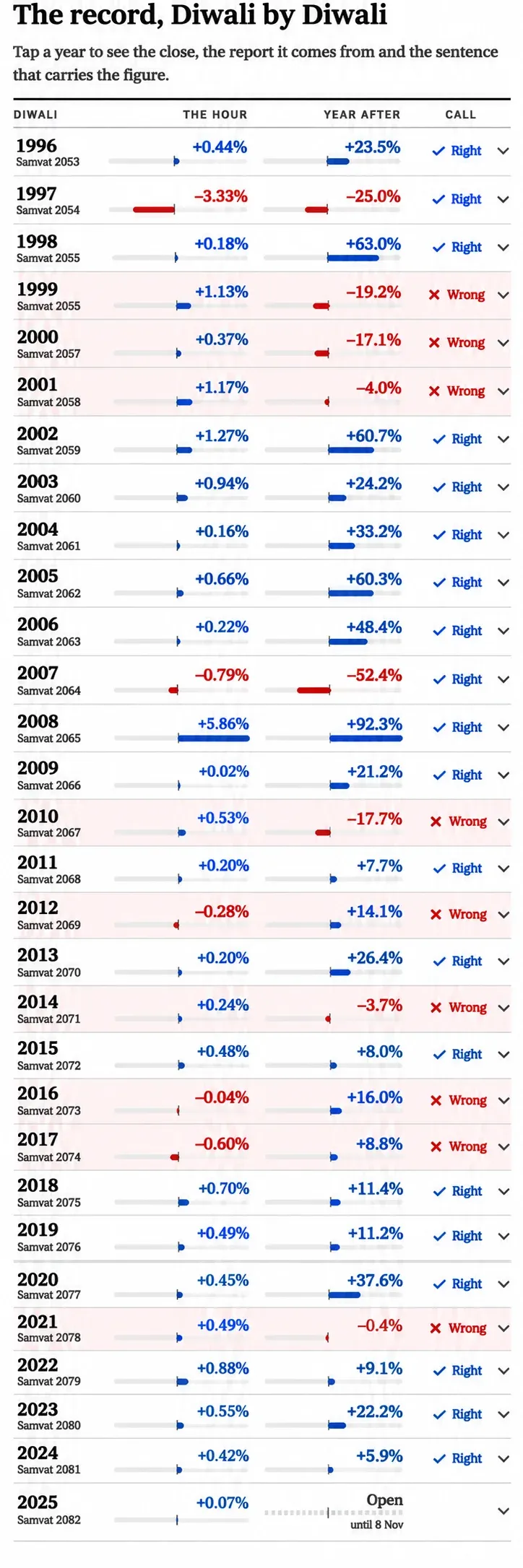
Last Diwali, the Nifty 50, the index that tracks 50 of India’s largest listed companies, closed the Muhurat session at 25,868.60, up 0.10%.
A modest green tick, the sort of movement that makes for a pleasant closing entry without demanding too much interpretation.
The Nifty 50 has ended the Muhurat session above the previous day’s close in each of the last eight years, from 2018 through 2025.
The moves have generally been small.
It is a pattern worth noticing, perhaps, but a ritual pattern rather than a signal.
The Nifty 50 fell 10.3% between the previous Diwali and 23 October 2026.
Over the same period, the broader Nifty 500 declined 7.8%, while the indices of mid-sized and smaller companies, the Nifty Midcap 100 and Nifty Smallcap 250, slipped 4.5% and 3.7%, respectively.
The order of those numbers is worth a second look.
The largest companies, where foreign investors have traditionally held their biggest positions, fell the most.
The smaller-company indices, where a good share of domestic fund money has been flowing, fell the least.
That alone does not prove the cause.
It is, though, what a market with changing ownership might be expected to look like.
There was no single entry responsible for the year’s mood.
Geopolitical uncertainty, elevated crude, rising global bond yields, a stronger US dollar and foreign selling all found their way into the account.
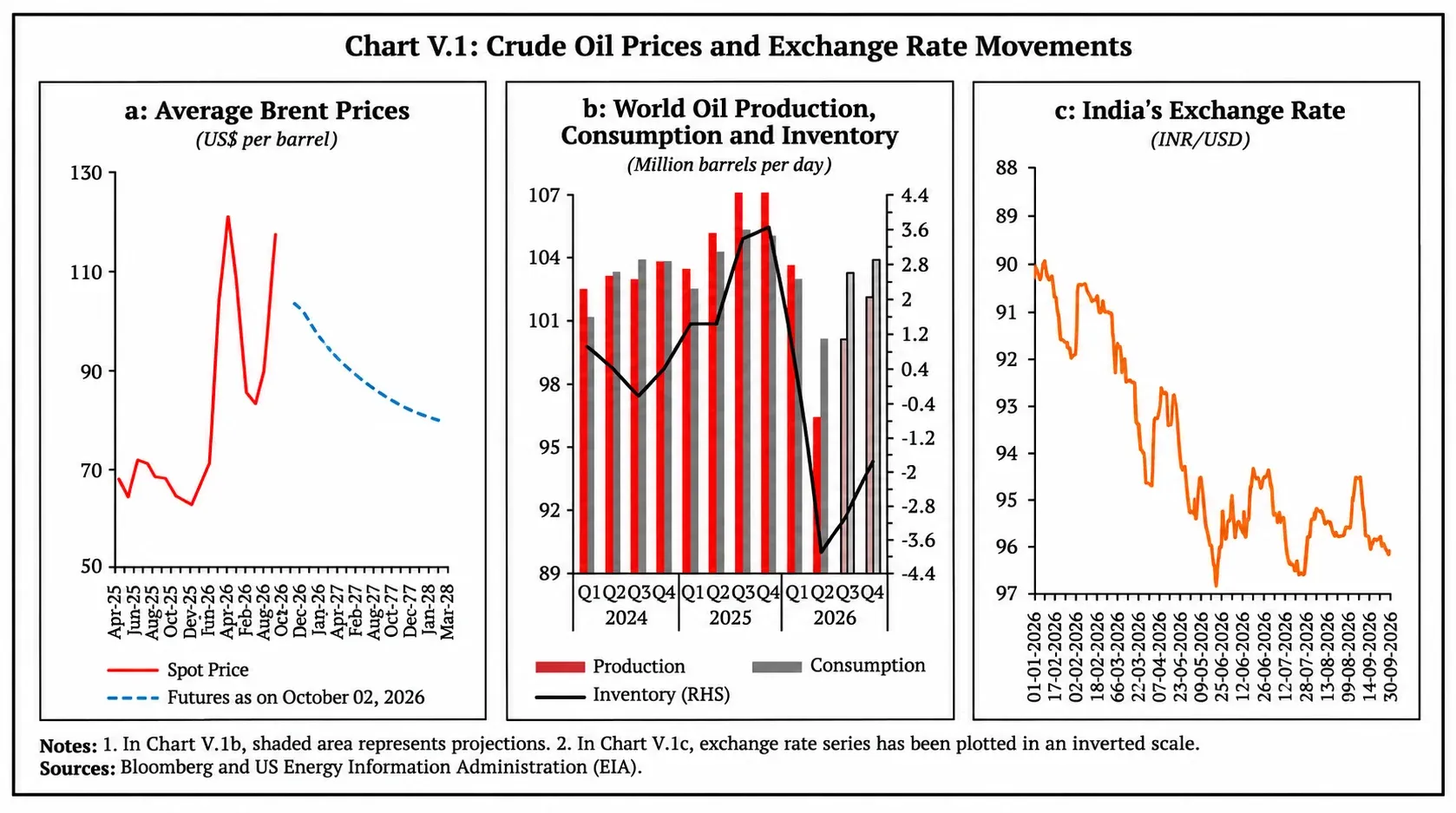
On 23 October, Brent crude, the international oil benchmark, was trading near US$114 a barrel.
The rupee, which had come close to ₹97 a dollar earlier in the month, closed at ₹94.9250 on 19 October, weighed down by dollar demand and importers locking in future dollar purchases.
The hour measures the mood of one afternoon. The year measures everything else.
Source: Reserve Bank of India
The people who kept writing
Two kinds of money moved through the market this year, and they moved very differently.
Foreign portfolio investors, overseas funds that buy and sell listed Indian shares, withdrew a net ₹2.95 lakh crore from Indian equities in calendar 2026 up to the end of October, close to 1.8 times the ₹1.66 lakh crore withdrawn in the whole of 2025.
The market had plenty to write about, and much of it was uncomfortable.
In the last week of October, foreign investors turned modest buyers again.
Then there was the household investor, whose monthly financial calendar does not necessarily consult the Nifty before proceeding.
Monthly systematic investment plan (SIP) contributions reached a record ₹32,490 crore in September 2026, up from ₹29,361 crore in September 2025 and ₹32,297 crore in August 2026.
September also saw 63.26 lakh new SIP registrations against 49.68 lakh SIPs discontinued or completed. The stoppage ratio, which compares SIPs stopped or completed with new ones registered, fell to 78.53%, its fifth consecutive monthly decline.
It does not tell us what percentage of investors have quit.
About 10.06 crore SIP accounts made a contribution in September.
These are accounts, not people; one investor can run several.
SIP assets under management, the total value of money held through SIPs, stood at around ₹17.86 lakh crore, roughly 4% lower than in August, largely because the market value of existing holdings fell.
More money went in, and the balance still shrank.
The entry and the balance are different lines in the same book. Imagine a salaried investor.
Every month, on the fifth, an instalment leaves the bank account automatically. It is a red month.
Crude is expensive, foreign investors are selling, and the index is having a thoroughly disagreeable time.
The bank mandate, however, carries on.
It does not read the market commentary or wait for the mood to improve.
That is the real difference between the two kinds of money in this story.
Foreign capital answers to global interest rates, currencies and comparisons with other markets, and it can move within days.
Household savings move to the rhythm of salaries and budgets.
Neither is permanent, but they do not respond to the same signals.
This is not a claim that every household stayed invested.
Some SIPs were stopped, and not every SIP rupee goes into shares.
But the aggregate numbers show a regular domestic savings channel continuing alongside volatile foreign flows.
The old bahi-khata discipline has acquired a digital form.
The pen has become an automatic mandate, and the monthly entry is now a mutual fund transaction.

Source: The New Indian Express
The infrastructure behind the habit
Household participation travels through a chain of institutions.
Asset managers run the mutual fund schemes that pool investors’ money.
Registrars and transfer agents handle transaction processing, investor records and servicing.
Central Depository Services (NSE: CDSL) provides the infrastructure for holding securities electronically and facilitating their transfer.
Every new SIP adds an account to open, a debit to process, units to allot and a statement to send.
Part of this work grows with the number of people taking part rather than with the level of the index.
Part of it, such as fees linked to the value of assets, still rises and falls with the market.
The infrastructure is tied to the habit as much as to the mood.
The shift in ownership from foreign funds towards domestic households changes the texture of the market.
It affects who is present during a market fall and who absorbs some of the selling.
It does not make the market immune to volatility.
It does mean that the market’s story increasingly includes the rhythm of domestic savings, not just the direction of international capital.
And that rhythm belongs to the household.
The salaried investor is not making a grand statement about market ownership.
The fifth arrives, the mandate runs, and another entry appears.
The ledger that matters
Back in the family home, the terminal is switched off.
The red bahi-khata is open, the pen has been returned, and the first entry sits quietly on the page.
Nobody has written down where the Nifty will be next year.
The ledger just records that another financial year has begun.
On 8 November, the Muhurat session may close green for a ninth year, or it may not.
Either way, it will be one afternoon’s entry.
The more revealing account will be the one households continue to maintain, month after month.
For investors, the year offers a simple way to read the market.
A single session, however auspicious, records the mood of an afternoon.
The longer account is shaped by slower things: who owns the market, how steadily money keeps arriving, and the gap between what goes into the ledger and what it is worth on any given day.
A green hour and a red year can both be true at once.
The green hour is a moment.
The ledger is a habit.
And the longer story of Indian markets may have more to do with the people who keep writing than with the colour of the opening bell.
Sources and References:
- NOTICEBLUE
- THEHINDUBUSINESSLINE
- BUSINESSTODAY
- ECONOMICTIMES
- TIMESOFINDIA
- RBI
- CNBCTV18
- REUTERS
- AMFIINDIA
- NEWINDIANEXPRESS
This article is for informational purposes only and does not constitute financial advice. It is not produced by the desk of the Kotak Securities Limited Research Team, nor is it a report published by the Kotak Securities Limited Research Team. The information presented is compiled from several secondary sources available on the internet and may change over time. Investors should conduct their own research and consult with financial professionals before making any investment decisions. The above images were generated using AI.
Investments in securities market are subject to market risks, read all the related documents carefully before investing. Brokerage will not exceed SEBI prescribed limit. The securities are quoted as an example and not as a recommendation. Registered Office: 27 BKC, C 27, G Block, Bandra Kurla Complex, Bandra (E), Mumbai 400051. Kotak Securities Limited; SEBI Registration No. INZ000200137(Member of NSE, BSE, MSE, MCX & NCDEX), Member Id: NSE-08081; BSE-673; MSE-1024; MCX-56285; NCDEX-1262. For compliance T&C and disclaimers, Visit bit.ly/ksecdisc.
0 people liked this article.

Shreyas is a capital markets enthusiast and content strategist at Kotak Neo, driving content for Kotak Stockshaala and Kotak Insights. His work sits at the intersection of market analysis and financial literacy, turning what's moving the market into content people can actually act on.
Outside the 9-to-5, he's usually chasing his next sneaker drop, planning his next vacation, or elbow-deep in a crossword.