Power Of Compounding In SIP
- Updated: 22 May 2026, 5:10 PM IST
- | 2m
- 1,787
 Add Preferred News Source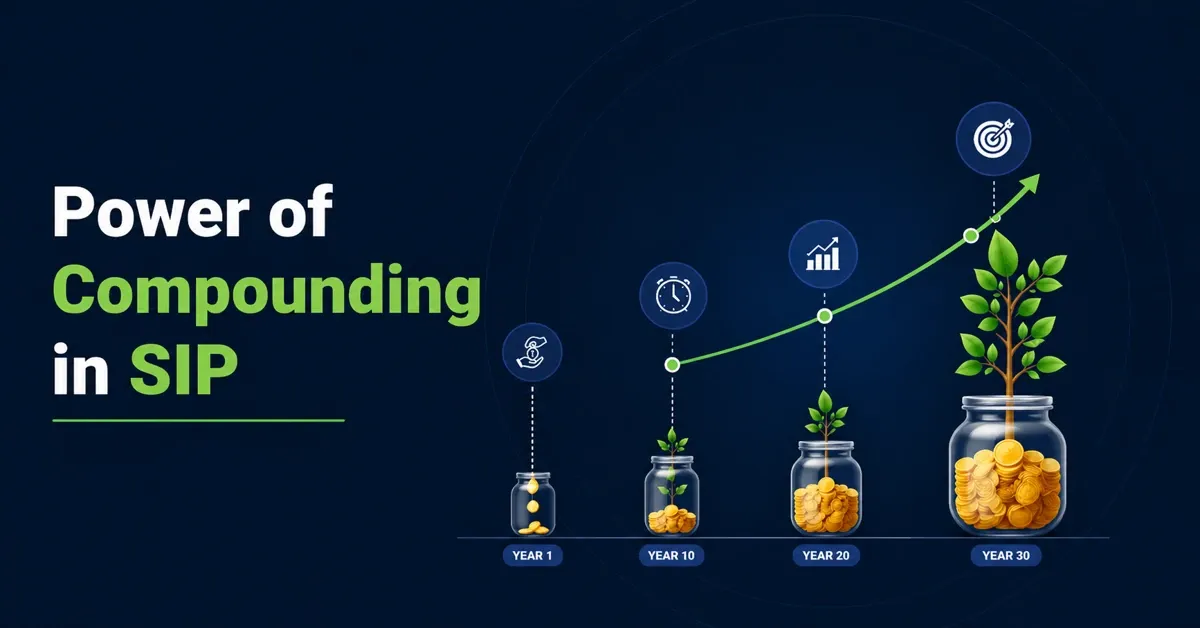
If you’ve ever saved money regularly, you already know this feeling. The first few months don’t show much progress. The numbers move, but not enough to feel exciting.
Then, after a few years, things start to look different.
That shift is not luck. It’s the power of compounding in SIP at work.
A Systematic Investment Plan (SIP) simply means putting in a fixed amount at regular intervals into mutual funds. It could be monthly, weekly, or quarterly. You don’t need a large sum to begin. What matters is consistency.
It doesn’t feel like much at first. But over time, these disciplined contributions start adding up. And that’s where compounding steps in.
What Is Compounding In SIP?
Compounding in SIP is simple in theory.
You invest a fixed amount every month. That money earns returns. Instead of taking those returns out, they stay invested.
Now, in the next cycle, you earn returns on both your original investment and the earlier returns.
So your money is not just growing. It is building on top of itself.
This is what people mean when they ask, "What is compounding in SIP?”
How Power Of Compounding Works In SIP
To understand how compounding works in SIP, focus on one thing: time.
Every SIP instalment you invest enters the market at a different point. Each one starts its own journey. Some get more time, some get less.
Over many years, three things will occur together:
-
Your total invested amount increases
-
The returns keep getting added back
-
The base on which returns are calculated keeps growing
In the beginning, most of your portfolio is your own money. Later, a larger portion starts coming from returns.
That is when compounding in SIP becomes visible.
It is not sudden. It builds quietly, then shows up strongly.
Example Of Compounding In SIP
Let’s keep this practical.
Say you invest ₹5,000 every month for 15 years.
At a 12% annual return:
-
Total investment: ₹9,00,000
-
Approximate value: ₹25,00,000
Now extend the same SIP by just 5 more years.
-
Total investment: ₹12,00,000
-
Approximate value: ₹50,00,000
You added ₹3,00,000* more. But the final value almost doubled.
This is a clear example of how does compounding work in SIP. The extra time does more heavy lifting than the extra money.
*These figures are illustrative, based on an assumed 12% annual return. Mutual fund returns are not guaranteed and depend on market performance.
Tips To Maximise Power Of Compounding In SIP
Compounding does not need complex strategies. It needs discipline. A few habits, such as the following, can make a big difference.
Start Early
Starting early gives your money more time to grow.
Even a small SIP started in your 20s can build a larger corpus than a bigger SIP started later.
Time is the biggest advantage here.
Stay Invested For Long Term
Short breaks slow things down. Markets will move up and down, but compounding works better over longer periods.
Staying invested for a longer time allows your returns to accumulate properly.
Increase SIP Amount Gradually
As your income grows, your SIP should too. You don’t need a big jump. Even a small yearly increase helps.
It strengthens the overall impact of the power of compounding in SIP.
Avoid Frequent Withdrawals
It’s tempting to pull money out when you see returns. But each time you do that, you’re cutting down the amount that’s working for you. Over time, this slows down your overall growth.
If you can, leave your investment as it is. The longer it stays untouched, the better it can grow.
Conclusion
The power of compounding in SIP has less to do with picking the “best” option and more to do with sticking with your plan. It comes down to consistency, patience, and time.
Start with what you can. Keep going. Give it enough time.
The results usually speak for themselves.
Sources:
Investopedia
The Economic Times
FAQs
SIP compounding is powerful because the returns come from more than what you’ve put in. After a point, a chunk of your portfolio starts coming from past returns. And those returns keep getting added back into the same pool. So next time returns are calculated, they’re applied to a bigger amount than before.
This keeps repeating. In the early years, you barely notice it. Later, it starts to make a visible difference. That’s when people really see the value of staying invested.
There isn’t a fixed number. In the first few years, the growth may seem slow. That’s normal.
Around the 10-year mark, you usually start seeing better momentum. The difference becomes much more noticeable if you stay invested for 15 to 20 years.
The content in this blog is intended purely for educational purposes. Any securities or mutual funds referenced are illustrative in nature and do not constitute a recommendation or endorsement by Kotak Neo. Investors are encouraged to assess their own financial situation and seek professional advice before making any investment decisions. For compliance T&C and disclaimers, Visit https://www.kotakneo.com/disclaimer/
0 people liked this article.

Kotak Neo (Kotak Neo) is India's venerable stockbroking company with a rich legacy. It offers comprehensive investment services across asset classes, prioritising a technology-first approach for a seamless experience. Trusted by 5 million+ customers, it guides you toward financial success with ease of investment and speed of trade.
Note: The opinions expressed in this blog are personal viewpoints and should not be construed as recommendations.