What is BSE? Meaning, Full Form & Role in Share Market
- Posted: 05 Nov 2026, 4:10 PM IST
- | 4m
- 1,004
 Add Preferred News Source
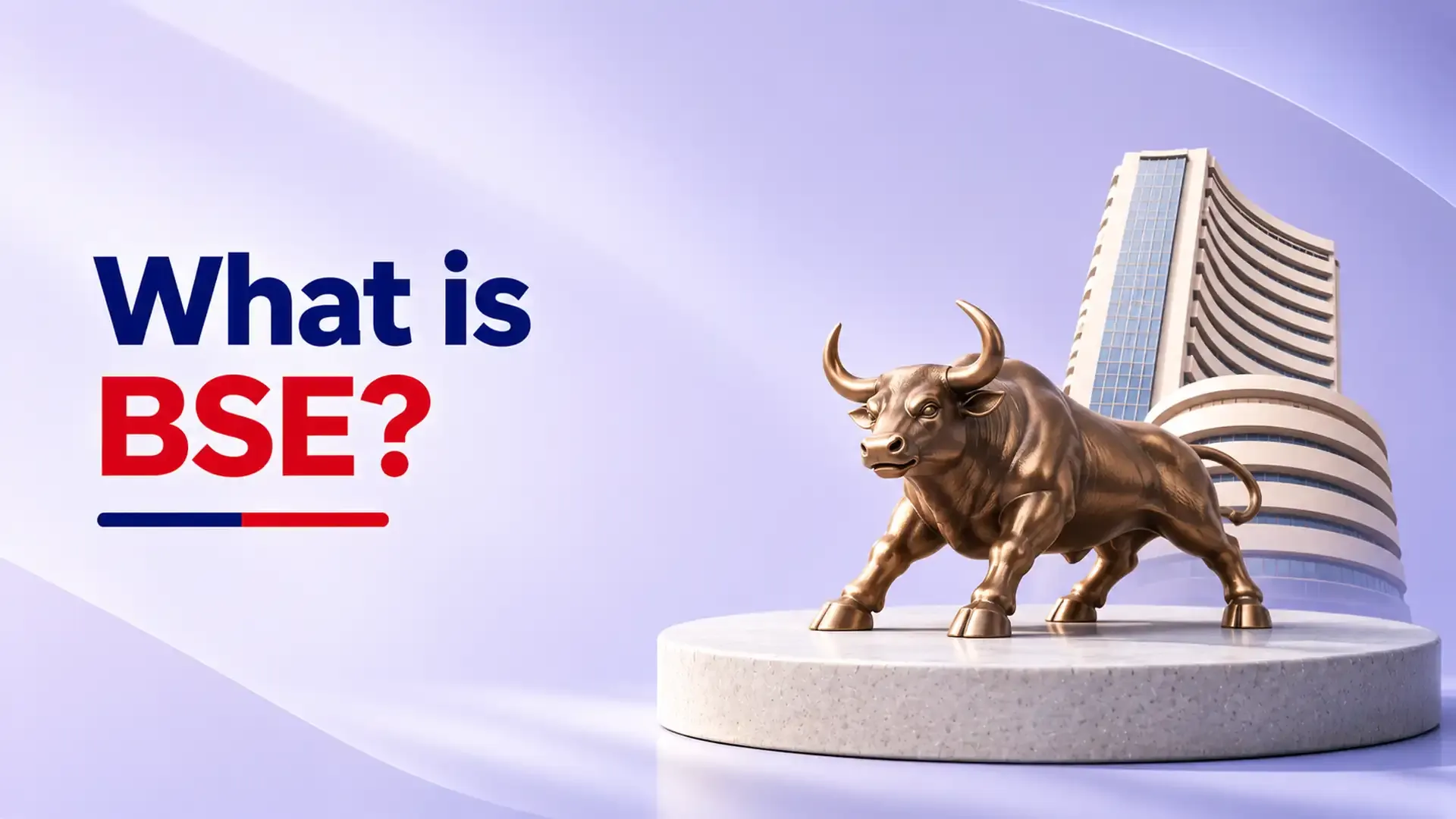
BSE is a regulated electronic exchange that allows trading in shares, derivatives, currencies, debt instruments, etc. It acts as a platform for raising capital for companies and supports price discovery under SEBI regulations. It is one of the largest exchanges in India, based on market capitalisation and the number of listed companies.
What is the Meaning of BSE?
Understanding what is BSE starts with its history. BSE is Asia's oldest stock exchange, founded in 1875 in Mumbai, India and the pioneer of organised financial trading on the continent. It was founded informally under a banyan tree in front of Mumbai's Town Hall by industrialist Premchand Roychand and other founding members, who later formalised the group as "The Native Share & Stock Brokers' Association". It was later moved to its iconic building, Phiroze Jejeebhoy Towers, Dalal Street.
It is home to iconic market indicators like the S&P BSE SENSEX, which represents 30 of the biggest and most financially stable companies in the key sectors of the Indian economy. Key structural highlights defining the identity of BSE include:
- Asia’s First Stock Exchange: BSE carries over 150 years of trading history, making it the oldest of all the securities exchanges in Asia.
- Permanent Statutory Recognition: The Government of India has granted permanent statutory recognition under the Securities Contracts (Regulation) Act, 1956.
- First Demutualised Exchange In India: BSE was the first Indian stock exchange to demutualise, converting from a member-owned association into a corporate entity, BSE Limited. Following its own IPO, its shares were listed on the NSE in February 2017 (not on BSE itself), since SEBI regulations do not allow a stock exchange to list its shares on its own trading platform.
- BOLT Trading Architecture: In 1995, the trading architecture was shifted from physical open-cry trading floors to the BSE On-Line Trading (BOLT) electronic platform in 1995 to automate order matching and bring transparency.
In simple words, what is BSE in share market terms? The answer is that it provides the infrastructure that links millions of retail investors in the country and abroad with expanding businesses in India.
How Does BSE Work in the Share Market?
BSE trading timings are from 9:15 AM to 3:30 PM IST (with a 9:00 AM to 9:15 AM IST pre-open session) from Monday to Friday. Here are the steps from listing a company to trading its shares on BSE:
- IPO and Listing: The company has to file a Draft Red Herring Prospectus (DRHP) with SEBI for its review. After SEBI issues its observation letter on the DRHP, the company complies with the listing and other applicable regulatory requirements of the stock exchange before launching its IPO. It then takes 12 months from that point to launch an initial public offering and list on the BSE.
- Order placement: Market participants can place buy/sell orders for securities listed on BSE through a SEBI-registered broker such as Kotak Neo.
- Order Matching: BSE's BOLT Plus system matches incoming orders against the best available counter-order based on price-time priority. BSE has stated that its BOLT Plus matching engine operates at order-matching speeds of up to 6 microseconds.
- Settlement: Trades settle through BSE Clearing Limited, a wholly owned subsidiary of BSE. Under the T+1 settlement cycle, the buyer's demat account receives shares, and the seller's bank account receives funds by the next business day.
Key Functions and Purpose of BSE
Some primary functions and purposes of BSE are mentioned below:
- Primary Capital Formation: Assists private companies, state governments and municipal entities with the raising of capital through initial public offerings, rights issues and debt placements.
- Price Discovery: Every trade on BSE reflects a real buyer meeting a real seller at an agreed price. Across millions of daily transactions, that process produces a continuously updated, transparent market valuation for every listed security.
- Index Maintenance: BSE maintains and publishes over 100 indices, including Sensex, BSE 100, and many more, which are used by fund houses, ETF providers, pension funds and policymakers as benchmarks and performance barometers.
- Liquidity: It offers a highly liquid secondary market where retail and institutional investors can enter or exit a financial position in real time during regular trading hours.
- Investor Protection: BSE keeps a check on the listed companies on their adherence to the disclosure norms, insider trading regulations and corporate governance standards laid down by SEBI and takes up the necessary action in case of any violation. SME Access To Capital: Through the BSE SME platform, the exchange gives smaller businesses a structured, regulated route to raise public capital.
Major Segments Traded on BSE
BSE spans a broad range of asset classes and serves individual retail traders, corporate treasuries and global institutional funds. Below are some of the key sectors on the BSE:
Trading Segment | Description & Instruments Traded | Key Examples / Sub-categories |
|---|---|---|
Equity (Cash Market) | The primary segment where investors buy and sell ownership shares of publicly listed companies. | Large-cap, mid-cap, and small-cap stocks (e.g., Reliance, HDFC, Tata Motors). |
Equity Derivatives (F&O) | Contracts whose value is derived from underlying equity shares or benchmark indices. | Index Futures & Options (Sensex, Bankex), Stock-specific F&O contracts. |
Currency Derivatives | Trading of futures and options contracts on specific currency pairs to hedge against foreign exchange risk. | USD-INR, EUR-INR, GBP-INR, and JPY-INR pairs. |
Commodity Derivatives | Financial contracts based on the future price of raw materials and physical commodities. | Gold, Silver, Crude Oil (WTI), Base Metals, and Agricultural commodities. |
Debt / Fixed Income | A platform for trading fixed-return financial instruments issued by governments and corporations. | Government Securities (G-Secs), Corporate Bonds, Treasury Bills (T-Bills). |
Mutual Funds (StAR MF) | A digital platform (BSE StAR MF) enabling brokers and distributors to execute mutual fund transactions for clients. | Equity funds, Debt funds, Hybrid mutual funds. |
BSE SME | A dedicated equity segment for Small and Medium Enterprises (SMEs) to raise capital and list their shares. | Startup and mid-sized company stocks. |
EGR (Electronic Gold Receipts) | A segment allowing investors to trade EGRs representing underlying physical gold held in approved vaults like equities and take physical delivery after meeting delivery requirements. | Spot trading of vaulted gold via electronic receipts. |
SLB (Securities Lending & Borrowing) | A legally approved mechanism allowing investors to lend their idle shares or borrow shares for short-selling. | Liquid stocks approved by SEBI for the SLB mechanism. |
Understanding Sensex: The Benchmark Index of BSE
The Sensex is BSE's flagship benchmark equity index. It tracks 30 companies selected based on criteria designed to represent important parts of the Indian equity market.
For investors, the Sensex provides a quick way to understand the broad direction of the large-company segment of the Indian stock market. When the Sensex rises, it generally indicates that the prices of its constituent stocks have moved higher overall; a fall indicates the opposite.
BSE launched the country's first equity index, the SENSEX, in 1986, with a base year of 1978-79.
Advantages of Listing on BSE
Listing equity shares on BSE provides significant long-term corporate, operational and strategic benefits to growing enterprises, as it allows them to raise capital from institutional and retail investors for expansion of operations, research and development, debt repayment or for domestic and international acquisitions.
A BSE listing also raises a company's profile, building public visibility and long-term trust among business partners, financial institutions and investors around the world.
Further, listing provides a regulated secondary market through which early stage venture investors, promoters and employees holding stock options (ESOPs) can offload their holdings over a period of time subject to lock-in periods and SEBI regulations on pre-IPO and promoter shareholding.
Difference Between BSE and NSE
Basis | BSE | NSE |
|---|---|---|
Full Form | Bombay Stock Exchange | National Stock Exchange of India |
Established | 1875 | 1992 |
Benchmark Index | SENSEX | NIFTY 50 |
Trading | Equity, derivatives, debt and other segments | Equity, derivatives, debt and other segments |
Trading System | Electronic trading through BSE's systems | Electronic trading through NSE's trading infrastructure |
Key Identity | Asia's oldest stock exchange | India's newer major exchange and a major venue for equity and derivatives trading |
Both exchanges provide regulated marketplaces for trading securities and are part of India's organised securities-market infrastructure.
Role of BSE in the Indian Economy
Zoom out from individual trades, and BSE’s real function becomes a lot easier to see. It is the mechanism that turns household savings from traditional avenues such as gold and fixed deposits into productive capital that can support businesses, investment and economic growth.
It is also where foreign money finds its way into Indian businesses. Global institutional investors do not wire cash directly to Indian companies; they come in through a regulated, transparent market like the BSE, which is what makes it a genuine bridge between domestic capital markets and international capital. The result is twofold: companies gain access to growth funding, investors have a structured way to support that growth, and the number of people participating in markets continues to expand beyond the traditional saver.
Final Take: Why Understanding What BSE is Matters for Investors
BSE is the oldest stock exchange in Asia and is an important part of the Indian financial system. Through its electronic trading systems, efficient clearing processes and diverse asset classes, it remains woven into the daily lives of millions of investors and continues to drive enterprise growth across the country.
FAQs
The full form of BSE is Bombay Stock Exchange. It was founded in 1875 as the Native Share & Stock Brokers' Association and subsequently changed its name to the Bombay Stock Exchange, reflecting its home city of Bombay (now Mumbai). The exchange was demutualised in 2005 and is now a corporatised public company known as BSE Limited. Although it is the official corporate name, the acronym BSE is still known worldwide in financial institutions, regulatory bodies and retail share market trading platforms.
The Bombay Stock Exchange headquarters is at Phiroze Jejeebhoy Towers, Dalal Street, Fort, Mumbai, Maharashtra (Pincode: 400001). Dalal Street, which means ‘Broker Street', has become the Wall Street of India. The iconic building, which is 29 storeys tall, has been the hub of Indian equity trading since 1980. BSE also has regional investor service centres and operational support offices in major cities in India, such as New Delhi, Kolkata, Chennai and Ahmedabad.
BSE operates under the regulatory framework of the Securities and Exchange Board of India (SEBI), the statutory regulator for India’s securities market established under the SEBI Act, 1992. The framework covers exchange operations, disclosures by listed companies and conduct of brokers and other intermediaries. The BSE was also the first exchange in India to receive permanent recognition under the Securities Contracts (Regulation) Act, 1956. Its clearing and settlement functions are handled by BSE Clearing Limited, which operates under SEBI’s regulatory oversight.
The Bombay Stock Exchange officially came into existence on 9 July 1875. It was established by cotton merchant Premchand Roychand and four other brokers under the name "The Native Share & Stock Brokers' Association. The group had first met informally under banyan trees in front of the Town Hall in Mumbai in the 1850s and had become a formal financial institution in 1875. This legacy makes BSE the oldest stock exchange in Asia with more than 150 years of history
Prof. Subhasis Chaudhuri is Chairman of the Board of Directors of BSE Limited, succeeding to the post of Chairman after getting approval from the Securities and Exchange Board of India (SEBI). Sundararaman Ramamurthy is the Managing Director and Chief Executive Officer (MD & CEO) of the exchange.
BSE is one of the largest stock exchanges in the world in terms of the total number of listed companies, which is more than 5,000. The listed companies include mega-cap blue-chip companies like Reliance Industries, Tata Consultancy Services (TCS), HDFC Bank and hundreds of small and medium companies listed on the dedicated BSE SME platform. The market capitalisation of all the companies listed on the BSE is more than ₹480 lakh crore.
The content in this blog is intended purely for educational purposes. Any securities or mutual funds referenced are illustrative in nature and do not constitute a recommendation or endorsement by Kotak Neo. Investors are encouraged to assess their own financial situation and seek professional advice before making any investment decisions. For compliance T&C and disclaimers, Visit https://www.kotakneo.com/disclaimer
0 people liked this article.

Vishwa has spent 10+ years across fintech and FMCG doing what most people miss, connecting the dots, catching trends before they trend, and finding the angle nobody else thought to ask about.
At Kotak Neo, she drives content strategy for neoshorts, Kotak News Desk, and Investing Guide, turning market noise into something worth reading.
When she's not decoding markets, she trades charts for canvases, chasing art, painting, and architecture across cities she's yet to explore.