Types of FDI - Foreign Direct Investment
- Updated: 22 May 2026, 5:11 PM IST
- | 4m
- 1,442
 Add Preferred News Source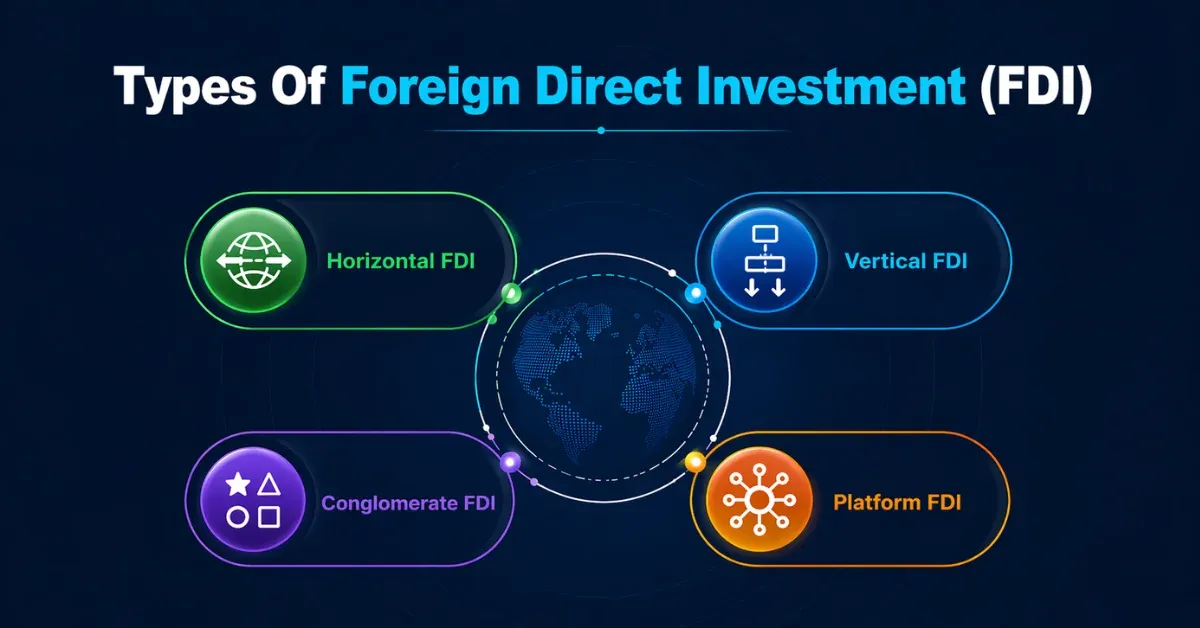
FDI plays an important role in the development of an economy. The full form of FDI is Foreign Direct Investment. As the term suggests, it involves investment coming in from outside the country, where foreign entities such as companies, institutional investors, or governments put money into a business in another country. This is usually done with a long-term view, often involving a certain level of ownership and involvement in how the business operates.
Along with capital, it also brings in expertise, technology, and access to global markets, all of which support long-term growth.
When FDI keeps coming in consistently, it is usually taken as a good sign. It shows that global investors are comfortable with the market and trust its stability.
How Does FDI Work?
At the initial stage, FDI is simply about finding the right opportunity in another market as a foreign investor. The way they choose to enter can differ. It could be setting up a new entity, acquiring an existing business, or simply increasing their stake in one they are already involved in.
Before any money actually comes in, there is usually a layer of approvals to deal with. Much of this depends on the sector and the host country’s regulatory framework.
After the necessary clearances, funds start coming in, and the investor usually gains a level of ownership and control in the business. That is really what distinguishes FDI from passive investments. There is usually some involvement here, whether in management decisions, day-to-day operations, or overall strategy.
The process does not end there. The investment is tracked over time. It may grow, scale up, or at times be restructured depending on how things are playing out and how market conditions shift. All of this sits within a broader framework of regulations, sectoral caps, and ongoing compliance in the host country.
Types Of FDI
There is no one-size-fits-all concept in FDI. The way an investment is structured can vary depending on what the investor is trying to achieve, whether it is expansion, cost efficiency, or diversification. That is why FDI is usually broken down into a few common types. Each one reflects a slightly different approach to entering and operating in a foreign market.
Horizontal FDI | Horizontal FDI is when a company invests in the same line of business in another country as it does in its home market. The idea is quite simple. If something works well in one market, it is replicated in another. There are no big changes to the way the business operates. You will usually see this in sectors like retail, food chains, or consumer services. |
Vertical FDI | Vertical direct investments by foreign investors are approached differently. Instead of entering the same business, the company moves along the supply chain. In some cases, companies invest in their suppliers (backward integration). In others, they move closer to the end customer through distribution or retail (forward integration). Either way, the goal is to improve efficiency and keep a tighter grip on operations. |
Conglomerate FDI | Conglomerate FDI follows a distinct pattern altogether. Here, the investment is made in a completely unrelated business in another country. There is no direct connection with what the company already does. That is what makes it different. It is usually driven by diversification, spreading risk or exploring new sectors. It is not the most common route, but it does come up in certain strategic decisions. |
Platform FDI | Platform FDI is more export-oriented in nature. In this case, a company sets up operations in one country mainly to serve other markets. The choice of location is usually driven by cost advantages, trade benefits, or access to resources. It is less about the domestic market and more about using that country as a base to reach global customers. |
Apart from these, foreign investment types are also classified based on the route through which it comes in, especially in India.
-
Automatic route - Investments through this route do not require prior government approval, making the process quicker.
-
Government route - This involves approvals before the investment can go through, usually in sectors that are more regulated or sensitive.
Advantages Of Foreign Direct Investment
FDI gives investors a chance to expand into new markets and diversify their presence. That is usually the starting point. The impact, however, does not stay limited to them but also shows up across the broader economy.
- Improves infrastructure and industry development
FDI is not limited to capital inflow. Over time, it starts influencing how things are done. Foreign investors bring structure and higher standards with them. The impact of this is often visible across the ecosystem. Local businesses start adapting, processes get stricter, and supply chains slowly get better. The business environment improves step by step. The business environment moves in a better direction gradually.
- Boosts jobs and economic activity
Foreign companies entering the market usually have to set up or grow their operations. That directly creates jobs. It does not just stop there. Suppliers, logistics, and service providers also gain from it. Over time, this creates a ripple effect that can be quite strong, especially in developing markets.
Disadvantages Of Foreign Direct Investment
Entering new markets through FDI can be a strong move for investors. Even so, it comes with its share of challenges. Different regulations, different ways of doing business, and a bit of unpredictability are all part of it. The impact on the host economy is not always balanced either.
- Risk of foreign control in key sectors
When FDI comes in, ownership is not always fully domestic anymore. That naturally brings in outside influence. In some sectors, this can feel like a concern, particularly in areas that are more sensitive. The question often comes down to how much control foreign players end up having, and where the line should be drawn.
- Profits may not stay within the country
While capital flows into the country, the returns do not always stay back. A portion of the profits is usually sent back to the investor’s home country. Over a period of time, less value may end up staying within the local economy. This tends to stand out more when reinvestment is limited.
Conclusion
FDI is no longer just about bringing money into an economy. It also reflects how competitive and investment-ready a market really is. Over time, the focus has started shifting towards the quality and long-term value of investments, because that is where the real impact begins to show.
Sources:
The Economic Times
Business Standard
Foreign Direct Investment FAQs
FDIs refer to investments made by individuals, businesses, or governments of one country into another country's economy. The different types of Foreign Direct Investment are horizontal FDI, vertical FDI, conglomerate FDI and platform FDI.
Gambling and betting, lottery businesses, atomic energy generation, Nidhi company, etc., cannot attract FDI.
FDI often comes into play when organisations are ready to move beyond their home base This lets them break into new markets and work closer to their customers. Most of the time, it's not just about making quick profits, it’s about sticking around for the long haul.
FDI does not come with repayment pressure. There is also no fixed interest component that debt instruments have. Instead, investors share risk and stay involved. That can ease the financial burden on businesses, especially in the early stages or during uncertain periods.
Along with capital, FDI supports job creation and improves industry practices. With time, it helps strengthen both infrastructure and supply chains, creating a more stable path for growth in developing economies.
The content in this blog is intended purely for educational purposes. Any securities or mutual funds referenced are illustrative in nature and do not constitute a recommendation or endorsement by Kotak Neo. Investors are encouraged to assess their own financial situation and seek professional advice before making any investment decisions. For compliance T&C and disclaimers, Visit https://www.kotakneo.com/disclaimer/
The content in this blog is intended purely for educational purposes. Any securities or mutual funds referenced are illustrative in nature and do not constitute a recommendation or endorsement by Kotak Neo. Investors are encouraged to assess their own financial situation and seek professional advice before making any investment decisions. For compliance T&C and disclaimers, Visit https://www.kotakneo.com/disclaimer
0 people liked this article.

Kotak Neo (Kotak Neo) is India's venerable stockbroking company with a rich legacy. It offers comprehensive investment services across asset classes, prioritising a technology-first approach for a seamless experience. Trusted by 5 million+ customers, it guides you toward financial success with ease of investment and speed of trade.
Note: The opinions expressed in this blog are personal viewpoints and should not be construed as recommendations.