What Is A Stock Market Bubble - Meaning, Causes & Impact
- Updated: 22 May 2026, 5:51 PM IST
- | 6 min read
- 1,683
 Add Preferred News Source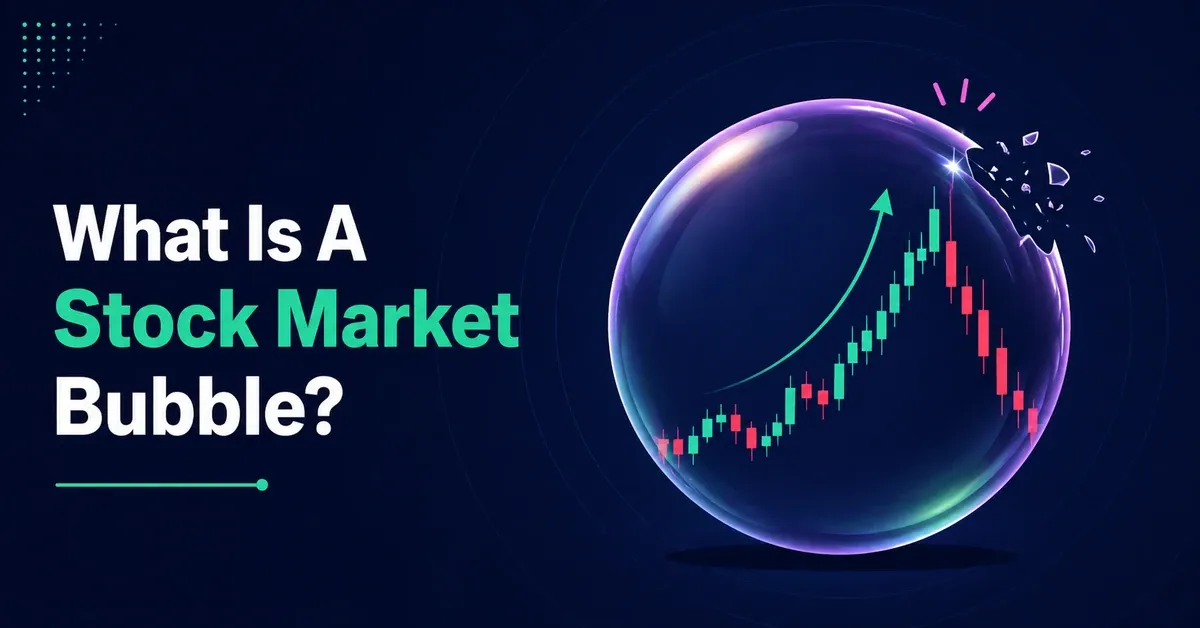
What Is A Stock Market Bubble?
A stock market bubble occurs when prices rise faster than the actual value of the underlying businesses.
You’ll often hear different terms used interchangeably, like a share market bubble, equity market bubble, or simply a market bubble. They all point to the same thing prices running ahead of reality.
At first, everything looks normal. Companies are growing, and investors are optimistic. But slowly, the logic shifts. People start buying not because something is worth it, but because they think someone else will pay more later.
That’s usually where the problem begins.
How A Stock Market Bubble Forms
It rarely starts with madness. Most stock market bubbles begin with something real, like a strong sector, a new idea, or a genuine growth story.
Then prices move up. Fair enough.
But once momentum kicks in, the kinds of buyers change. Long-term investors get replaced by short-term traders. Decisions become quicker, less thoughtful.
At some point, earnings stop keeping up with prices. But the rally continues anyway. That gap between what a company earns and what people are paying quietly keeps widening.
And nobody worries about it… until they suddenly do.
Key Causes Of Stock Market Bubbles
No single factor creates a stock market bubble. It is usually a mix of behaviour, liquidity, and expectations coming together.
Speculation And Hype
When people start chasing price instead of value, speculation takes over.
You’ll notice stocks doubling or tripling without any meaningful change in business performance. That’s not growth. That’s momentum being mistaken for strength.
Herd Mentality (FOMO)
This is probably the most visible trigger.
When everyone around you seems to be making money, sitting out feels uncomfortable. So more people jump in.
That demand isn’t based on analysis. It’s driven by Fear Of Missing Out (FOMO). And that’s what pushes a share market bubble further.
Excess Liquidity
When money is easily available, risk-taking increases.
Low interest rates, high inflows, and easy leverage all create a situation where too much capital chases too few opportunities. Prices rise, not because value has increased, but because money needs somewhere to go.
Over-Optimism
Expectations lose touch with reality. Growth projections become aggressive. Valuations expand. Investors start assuming that current trends will continue indefinitely.
In most equity market bubbles, this phase feels the most convincing, and that’s why it’s the most dangerous.
What Happens When A Bubble Bursts?
The turning point is usually subtle. It might be a weak result, a policy change, or just buyers stepping back.
Then prices stall.
Once they start falling, the behaviour flips. The same crowd that was eager to buy now wants to exit. At the same time.
That’s when liquidity disappears and prices fall faster than they rose.
In many cases, you’ll also see insiders reducing their holdings before the broader market reacts.
Famous Examples Of Stock Market Bubbles
Looking at past stock market bubbles helps put things into perspective, especially how quickly sentiment can shift once reality catches up.
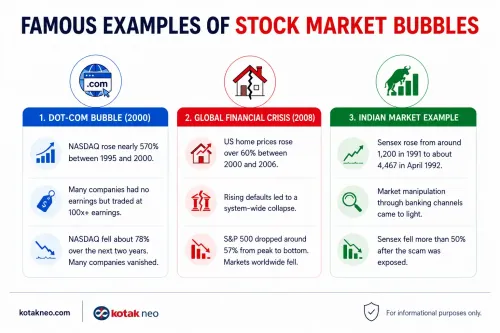
Dot-Com Bubble (2000)
The late 1990s saw massive excitement around internet companies.
The NASDAQ rose nearly 570% between 1995 and 2000. Many companies had no earnings at all. And those that did were trading at absurd valuations of 100 times earnings or more.
When reality set in, the index fell about 78% over the next two years. Several companies simply disappeared.
Global Financial Crisis (2008)
This wasn’t just a stock market issue. It started with housing.
US home prices rose more than 60% between 2000 and 2006, supported by easy credit. When defaults increased, the system cracked.
The S&P 500 dropped around 57% from peak to bottom, and markets across the world fell together. It showed how interconnected markets can become during a bubble.
Indian Market Example (1992 Scam)
In India, the 1992 episode is a clear example of how quickly a bubble can form and collapse.
The Sensex rose from around 1,200 in 1991 to about 4,467 in April 1992 before falling more than 50% after the scam was exposed.
Impact Of Stock Market Bubbles On Investors
The outcome depends on when you enter and when you exit.
Early participants can earn strong returns. But most retail investors don’t enter early. They usually come in when the narrative is strongest, which often means prices are already stretched.
When the market bubble bursts, these are the investors who take the biggest hit.
There’s also a longer-term effect. After a sharp correction, confidence drops. People stay away from markets even when good opportunities return.
How To Protect Yourself From Market Bubbles
There is no way to completely avoid a market bubble, but a few practical habits can help reduce the damage when things turn against you.
Diversify Your Portfolio
Putting too much money into one theme or sector increases risk. Portfolio diversification won’t eliminate losses, but it can limit the damage.
Stay Long-Term Focused
Short-term rallies can be misleading.
If the business is strong and earnings are growing steadily, the price eventually follows. If not, the correction is just a matter of time.
Avoid Herd Mentality
If you’re buying only because others are making money, pause. In most stock market bubbles, the biggest mistake is not a lack of knowledge, but a lack of discipline.
Conclusion
A market bubble doesn’t burst because people suddenly become irrational. It bursts because reality eventually overrides expectation.
The real question is not whether stock market bubbles will happen again they will.
The question is whether you can recognise when prices are being driven by belief rather than business, and choose not to follow the crowd.
Sources
DW
Brookings
Mint
The content in this blog is intended purely for educational purposes. Any securities or mutual funds referenced are illustrative in nature and do not constitute a recommendation or endorsement by Kotak Neo. Investors are encouraged to assess their own financial situation and seek professional advice before making any investment decisions. For compliance T&C and disclaimers, Visit https://www.kotakneo.com/disclaimer/
0 people liked this article.

Kotak Neo (Kotak Neo) is India's venerable stockbroking company with a rich legacy. It offers comprehensive investment services across asset classes, prioritising a technology-first approach for a seamless experience. Trusted by 5 million+ customers, it guides you toward financial success with ease of investment and speed of trade.
Note: The opinions expressed in this blog are personal viewpoints and should not be construed as recommendations.