Swiggy to Go Public Soon: What Investors Need to Know Before it Hits the Market?
- 4 min read
- 3,841
- Published 18 Dec 2025

It’s finally out. After months of speculation, food delivery and quick commerce giant Swiggy Limited has filed its updated draft red herring prospectus (DRHP) with capital market regulator Sebi for its initial public offering (IPO). The IPO marks a significant milestone for the company, which, along with Zomato, has given food delivery and quick commerce a new face in India. If you want to know the finer aspects of this IPO, read on.
About Swiggy Limited
Swiggy is a new-age, consumer-first technology company offering users an easy-to-use convenience platform. The platform is accessible through a unified app, where users can browse, select, order, and pay for food, groceries, and household items. The company's platform can also be used to make restaurant reservations and event bookings, avail of product pickup/drop-off services, and engage in other hyperlocal commerce activities.
Swiggy is unique, as it is the only unified app in India that fulfils, through its own platform, all urban users' food and related missions of ordering in, eating out, and cooking at home. The image captures the company's journey so far.
IPO details of Swiggy
Swiggy IPO consists of fresh issue and an offer for sale. While the fresh issue aggregates up to ₹3750 crores, the offer for sale (OFS) constitutes up to 185,286,265 equity shares. The following entities will offload their stake through OFS:
Accel India IV (Mauritius) Limited | Up to 10,572,706 equity shares |
Apoletto Asia Ltd | Up to 1,696,504 equity shares |
Alpha Wave Ventures, LP | Up to 5,573,473 equity shares |
Coatue PE Asia XI LLC | Up to 3,885,413 equity shares |
DST EuroAsia V B.V. | Up to 5,621,668 equity shares |
Elevation Capital V Limited | Up to 7,396,253 equity shares |
Inspired Elite Investments Limited | Up to 6,747,246 equity shares |
MIH India Food Holdings B.V. | Up to 118,215,233 equity shares |
Norwest Venture Partners VIIA-Mauritius | Up to 6,406,307 equity shares |
Tencent Cloud Europe B.V | Up to 6,327,243 equity shares |
The offer is structured in the following manner for different category of investors:
- Not less than 75% of the offer is available for qualified institutional buyers (QIBs)
- Not more than 15% of the offer is allocated for non-institutional bidders (NIBs)
- Not more than 10% of the offer is available for retail individual bidders (RIBs)
Use of IPO proceeds
The company plans to utilise the proceeds received from the IPO for:
- Investment in its material subsidiary, Scootsy, for repayment or prepayment, in full or in part, of certain or all of its borrowings
- Investment in its material subsidiary, Scootsy, for:
- Expansion of its Dark Store network for its Quick Commerce segment .
- Making lease / licence payments for Dark Stores
- Investment in technology and cloud infrastructure
- Brand marketing and business promotion expenses for enhancing the brand awareness and visibility of its platform across its segments
- Funding inorganic growth through unidentified acquisitions and general corporate purposes
Swiggy’s business segments and revenue models
Swiggy has five business segments: food delivery, out-of-home consumption, quick commerce, supply chain and distribution, and platform innovations. Each segment has a different revenue model.
1. Food segment
Swiggy’s most scaled business, the revenue model from this business segment includes:
➔ Pre-agreed commissions from restaurant partners
➔ Advertising revenue from restaurant partners
➔ Fees that it charges to users and delivery partners for the use of its technology platform
➔ Fees for other business enablement services from restaurant partners
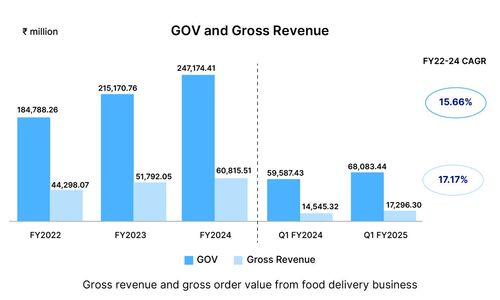
Gross revenue and gross order value from food delivery business
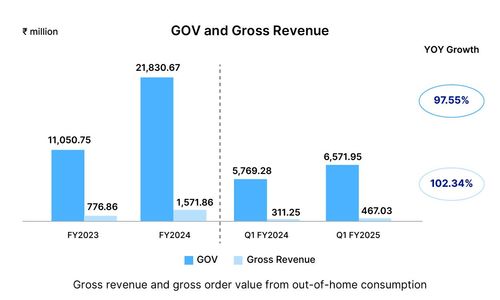
2. Out-of-home consumption
The company started its out-of-home consumption business in fiscal 2023 by acquiring Dineout. Revenue from its Dineout business includes:
➔ Pre-agreed commissions that it charges to its restaurant partners
➔ A recently introduced advertising revenue from restaurant partners and brand partners
➔ Fees that it charges to users for the use of its technology platform
3. Quick commerce
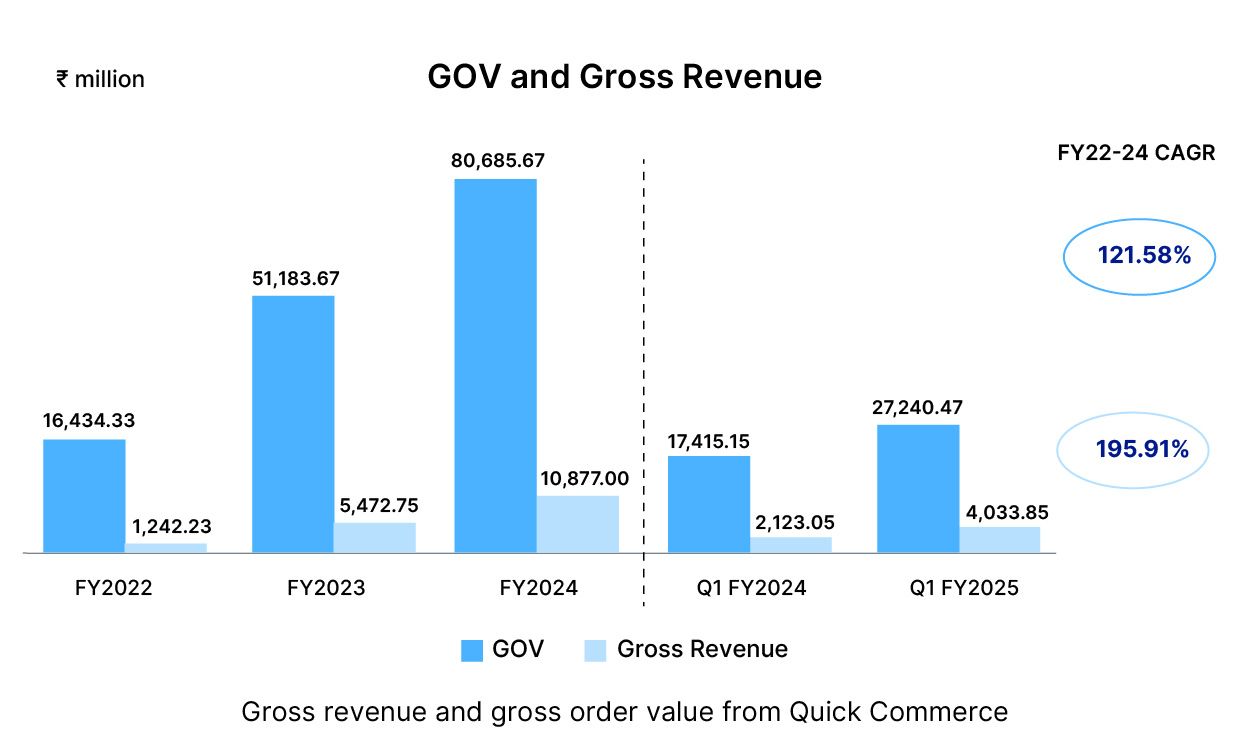
Quick commerce is Swiggy’s second-largest business. Revenues from it include:
➔ Pre-agreed commissions from merchant partners
➔ Advertising revenue from brand partners
➔ Fees that it charges to users and delivery partners for the use of its technology platform
➔ Fees for other business enablement services from merchant partners
4. Supply chain distribution
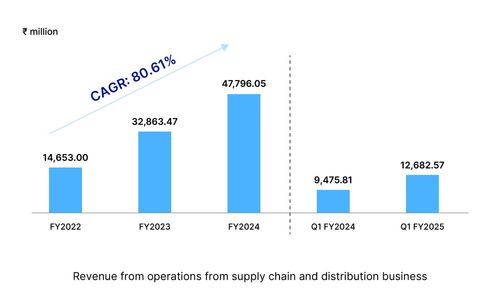
Swiggy’s revenue for supply chain and distribution services includes:
➔ Revenue from sale of goods to wholesalers and retailers
➔ Revenue from its supply chain customers for rendering supply chain management services
➔ Other business enablement services
5. Platform innovations
The revenue model varies based on the nature of the offering. Revenue from Platform Innovations business typically includes:
➔ Revenue from the sale of food and products
➔ Fees that it charges to its users and delivery partners
➔ Advertising fees from restaurant partners, merchant partners and brand partners
➔ Fees for other business enablement services from restaurant partners and merchant partners
Financial snapshot of Swiggy Limited
Here are the key financials of the company as per its DRHP across different financial years:
Total equity and liabilities (in ₹ crores) | 10529.421 | 11280.645 | 14405.736 |
Total income (in ₹ crores) | 11634.349 | 8714.453 | 6119.777 |
Total expenses (in ₹ crores) | 13947.384 | 12884.399 | 9574.453 |
Return on net worth (in %) | (30.16) | (46.15) | (29.58) |
Group companies and management of Swiggy Ltd
Swiggy has four group companies, namely:
- Loyal Hospitality Private Limited
- Loyal Hospitality Kitchens Private Limited
- MIH India Food Holdings B.V.
- Vijayawada Hospitalities Private Limited
The company’s management consists of:
- Anand Kripalu (Independent Director and Chairman)
- Sriharsha Majety (MD and Group CEO)
- Lakshmi Nandan Reddy Obul (Whole-time Director and Head of Innovation)
- Shailesh Vishnubhai Haribhakti (Independent Director)
- Sahil Barua (Independent Director)
- Suparna Mitra (Independent Director)
- Anand Daniel (Nominee Director Non-Executive)
- Ashutosh Sharma (Nominee Director Non-Executive)
- Sumer Juneja (Nominee Director Non-Executive)
- Roger Clark Rabalais (Nominee Director Non-Executive)
Listed industry peer of Swiggy
Zomato Limited is Swiggy's listed industry peer. As per the DRHP, while Swiggy’s revenue from operations stood at ₹11247.390 crores in FY 24, Zomato clocked ₹1214 crores during the same period. However, Zomato’s return on net worth stood at 1.72%, while that of Swiggy was (30.16%).
Competitive strengths of Swiggy
Some of Swiggy’s competitive strengths include:
- Pioneers of high-frequency hyperlocal commerce categories driven by an innovation-led culture
- A consistently growing network of users
- Rising user engagement on its platform
- Swiggy brand delivered through a unified app with consistent user experience
- A preferred choice for restaurant partners, merchant partners, brand partners and delivery partners
- Creation of a strong network effects driven by its wide user and partner base
- An experienced professional management team and high standards of governance
Industry overview
The Indian food services market comprises online food delivery and out-of-home consumption stood at ₹5,600 billion as of 2023. The online food delivery market is the fastest-growing segment within the food services market, and is expected to grow at 17-22% between 2023 and 2028.
In the out-of-home consumption market, the organised segment and the online dining out segment are expected to grow at 15-18% and 46-53% respectively between 2023 and 2028. The Indian retail market is evolving with the growing need for convenience and is expected to grow from ₹ 76-78 trillion in 2023 to ₹116-124 trillion in 2028.
The market is dominated by grocery products, which hold approximately 61% of the share as of 2023. However, convenience-first quick commerce models, which are gaining prominence among time-constrained urban consumers, are digitally disrupting the market.
In conclusion
Being among the first hyperlocal commerce platforms, Swiggy has successfully pioneered the industry in India, launching Food Delivery in 2014 and Quick Commerce in 2020. Its unified app, growing offerings, and wide network of partners drive greater selection and faster delivery times. These have enhanced the user experience on its platform and encouraged more users to transact with it.
That said, hyperlocal platforms like Swiggy are subjected to several risks including economic and inflationary pressures, logistics complexity and rise of other models like ONDC. Being mindful of these risks before investing and doing proper homework can help you figure out if you should invest in Swiggy’s IPO or not. Go through the draft red herring prospectus for a granular overview across various aspects.
Disclaimer: This article is for informational purposes only and does not constitute financial advice. It is not produced by the desk of the Kotak Neo Research Team, nor is it a report published by the Kotak Neo Research Team. The information presented is compiled from several secondary sources available on the internet and may change over time. Investors should conduct their own research and consult with financial professionals before making any investment decisions. Read the full disclaimer here.
Investments in securities market are subject to market risks, read all the related documents carefully before investing. Please read the SEBI prescribed Combined Risk Disclosure Document prior to investing. Brokerage will not exceed SEBI prescribed limit.
0 people liked this article.