What Is Short Selling?
- Updated: 09 May 2026, 11:00 AM IST
- | 4m
- 2,021
 Add Preferred News Source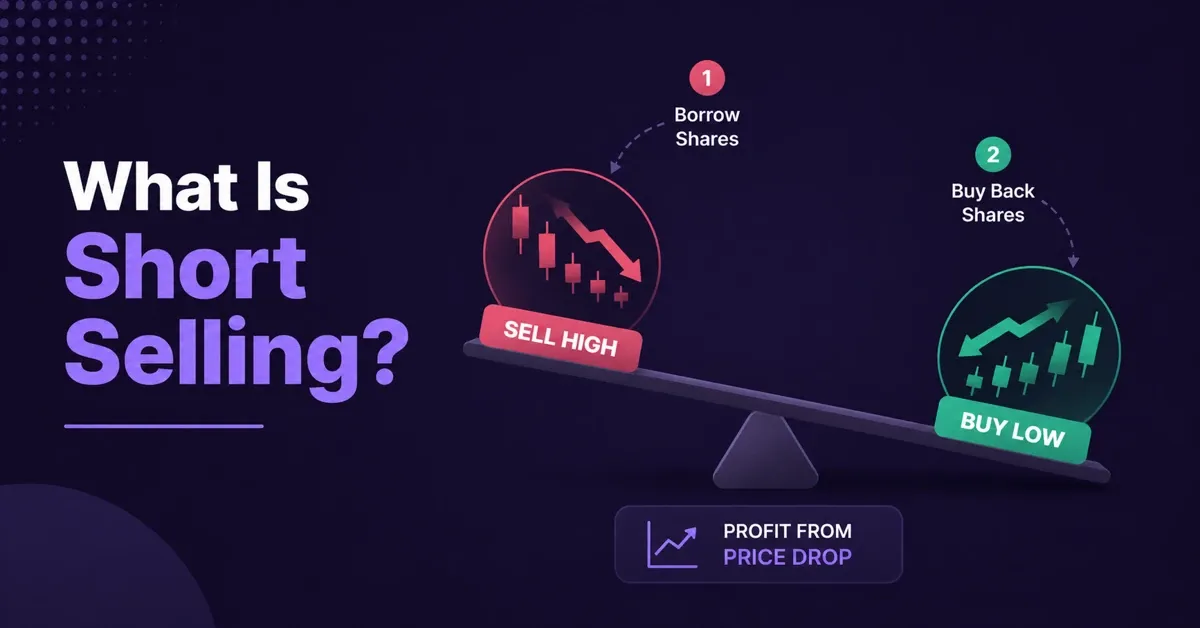
Short selling, or short trading, is a unique and often misunderstood practice in stock market investment. It plays a significant role in the world of stock markets, providing opportunities for investors to profit in bullish and bearish market conditions. Read on to learn what is short selling and its working mechanism.
Short Selling Meaning
If you are wondering what is short selling, is a trading strategy where an investor borrows a company's stock from a broker to sell them in the open market. The goal of short selling is to profit from a declining stock price. In essence, short sellers bet the stock's value will decrease over time.
How Does Short Selling Work?
-
Borrowing Shares: To engage in short selling, an investor borrows shares from a stock brokerage firm. These borrowed shares are then sold on the open market.
-
Selling in the Open Market: The investor sells the borrowed shares at the prevailing market price. This is done with the expectation that the stock price will decrease, allowing them to purchase back the shares at a lower price later.
-
Buying Back and Returning Shares: The investor repurchases the shares at the lower price after the stock price falls. These shares are then returned to the brokerage, effectively closing the short position.
-
Calculating Profit: The difference between the price at which the shares were initially sold and the price at which they were bought back represents the investor's profit. Conversely, the short seller incurs a loss if the stock price rises.
What Are Short Selling Metrics
People who keep an eye on short selling usually start by looking at a few key numbers. Those numbers reveal how many traders are actually betting against a stock. They do not predict the future, but they can offer useful signals. Two of the better-known measures are the days to cover ratio and the short interest ratio.
Used properly, they can help explain whether a stock has heavy short positions or only limited bearish activity.
Days To Cover Ratio
The days to cover ratio gives an estimate of how long it may take short sellers to close their positions, based on the stock’s normal daily trading volume. It is worked out by dividing the total shares sold short by the average number of shares traded each day. If 90,000 shares are shorted and average daily volume is 30,000 shares, the ratio comes to 3 days.
A higher number can sometimes matter. It may mean many traders would need time to exit if the price starts rising sharply. That kind of rush can send the price soaring, even faster than expected. You’ve probably heard this called a short squeeze when short sellers are forced to buy shares back in a hurry because prices just won’t stop climbing. Stocks with a high days to cover ratio are generally considered more vulnerable to one.
Short Interest Ratio
The short interest ratio looks at how many shares are currently sold short compared with the shares available for trading. It helps give a sense of market mood around that stock. If the ratio is very high, it may indicate quite strongly that many traders are predicting a market drop. If it is low, then fewer traders are probably sharing that viewpoint.
This number is useful, but it should not be read alone. Business results, news flow, and market conditions still matter.
When Does Short Selling Result In Loss?
A short sale turns into a loss when the share price rises after the trade is placed. The trader sells first and plans to buy later. If the later purchase happens at a higher rate, the difference becomes a loss.
This is the opposite of normal investing, where people buy first and hope to sell later at a higher price.
One more point matters here. If a stock keeps climbing, losses in short trading can rise too. That is why many traders keep strict stop-loss levels.
Example Of Short Selling For A Loss
Imagine a trader believes a stock priced at ₹400 may decline. The trader shorts 100 shares at that level. Total sale value becomes ₹40,000.
Rather than falling, the share price reaches ₹460. The trader then decides to close the position and buys 100 shares at a price of ₹46,000.
The difference is ₹6,000. That becomes the trading loss, before charges.
This simple example shows why short selling can be risky when the market moves the other way.
When Is Short Selling Profitable?
Short selling works when the share price falls after the trade begins. Since the trader sold at a higher level first, buying later at a lower price creates a gain.
Many traders use this method when they believe a stock is overpriced or may weaken due to poor results, weak sentiment, or sector pressure.
Still, timing matters. Even if the view is correct in the long run, a temporary rise can create pressure in the short term.
Example Of Short Selling For A Profit
Imagine a trader who goes short on 100 shares of a company, each share being worth ₹650. The entire sale amount of the shares is ₹65,000.
After a couple of days, the price falls to ₹590. At this point, the trader re-enters the market and purchases 100 shares at ₹59,000 to complete the trade.
The difference is ₹6,000. That is the gross profit, before charges.
These examples demonstrate what is short selling of shares and how you can benefit from it.
Short Selling Benefits
-
Profit from Market Declines: Short selling allows investors to profit from stocks or markets that are experiencing a downward trend. This can provide a hedge against losses in a diversified portfolio.
-
Enhanced Market Efficiency: Short sellers make markets more efficient by identifying overvalued stocks and influencing their prices to align with their actual value.
-
Diversification: Short selling adds a layer of diversification to investment strategies, as it enables investors to profit from falling prices in addition to rising prices.
Risks and Considerations
-
Unlimited Loss Potential: Unlike traditional investing, where losses are capped at the initial investment, short selling has unlimited loss potential if the stock price rises significantly.
-
Timing Challenges: Short selling requires precise timing, as there's no guarantee when or if the stock price will decline.
-
Dividend Payments: Short sellers may be responsible for paying any dividends distributed by the company while they hold the short position.
-
Regulatory Risks: Short trading is subject to regulatory oversight and restrictions, which can impact its feasibility.
Impact on Financial Markets
Short selling is vital in ensuring market efficiency by exposing overvalued stocks and allowing market participants to express bearish sentiments. It can contribute to price discovery, ultimately leading to more accurate stock valuations. However, excessive short selling can also exacerbate market downturns and lead to increased volatility.
Summing it Up
Short selling is a complex and powerful trading strategy through which investors profit from falling stock prices. While it has its benefits, investors must be aware of the substantial risks involved and exercise caution. Short selling is a crucial component of modern financial markets, contributing to price efficiency and market transparency. As with any investment strategy, a thorough understanding of what is short selling in share markets is essential before considering its incorporation into an investment portfolio.
Sources:
The Economic Times
Short Selling FAQs
Short selling transpires when an investor borrows security, subsequently selling it on the open market to repurchase it at a lower cost in the future. Short sellers capitalize on and gain from a decrease in the security's value. This stands in contrast to long investors who anticipate price appreciation.
Imagine an investor who borrows a specific quantity of shares from a broker and subsequently sells them in the market for Rs 100. Later, as the share price dips to Rs 80, the investor seizes the opportunity to repurchase the shares at this reduced price. By then returning these shares to the broker, the investor locks in a profit of Rs 20.
Naked short selling is strictly prohibited within the Indian securities market, and all investors are obligated to fulfill their responsibility of delivering the securities during the settlement period.
In technical terms, individuals of Indian nationality are prohibited from establishing margin accounts with US stockbrokers. This translates to the inability to engage in short selling of US stocks while situated in India.
The content in this blog is intended purely for educational purposes. Any securities or mutual funds referenced are illustrative in nature and do not constitute a recommendation or endorsement by Kotak Neo. Investors are encouraged to assess their own financial situation and seek professional advice before making any investment decisions. For compliance T&C and disclaimers, Visit https://www.kotakneo.com/disclaimer
0 people liked this article.

Kotak Neo (Kotak Neo) is India's venerable stockbroking company with a rich legacy. It offers comprehensive investment services across asset classes, prioritising a technology-first approach for a seamless experience. Trusted by 5 million+ customers, it guides you toward financial success with ease of investment and speed of trade.
Note: The opinions expressed in this blog are personal viewpoints and should not be construed as recommendations.
Similar Articles

Indian Market Strategy for 5th Oct. | Nifty Up 100 Points; 19,330 Crucial Support Level

Indian Market Strategy for 4th Oct. | Nifty Trades Lower; 19,350 Crucial Support Level

Indian Market Strategy for 3rd Oct. | Nifty Down 106 Points; 19,490 Crucial Support Level