Demat Account Number: Meaning, Format, And How To Find It
- Updated: 22 May 2026, 5:10 PM IST
- | 3 min read
- 21,181
 Add Preferred News Source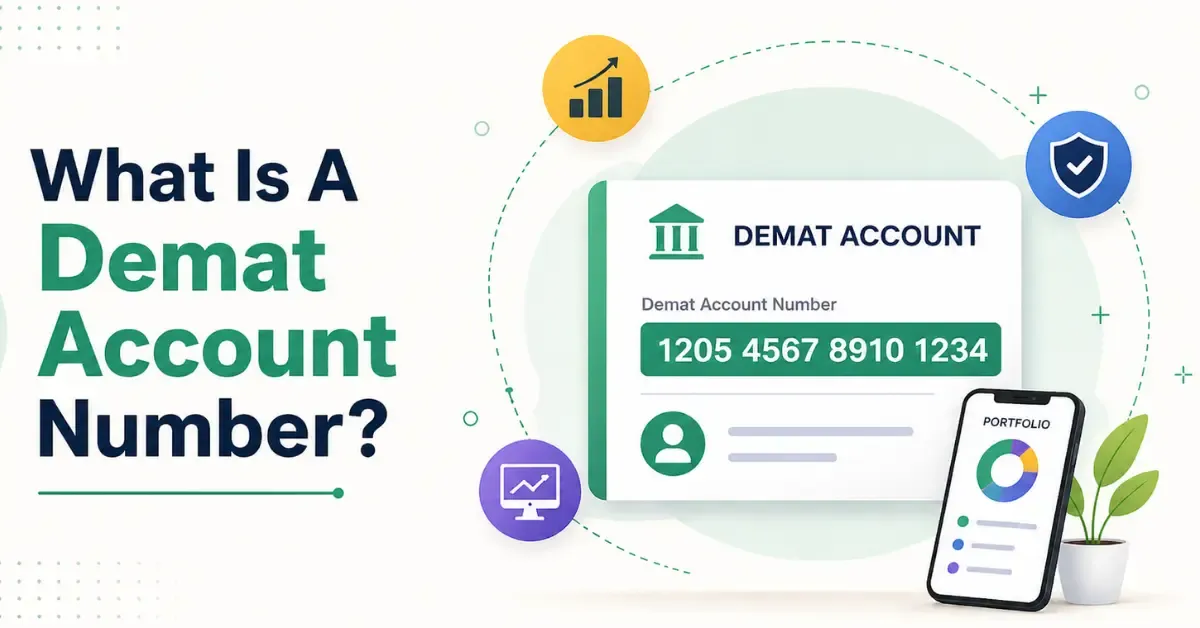
Every time a security is bought or sold in the Indian market, it needs a specific destination to be stored or removed from. Your Demat Account Number is what ensures the security lands in the right place, credited or debited against your specific account rather than someone else's.
What Is A Demat Account Number?
When you open a Demat account, you are given a unique Demat account number. It is a 16-character identifier code that holds all your investments together and works like a bank account number, but for securities. Shares, bonds, mutual funds, and other assets all sit under that one number, stored electronically for ease of access and safety.
Demat Account Number Meaning In Simple Terms
Picture a digital locker. The stock exchange is where the buying and selling happen, but your Demat account is the locker where everything you have bought actually lives. The account number is the locker's unique ID.
Without it, you are effectively locked out of the modern market. It is required for electronic trading, ensuring dividends land in your account, and receiving bonus shares. This number becomes the primary entry point for any transaction involving your securities.
Format Of A Demat Account Number
The format of the number is not universal. It depends on which central depository your broker is registered with either CDSL or NSDL.
CDSL (Central Depository Services Ltd)
The ID is a 16-digit numeric number (e.g., 1234567890123456).
-
DP ID: The first 8 digits identify your broker.
-
Client ID: The last 8 digits identify you as the individual investor.
NSDL (National Securities Depository Ltd)
The ID is alphanumeric.
-
It starts with "IN" and has 14 numbers after that, like IN12345678901234.
-
DP ID: The "IN" and the first 6 digits identify the broker.
-
Client ID: The last 8 numbers are your unique client ID.
Difference Between Demat Account Number And DP ID
These two terms generally confuse investors, but they serve different purposes.
DP ID: It is an 8-digit (CDSL) or 6-digit (NSDL) code that identifies your broker or financial institution.
Demat Account Number: It is the full 16-character ID that identifies you as the account holder. It includes both your DP ID and your unique Client ID.
Why Is A Demat Account Number Important?
This number works as a precise identifier in a market with millions of active investors. Every account is distinct. Your holdings, transaction history, and corporate benefits like dividends or split shares all sit under that one ID.
It is also required for several critical processes:
-
IPO Applications: A Demat account is essential to apply for Initial Public Offers of companies. This is where your shares are credited.
-
Off-Market Transfers: Moving shares outside the exchange requires both party IDs.
-
Share Pledging: Using your shares as collateral for loans.
-
Security: It acts as a gatekeeper. No securities can be moved or accessed unless the action is authorised and tied to your specific ID.
How To Use A Demat Account Number
The most common situation is applying for an IPO. You must provide the number so that any allotted shares are credited to the correct account rather than being left unassigned.
You will also need it when updating your account details with your DP, such as a new mobile number, email address, or a revised bank link. Furthermore, if you decide to shift your portfolio from one broker to another, the transfer process requires both your existing and receiving Demat Account Numbers to be confirmed before the assets can be moved.
Conclusion
A Demat account number is what helps the securities infrastructure recognise you. The Demat account is where your shares are stored. You will need this number for a variety of purposes, especially when applying for IPOs. The structure of your Demat account number will depend on whether you are registered with CDSL or NSDL. Be sure to write this number down so you can find it later.
Sources:
Kotak Neo
NSDL
FAQs
A Demat account number consists of 16 characters. For CDSL, it is 16 digits; for NSDL, it is "IN" followed by 14 digits.
You can use your PAN to log in to the depository participant or the NSDL/CDSL Consolidated Account Statement (CAS) portal to retrieve it. For security reasons, you cannot find your number directly via a public PAN search.
Yes, for accounts held with CDSL, the 16-digit Demat account number is officially referred to as the Beneficiary Owner ID or BO ID.
The content in this blog is intended purely for educational purposes. Any securities or mutual funds referenced are illustrative in nature and do not constitute a recommendation or endorsement by Kotak Neo. Investors are encouraged to assess their own financial situation and seek professional advice before making any investment decisions. For compliance T&C and disclaimers, Visit https://www.kotakneo.com/disclaimer/
0 people liked this article.

Kotak Neo (Kotak Neo) is India's venerable stockbroking company with a rich legacy. It offers comprehensive investment services across asset classes, prioritising a technology-first approach for a seamless experience. Trusted by 5 million+ customers, it guides you toward financial success with ease of investment and speed of trade.
Note: The opinions expressed in this blog are personal viewpoints and should not be construed as recommendations.