Behind 95% of India’s Trade: The Maritime Industry
- Updated: 12 Jun 2026, 3:04 PM IST
- | 5 min read
- 1,064
 Add Preferred News Source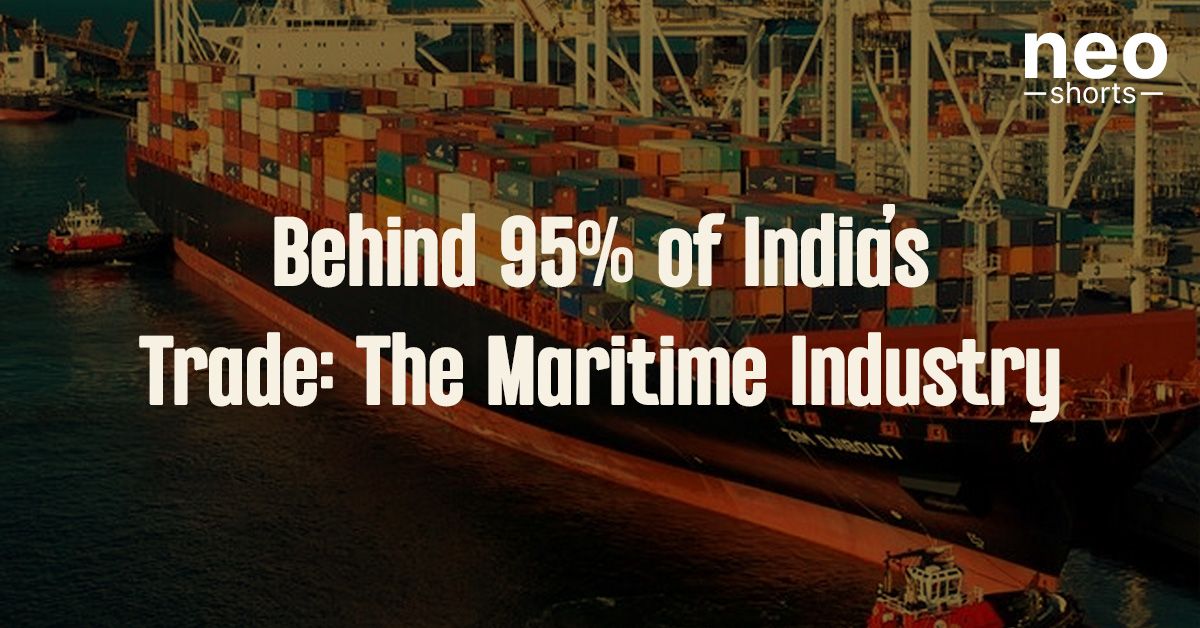
India’s economy depends heavily on trade.
From crude oil to textiles, maritime networks facilitate the movement of goods across the country and around the world.
This dependence is clearly reflected in the numbers.

Around 95% of India’s trade by volume and 70% by value moves through maritime routes.
As trade volumes continue to rise, companies across the ports, shipping, logistics, and shipbuilding segments could benefit from the sector’s expansion.
The reason is that the maritime sector supports an entire ecosystem that keeps trade moving.
The value chain begins with shipbuilding, where vessels are designed and constructed.
These ships transport cargo through domestic and international waters, then reach ports where goods are loaded, unloaded, and processed.
Logistics operators and shipping companies then ensure products reach their final destinations.
Together, these segments form the backbone of India’s maritime ecosystem.
India also enjoys several natural advantages that support maritime growth.
The country has an 11,099-kilometre coastline, around 14,500 kilometres of potentially navigable waterways, 12 major ports, more than 200 non-major ports, and 111 national waterways.
This extensive network provides a strong foundation for handling rising trade volumes and improving logistics efficiency.
The growth of India’s maritime sector over the past decade has been significant.
One of the clearest indicators of this growth can be seen in port infrastructure.
India’s cargo handling capacity increased from 1,400 million tonnes per annum (MTPA) in FY14 to 2,771 MTPA in FY26.
At the same time, total cargo handled across Indian ports increased from 1,052 million metric tonnes (MMT) in FY15 to 1,668 MMT in FY26.
Major ports have also benefited from this growth.
The cargo handled by major ports increased from 606 MMT in FY16 to 915 MMT in FY26.
Deendayal Port accounted for the largest share of cargo handled in FY26 at 17.5%, followed by Paradip Port at 17.1%.
The composition of cargo handled at ports provides further insight into India’s trade activity.
Petroleum and crude products accounted for 29.8% of cargo traffic in FY26, making them the largest category.
Growth has not been limited to ports.
India’s fleet of Indian-flagged vessels increased from 1,204 ships in 2015 to 1,592 ships in 2025.
At the same time, coastal cargo handled through major ports increased from 119.5 MMT in FY15 to 213.5 MMT in FY26.
Another major growth driver has been inland waterways.
Cargo transported through national waterways increased from 18.1 MMT in FY14 to 218.2 MMT in FY26.
The sharp rise highlights the increasing use of waterways as an alternative logistics route for bulk cargo movement.
A key contributor to the sector’s development has been the Sagarmala Programme.
Launched in 2015, the initiative focuses on modernising ports, improving connectivity, reducing logistics costs, boosting coastal shipping, and attracting investments.
The scale of the programme has been substantial.
As of March 2026, a total of 845 projects worth ₹6.06 lakh crore had been identified under Sagarmala.
Of these, 315 projects had been completed, 210 were under implementation, and 320 were under planning.
Government support for the maritime sector extends beyond Sagarmala.
Under Maritime India Vision 2030, more than 150 initiatives have been identified across ports, shipping, and inland waterways.
The roadmap estimates an investment opportunity of approximately ₹3-3.5 lakh crore.
Several additional measures have also been announced to strengthen the sector, including the Maritime Development Fund, the Shipbuilding Financial Assistance
Scheme, the Shipbuilding Development Scheme, and the Indian Ship Technology Centre.
Looking further ahead, Maritime Amrit Kaal Vision 2047 outlines an even more ambitious roadmap.
The vision includes an investment push of around ₹80 lakh crore aimed at transforming India into a global maritime powerhouse.
Key targets include becoming one of the world’s top five shipbuilding nations, creating a 4 million GRT shipbuilding capacity, and increasing annual port handling capacity to 10 billion metric tonnes.
As these projects progress, companies across the maritime ecosystem could stand to benefit.
These include listed firms operating in ports, shipping, logistics, and shipbuilding.
Mazagon Dock Shipbuilders and Cochin Shipyard are among the leading shipbuilding companies.
Adani Ports and JSW Infrastructure are major players in the ports segment.
Container Corporation of India and Allcargo Logistics operate in cargo handling and logistics, while Great Eastern Shipping Company and Shipping Corporation of India represent the shipping segment.
Looking ahead, India’s maritime sector still appears to have significant room for expansion despite a decade of growth.
Government initiatives, rising trade volumes, expanding infrastructure, and growing logistics requirements continue to support the industry’s long-term growth prospects.
As India strengthens its position in global trade, the maritime ecosystem could play an increasingly important role in the country’s economic development.
Sources:
The content in this blog is intended purely for educational purposes. Any securities or mutual funds referenced are illustrative in nature and do not constitute a recommendation or endorsement by Kotak Neo. Investors are encouraged to assess their own financial situation and seek professional advice before making any investment decisions. For compliance T&C and disclaimers, Visit https://www.kotakneo.com/disclaimer
0 people liked this article.

Kotak Neo (Kotak Neo) is India's venerable stockbroking company with a rich legacy. It offers comprehensive investment services across asset classes, prioritising a technology-first approach for a seamless experience. Trusted by 5 million+ customers, it guides you toward financial success with ease of investment and speed of trade.
Note: The opinions expressed in this blog are personal viewpoints and should not be construed as recommendations.