The $17 Billion Cable Market Powering India’s Infra Push
- Posted: 29 May 2026, 6:51 PM IST
- | 5 min read
- 1,001
 Add Preferred News Source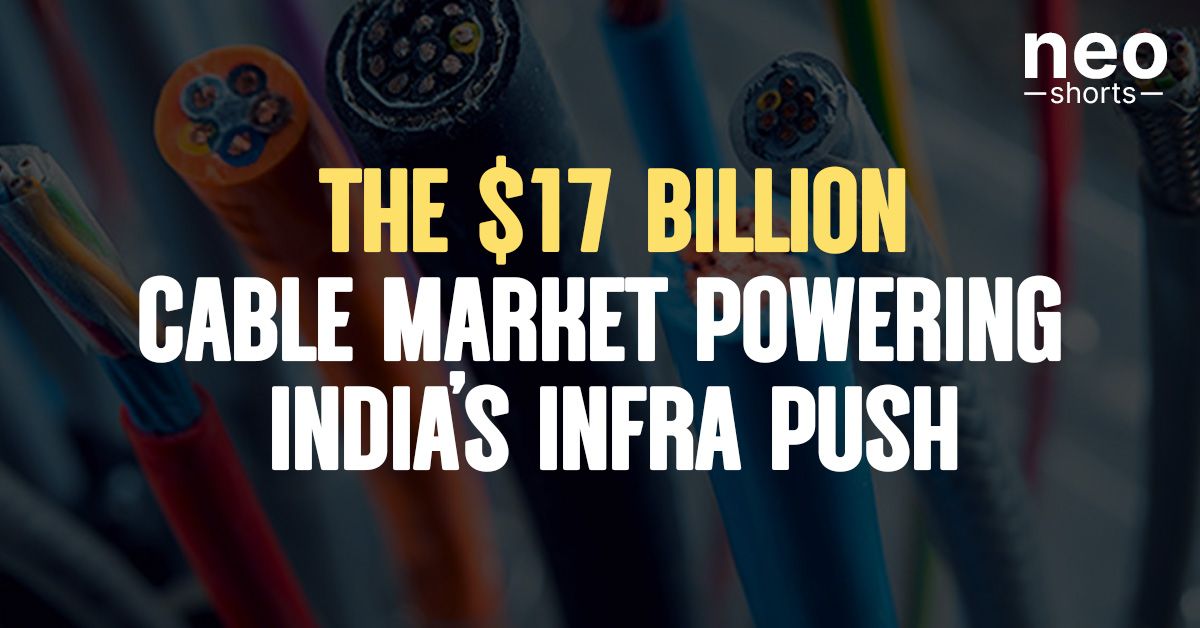
Every major buildout needs one basic layer of infrastructure.
Wires and cables.
Whether India is building roads, metros, factories, power plants, solar parks, data centres, telecom towers, homes, or smart cities, electricity and connectivity must flow through physical networks.
That is why the wires and cables industry is becoming an important part of India’s infrastructure story.

India’s GDP growth is pegged at 7.6% for FY2025-26.
This growth is being supported by a record capex budget of ₹11.21 lakh crore.
Around 0.5% to 2% of every rupee from this capex budget goes into wires and cables.
That translates to an opportunity of nearly ₹5,605 crore to ₹22,420 crore.
The market size also reflects this growth.
India’s wires and cables market stood at $8.71 billion in 2023.
It increased to $9.32 billion in 2024 and was estimated at $10.01 billion in 2025. By 2032, the market is expected to reach $17.08 billion.
That means the market could nearly double between 2023 and 2032, growing at an expected CAGR of 7.94%.
This demand is coming from multiple sectors.
The power sector is a key driver as India expands generation, transmission, and distribution capacity.
Infrastructure and urbanisation are also important factors.
Every new road, metro, factory, housing project, and smart city needs wiring and electrical systems.
Renewable energy is another big driver. Solar and wind projects need special cables to move power from project sites to the grid.
Digitalisation and 5G are also adding demand. Data centres, telecom towers, and digital networks depend on optical fibre and communication cables.
Exports are another growth area, with rising orders from West Asia and Africa.
Together, these drivers make wires and cables a common link across India’s power, infrastructure, real estate, renewable, and digital buildout.
The structure of the market is also changing.
In 2018, organised players had a 45% market share, while unorganised players held 55%.
By 2025, organised players had captured 78% of the market, while the unorganised share had reduced to 22%.
In 2026, the organised share is estimated to rise further to more than 85%, while the unorganised share may fall below 15%.
This shift shows that the industry is becoming more organised. Demand is moving towards safer, branded, and better-quality cables.
Based on FY24 organised market revenue of ₹820 billion, housing wires contributed 30% of revenue.
Power cables, including LT, HT, and EHV cables, contributed 27%.
Flexible and speciality cables contributed 22%.
Control and instrumentation cables contributed 15%, while communication cables contributed 6%.
This shows that the market is not dependent on only one product category, but it is spread across housing, power, industrial, communication, and specialised applications.
Among organised players, Polycab is the clear leader.
Polycab led the organised wires and cables market in FY25, with an estimated share of 26% to 27%.
KEI Industries followed with a 10% to 11% share, while RR Kabel and Finolex Cables stood at 8% to 9% and 6% to 7%, respectively.
Other organised players together made up the remaining 47% to 50% of the market.
The financial numbers also show Polycab’s scale.
Polycab India reported revenue of ₹28,884 crore and net profit of ₹2,708 crore in FY26.
Havells India reported revenue of ₹22,528 crore and net profit of ₹1,689 crore.
KEI Industries reported revenue of ₹11,748 crore and net profit of ₹918 crore, whereas RR Kabel reported revenue of ₹9,722 crore and net profit of ₹492 crore.
But this opportunity also comes with some risks.
Copper and aluminium price volatility is a key risk because raw material costs can pressure margins.
The industry is also competitive, with many listed and unlisted players operating in the market.
A real estate slowdown can affect demand for housing wires, while delays in infrastructure projects can slow cable order execution.
Valuation risk also matters because strong growth themes often trade at premium valuations.
So the long-term opportunity is large, but investors still need to track costs, competition, execution, real estate demand, and valuations.
The larger picture is clear.
Wires and cables connect India’s growth themes. Power, housing, renewables, telecom, railways, and manufacturing all depend on them.
As these sectors expand, cable demand moves with them.
That makes wires and cables a core layer of India’s infrastructure story.
Sources:
The content in this blog is intended purely for educational purposes. Any securities or mutual funds referenced are illustrative in nature and do not constitute a recommendation or endorsement by Kotak Neo. Investors are encouraged to assess their own financial situation and seek professional advice before making any investment decisions. For compliance T&C and disclaimers, visit www.kotakneo.com/disclaimer
0 people liked this article.

Kotak Neo (Kotak Neo) is India's venerable stockbroking company with a rich legacy. It offers comprehensive investment services across asset classes, prioritising a technology-first approach for a seamless experience. Trusted by 5 million+ customers, it guides you toward financial success with ease of investment and speed of trade.
Note: The opinions expressed in this blog are personal viewpoints and should not be construed as recommendations.