Bond Credit Rating: Meaning, Types & How Ratings Are Decided
- Updated: 29 May 2026, 5:17 PM IST
- | 5m
- 1,611
 Add Preferred News Source
When people invest in bonds, the first question they ask is, “How safe are they?” This is where the bond credit rating will help them. Bond credit rating gives you an overall idea about how reliable the borrower is.
So, what is bond credit rating? It is a grade given to a bond after checking the issuer’s ability to repay interest and principal. This makes comparison easier, especially when looking at bond rates in India.
What Is A Bond Credit Rating?
A bond credit rating is like a report card for a bond. It tells you how strong or weak the borrower looks from a repayment point of view.
These ratings are issued by bond credit rating agencies. In India, a few popular credit agencies are Credit Rating Information Services of India Limited (CRISIL), Investment Information and Credit Rating Agency (ICRA), and Credit Analysis and Research Limited (CARE). They study the company or issuer before giving a score.
So when you see a bond rating in India, it is not random. It reflects how likely the issuer is to pay back on time.
Bond Credit Rating Scale (AAA to D Chart)
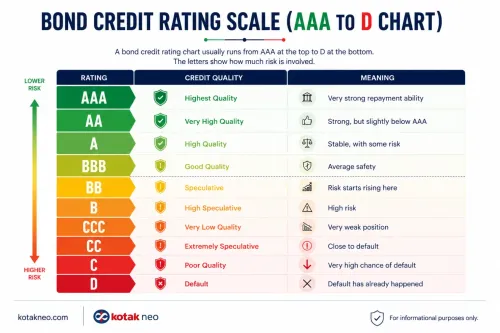
A bond credit rating chart usually runs from AAA at the top to D at the bottom. The letters show how much risk is involved.
Bond Credit Rating Scale (AAA to D Chart)
A bond credit rating chart usually runs from AAA at the top to D at the bottom. The letters show how much risk is involved.
AAA | Very strong repayment ability |
AA | Strong, but slightly below AAA |
A | Stable, with some risk |
BBB | Average safety |
BB | Risk starts rising here |
B | High risk |
CCC | Very weak position |
CC | Close to default |
C | Very high chance of defaulting |
D | Has already defaulted |
This bond ratings chart helps investors read risk without going into too much detail.
Types Of Bond Ratings
Investment Grade Bonds (AAA–BBB)
These bonds fall in the safer zone. Ratings from AAA to BBB come under this group.
Many investors prefer them because the risk is lower. The returns may not be very high, but the chances of default are also limited.
Speculative Grade Bonds (BB & Below)
These bonds are riskier. Ratings below BBB fall into this category.
They often offer higher returns to attract investors. But there is a clear trade-off. The risk of missing payments is higher.
How Do Agencies Rate Bonds?
The process of rating bonds is not based on guesswork. Agencies go through company reports, earnings, and debt levels.
They also look at how steady the cash flow is. A company with regular income stands a better chance of getting a higher rating.
Meetings with management and industry checks are also part of the process. After this review, a rating is assigned.
These ratings do not stay fixed. They can change if the company’s situation changes.
Factors Influencing Bond Ratings
Many things affect the credit rating of bonds in India. A few key ones are listed below.
-
Income stability: Regular earnings support a better rating.
-
Debt burden: Too much borrowing can pull ratings down.
-
Industry type: Some sectors are more stable than others.
-
Track record: Past repayment behaviour matters a lot.
-
Economic conditions: Slowdowns can affect even strong companies.
All these together decide where a bond fits on the bond credit rating chart.
How To Use Bond Ratings In Your Investment Strategy?
Ratings can act as a first filter. They help you sort bonds based on risk.
If you prefer capital safety, you may look at AAA or AA-rated options. If you are okay with some risk, you might explore lower ratings.
Some investors also mix different types. This spreads risk across the portfolio.
While checking bond rates in India, it is useful to see the rating alongside the return. A high return with a low rating often means higher risk.
Why Are Bond Ratings Important?
Bond ratings save time. Instead of studying every company in detail, you get a quick sense of risk. They also help bring some discipline to the market. Investors and lenders use them as a reference point.
For companies, a good rating can reduce borrowing costs. It makes it easier for them to raise funds.
In short, bond credit ratings help both sides make better choices.
Conclusion
A bond credit rating gives a clear snapshot of risk. It does not remove risk, but it helps you see it better. Higher-rated bonds offer more comfort. Whereas lower-rated ones may offer higher returns with added uncertainty.
Before investing, it helps to check the rating, compare options, and match them with your own risk level.
Source:
Bondbazaar
FAQs On Bond Credit Rating
Agencies study financial data, debt levels, repayment history, industry and future outlook to decide bond credit ratings.
Ratings may move up or down if the company’s finances change. Economic or sector-related shifts can also affect these ratings.
They are safer, but returns are usually lower. Some investors accept lower ratings to earn higher returns.
Ratings like AAA, AA, and A are considered good as they indicate lower chances of defaulting.
Yes, many investors rely on them. Ratings help match risk with investment goals and make comparisons easier.
The content in this blog is intended purely for educational purposes. Any securities or mutual funds referenced are illustrative in nature and do not constitute a recommendation or endorsement by Kotak Neo. Investors are encouraged to assess their own financial situation and seek professional advice before making any investment decisions. For compliance T&C and disclaimers, visit https://www.kotakneo.com/disclaimer/
0 people liked this article.