What Does A High Current Account Deficit Mean To Investors?
- Updated: 22 May 2026, 5:10 PM IST
- | 4m
- 1,281
 Add Preferred News Source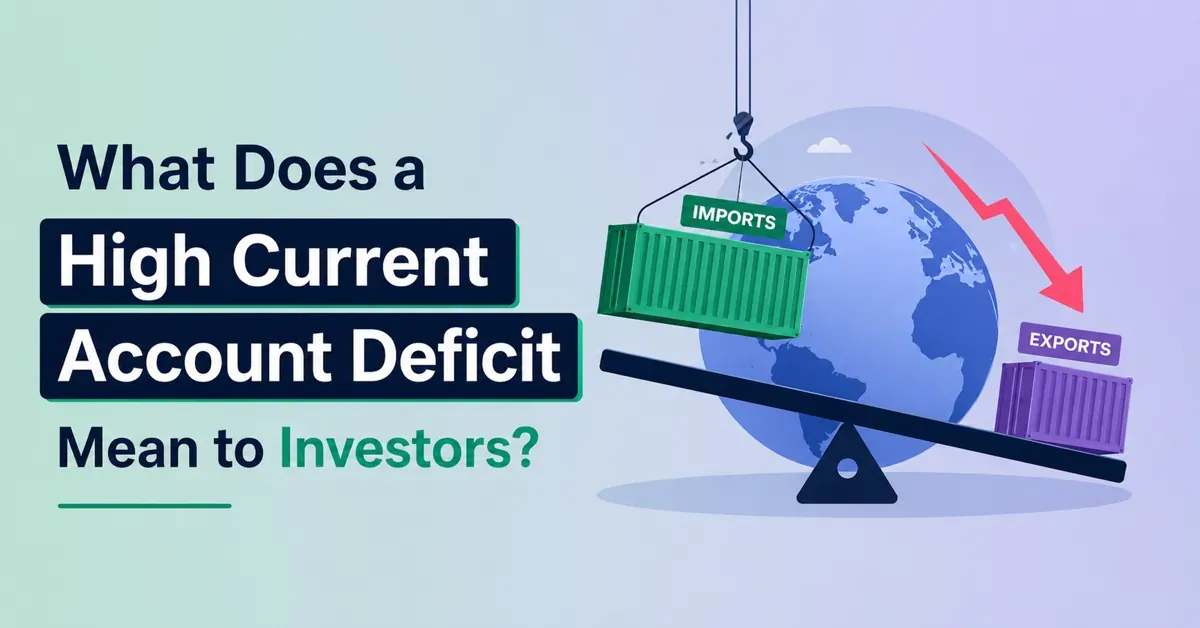
When oil prices spike or foreign investors turn cautious, the Current Account Deficit (CAD) tends to pop up in the news. It represents the fundamental gap between a country’s imports and exports. Global events always have an impact, but when it comes to the Reserve Bank of India’s decisions about interest rates and keeping the rupee strong, this factor really drives the process. A nuanced investor looks for the driving force behind the deficit, whether it is due to an unsustainable import bill or domestic expansion.
What Is CAD (Current Account Deficit)
The Current Account Deficit, or CAD, is basically the difference between what India brings in from the outside world and what it sends out.
It boils down to three things:
-
Goods trade, such as oil, gold, and electronics
-
Services, mainly exports like software
-
Money flows, including investments and remittances
When the outflow is higher than the inflow, the country runs a deficit.
In India, this gap often widens for a simple reason. The country imports a large share of what it consumes in energy and a substantial portion of high-value electronics. Earnings do come in through IT services and remittances, but they do not always keep pace when import costs jump.
In the April-December 2025 period, India’s CAD stood at $30.1 billion, or 1% of the GDP.
Reasons Behind A High Current Account Deficit
A higher deficit is usually not triggered by one event. It builds when a few pressures overlap.
Higher imports than exports
When demand within the country picks up, imports rise with it. Businesses buy more machinery, consumers spend more on goods, and the import bill expands.
Increased oil and commodity prices
India imports nearly 90% of its total crude requirement. Even a small rise in global prices tends to show up quickly in the total numbers.
Investment outflows or lower foreign inflows
Foreign funds can flow out as rapidly as they were invested. At the same time, investment inflows could slow down. During the April-December 2025 period, Foreign Portfolio Investments (FPIs) recorded a net outflow of $4.3 billion, as compared to net inflows of $9.4 billion during the same period in 2024.
Macroeconomic factors like fiscal deficit and currency depreciation
Depreciation of the national currency makes imports expensive. Besides, the government's spending patterns might also determine the reliance on imports.
Impact Of A High CAD On Investors
The impact of a high CAD works via currency, prices and decisions of the country's authorities.
Currency Depreciation
Higher deficits translate into an increased need for foreign currency, which puts additional pressure on the rupee. The rupee depreciated 5% in 2025 against the dollar.
For companies that depend on imported inputs, this shows up as higher costs. Exporters see the opposite effect, as their earnings convert into more rupees.
Stock Market Volatility
International players who invest in Indian equities are keenly watching the country's macroeconomic indicators. An increasing CAD is likely to make them cautious, and this translates into market fluctuation.
The reaction is not uniform. Oil-linked sectors may come under pressure, while export-driven businesses tend to be more stable in comparison.
Inflation Concerns
Higher import costs rarely stay contained. They move through the system.
Increasing imports would eventually result in higher prices. First, the cost of fuels increases, then transportation costs rise, and finally, the Consumer Price Index (CPI) is affected.
Interest Rates
To manage inflation and currency pressure, the Reserve Bank of India may hold rates higher than what markets initially expect.
That has a knock-on effect. Borrowing becomes pricier, and some spending decisions get delayed.
How Investors Should React To A High CAD
An investor should not make a sudden decision based on an increasing CAD. This should only be a parameter in his/her decision-making process.
Diversify Portfolios
A diversified portfolio makes you less vulnerable to any change in the economy.
Focus On Export-Oriented Sectors
Export-based industries generate foreign currencies. Hence, they perform well during currency depreciation. Information Technology (IT) services and pharmaceutical products are classic examples.
Consider Hedging Strategies
Currency movements can affect returns, especially for those with global exposure. Some investors use hedging to manage that risk.
Monitor Macroeconomic Indicators
The deficit rarely moves alone. It sits alongside inflation, interest rates, and commodity prices. Looking at them together gives a clearer sense of direction.
Conclusion
A high current account deficit reflects how domestic demand, global prices, and capital flows are interacting at a given point. In India, oil imports and foreign investment trends usually play the biggest role.
For investors, the number becomes useful only when placed in context. Currency direction, inflation, and sector-level impact often provide better signals. The more relevant question is whether the underlying pressures are easing or continuing.
Sources
News On Air
The Print
Investopedia
FAQs
Because it indicates that on the global scale, the country is consuming more than it is producing, therefore requiring foreign investments to prop up the economy.
A high CAD requires foreign inflows to keep the market stable. However, at the first sign of global unrest, these funds are withdrawn, leading to volatility in the domestic market.
Yes, increased demand for foreign currency tends to depreciate the value of the rupee.
By diversifying investments, focusing on export-oriented sectors, and tracking broader economic indicators.
It is calculated as total imports and outflows minus total exports and inflows.
Here’s the current account deficit formula:
Current Account = (X - M) + NY + NCT
Where,
X = Export of goods and services
M = Import of goods and services
NY = Net income abroad (interest, dividends, salaries)
NCT = Net current transfers (remittances, gifts, foreign aid)
The content in this blog is intended purely for educational purposes. Any securities or mutual funds referenced are illustrative in nature and do not constitute a recommendation or endorsement by Kotak Neo. Investors are encouraged to assess their own financial situation and seek professional advice before making any investment decisions. For compliance T&C and disclaimers, Visit https://www.kotakneo.com/disclaimer/
0 people liked this article.