India Opens Tactical Missile Production To Private Firms, Ending BDL's Monopoly
 Add Preferred News Source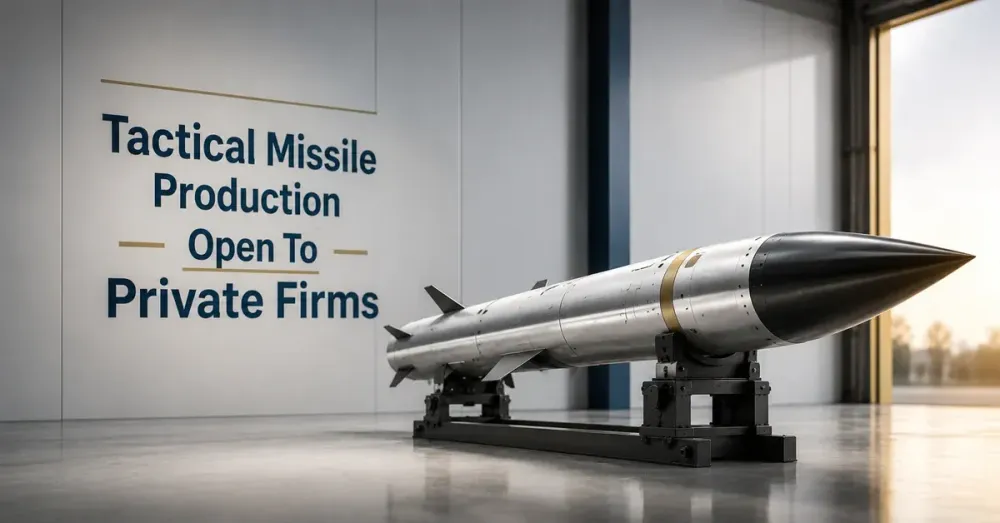
India's Ministry of Defence has ended Bharat Dynamics Limited's monopoly on tactical missile production, opening the sector to private defence firms under the proposed Defence Acquisition Procedure 2026. Read ahead to know more.
India's Ministry of Defence has ended the production monopoly held by state-owned Bharat Dynamics Limited (BDL) in the tactical missile segment, opening the space to private defence companies.
Around 10 to 12 tactical missile development programs run by the Defence Research and Development Organisation (DRDO) have been distributed among both public and private entities based on their technical capabilities, moving away from the earlier practice of routing almost everything through BDL.
The move is aligned with the proposed Defence Acquisition Procedure 2026 and follows a similar decision to end Hindustan Aeronautics Limited's monopoly in aerospace manufacturing.
Who Has Been Brought In
At least four private defence firms have been designated as Development-cum-Production Partners. These are Adani Defence and Aerospace, Bharat Forge, ICOMM, and Solar Defence and Aerospace Limited. Each has been tasked with completing assigned DRDO missile programmes within a three to five year window.
Under the Development-cum-Production Partner model, DRDO and a selected industry partner work together to co-develop a functional system or prototype, covering design finalisation, field trials and technical evaluations. Final production orders from the armed forces follow once this process is complete.
Public sector companies are not being sidelined. BDL and Bharat Electronics Limited (BEL) have also been contracted for the same missile projects. In some cases BDL is working alongside private firms, reflecting a hybrid approach rather than a straight replacement of state entities.
Which Programs Are Involved
Several missile categories are part of the private sector push. These include the Naval Anti-Ship Missile Short Range, India's first indigenous helicopter-launched anti-ship weapon; the Rudram series of supersonic and hypersonic air-to-surface and anti-radiation missiles; the Very Short-Range Air Defence System, a fourth-generation man-portable air defence system; the Long-Range Glide Bomb, a 1,000 kg class air-to-ground smart weapon; and the UAV-Launched Precision Guided Missile Version 3.
The Pralay missile, which completed user evaluation trials in December 2025 demonstrating precision strike capability across ranges of 150 to 500 kilometres, is being jointly produced by BDL and BEL.
Why This Is Happening Now
Tactical missiles have gained renewed strategic importance globally, with the ongoing US-Israel-Iran war shining a spotlight on their role in modern warfare. Indian armed forces, which previously leaned on imports for such systems, are now pushing for home-grown solutions to protect operational independence.
Also Read - OPEC+ Lifts Quotas For Fourth Month Running Despite Gulf Production Collapse
The reform also sets the stage for a broader shift. The Ministry of Defence is considering extending private sector participation to ballistic missile manufacturing as well. Defence Secretary Rajesh Kumar Singh said at an industry event last month that the time has come to open ballistic missile production to private companies.
Sources:
Republic World
Businessline
This article is for informational purposes only and should not be considered investment advice from Kotak Neo. For compliance T&C and disclaimers, Visit www.kotakneo.com/disclaimer
Right Tools, Rich Insights