












































1,035 Views| 24 Oct 2026
IPO - Initial Public Offerings 2026
The financial markets are on the move, Invest in companies listing on the Indian exchanges with an IPO.
Current IPOs (1)
Current IPOsName | Bidding Dates | Price Range | Lot Size | Investment/Lot | IPO Size | Apply |
|---|---|---|---|---|---|---|
 Core4 Engineers IPO SMESubscribed 0.05x | 23 Oct'26 - 27 Oct'26 | ₹88 - ₹93 | 1200 | ₹1,11,600 | ₹55 Cr |
Showing 1–1 of 1 companies
Upcoming IPOs (638)
Upcoming IPOsName | Bidding Dates | Price Range | IPO Size | Document | Pre Apply |
|---|---|---|---|---|---|
 Bombay Coated and Special Steels IPO Mainboard | 29 Oct'26 - 02 Nov'26 | ₹78 - ₹82 | ₹183 Cr | -- | |
28 Oct'26 - 30 Oct'26 | ₹76 - ₹80 | ₹28 Cr | -- | ||
 M.K. Sons Fine Jewels IPO Mainboard | 28 Oct'26 - 30 Oct'26 | ₹153 - ₹162 | ₹275 Cr | -- | |
 SFC Environmental Technologies IPO Mainboard | 27 Oct'26 - 29 Oct'26 | ₹313 - ₹330 | ₹668 Cr | -- | |
 BLS Polymers IPO Mainboard | 27 Oct'26 - 29 Oct'26 | ₹142 - ₹150 | ₹255 Cr | -- | |
27 Oct'26 - 29 Oct'26 | ₹194 - ₹204 | ₹110 Cr | -- | ||
 EAAA India Alternatives IPO Mainboard | 26 Oct'26 - 28 Oct'26 | ₹1585 - ₹1665 | ₹1200 Cr | -- | |
 Indian Gas Exchange IPO Mainboard | To be announced | -- | ₹TBA Cr | -- |
Showing 1–8 of 638 companies
Closed IPOs (4)
Closed IPOsName | Listing Date | Price Range | IPO Size | Subscribed Times | Allotment Status |
|---|---|---|---|---|---|
 Jio IPO Mainboard | 28 Oct'26 | ₹1065 - ₹1119 | ₹30213 Cr | 15.04x | |
 Paras Healthcare IPO Mainboard | 28 Oct'26 | ₹660 - ₹693 | ₹1450 Cr | 2.22x | |
 NSE IPO Mainboard | 24 Sep'26 | ₹1700 - ₹1785 | ₹22,562 Cr | 5.7x | |
 Jindal Supreme (India) IPO Mainboard | 23 Sep'26 | ₹88 - ₹93 | ₹125 Cr | 177.92x |
Showing 1–4 of 4 companies
Recently Listed IPOs (797)
Recently Listed IPOsName | Listed On | Listed Price | Issue Price | Premium | Invest |
|---|---|---|---|---|---|
 Zetwerk Manufacturing Businesses IPO Mainboard | 23 Oct'26 | ₹159.00 | ₹151 | +5.30% | |
 Sahajanand Medical Technologies IPO Mainboard | 23 Oct'26 | ₹368.05 | ₹344 | +6.99% | |
 Bonfiglioli Transmissions IPO Mainboard | 23 Oct'26 | ₹586.00 | ₹586 | -- | |
 Tonbo Imaging India IPO Mainboard | 23 Oct'26 | ₹1,162.00 | ₹700 | +66.00% | |
 Shellz India IPO SME | 23 Oct'26 | ₹179.00 | ₹179 | -- | |
 Fusion CX IPO Mainboard | 22 Oct'26 | ₹292.00 | ₹289 | +1.04% | |
21 Oct'26 | ₹112.00 | ₹112 | -- | ||
 HD Fire Protect IPO Mainboard | 21 Oct'26 | ₹334.40 | ₹271 | +23.39% |
Showing 1–8 of 797 companies
About IPO
Initial Public Offering (IPO) is the process where private companies sell their shares to the public. The IPO process is done to raise equity capital from the public investor. A private company becomes a public company through the IPO process. IPO in India creates an opportunity for small investors to earn potential returns on their investments.
Investing in an IPO can be a wise move only if you are a well-informed investor. As an investor, you should know that not every new IPO is a great opportunity. Benefits and risks go hand-in-hand in investing. Before you invest in an IPO, it is important to understand the IPO details.
What is an Initial Public Offering (IPO)?
In an Initial Public Offering, a private company or corporation sells a portion of its stake to an investor in order to become public. The purpose of an IPO is to infuse new equity capital into the firm, facilitate easy trading of existing assets, raise future capital or monetize stakeholder investments.
A prospectus describing the first sale of shares is available to institutional investors, high net worth individuals, and the public. A prospectus describes the upcoming IPO details. Once the IPO has been completed, the firm’s shares will be listed on the open market. A minimum free float is imposed on the shares by the stock exchange, both in absolute amount and as a percentage of the total share capital.
How Does an IPO Work?
When a company decides to sell its shares on a stock exchange, it begins the IPO process. After that, an audit must be conducted, taking into account all aspects of the company’s financials. If everything is in order, the company has to prepare a registration statement and file it with SEBI (Securities and Exchange Board of India).
Following that, the stock exchange that the company wants to list on will review the application, and it will either be accepted or rejected. For IPO listing, the underwriter helps the company on how many shares to issue and at what price if it is approved. Underwriters are usually banks, and their job is to start a book building process to find investors to subscribe to the IPO. Shareholders will receive a prospectus containing information about the shares, where they’ll be listed and the potential opening price. As part of the IPO, non-private investors have the opportunity to purchase shares of the company in a primary market. Before, only institutional investors were able to participate fully in IPOs, while retail investors could only participate in the secondary market when shares were exchanged.
Who is Eligible to Apply for an IPO?
As an individual investor, you are required to fulfill basic eligibility criteria to apply for an IPO. They are as follows:
- An investor needs to be an adult (18+years of age)
- According to the laws of the country, investors should be capable of entering into a legal contract.
- Investors are required to have a valid Demat account. If an investor sells their stocks on the listing, they would additionally need a trading account. Thus, it is advisable to open a trading account along with the demat account.
- Any investor who is interested in IPO shares has to mandatorily hold a PAN card issued by the Income Tax department. A PAN card is a necessary proof of document to surpass the IPO eligibility criteria.
Steps to Apply for an IPO Online from Kotak Neo
Kotak Neo offers a simple and quick way to apply for an IPO online. Below are a few steps to apply for an IPO in India:
Step 1: Visit the Kotak Neo website and log into your trading account.
Step 2: After logging in, click on the “invest” option and go to the IPO section.
Step 3: Select the IPO from the list and click the “buy” option. You can also check the IPO calendar.
Step 4: Set the bid price and lot. And place order option.
Step 5: Approve the mandate.
Step 6: In the IPO section, check the IPO status. If it shows “Processed”, it means your IPO application request has been processed successfully.
Related News
- 1,098 Views| 23 Oct 2026
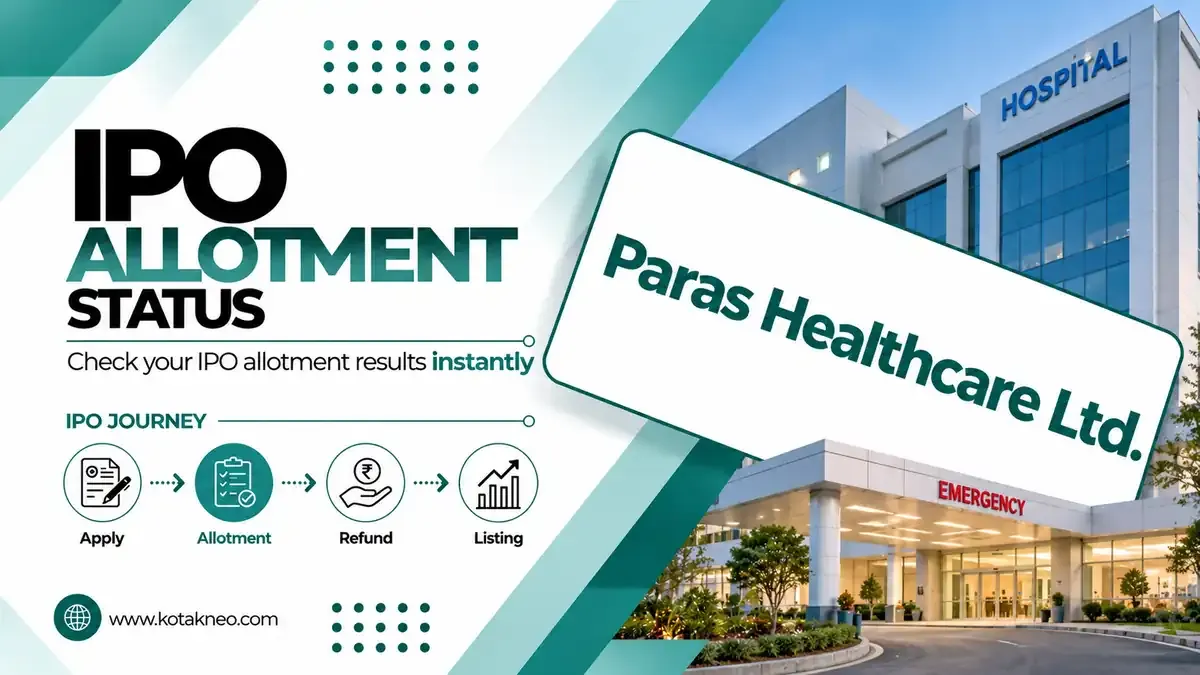
- Paras Healthcare IPO Allotment Status: Check Online on MUFG Intime India, NSE & BSE for Live Updates
 1,085 Views| 23 Oct 2026
- 1,068 Views| 23 Oct 2026
- 1,073 Views| 23 Oct 2026
- 1,016 Views| 23 Oct 2026
- 1,076 Views| 23 Oct 2026
- 1,078 Views| 23 Oct 2026
- 1,072 Views| 23 Oct 2026
- 1,037 Views| 22 Oct 2026







Initial Public Offerings (IPO) FAQs
IPO listing is the process by which IPO shares are admitted to trading on a stock exchange. The shares of the company become available for public trading after they are listed on the stock exchange.
IPO lock-up periods are periods during which some early employees and investors cannot sell their shares after a company goes public. The lock-up period is usually between 90-180 days.
Raising funds is one of the main reasons for launching an IPO. A company may need funds for a variety of reasons, such as financing a new project, repaying a loan, or expanding the business.
You can place a buy order for IPO shares after 10 Am on the listing day. Following the IPO listing, shares can be bought and sold just like regular shares.
Investing in an IPO comes with significant risk due to the lack of historical performance data. In contrast to established public companies, IPOs lack this critical information about financial performance and market behavior.
There are no restrictions on who can apply for an IPO, The only prerequisite related to applying for IPOs is that you should hold a brokerage (Demat) account.
You can apply in IPO online either through ASBA (if you have a bank account with Kotak Neo/Bank) or you can apply through UPI facility.
The IPO issue needs to be open for at least three working days, but not more than ten working days.
The process of applying online for shares in an IPO is very simple:
Step 1: Select the IPO that you want to invest in & click on apply .
Step 2: Verify mobile number , fill the application form and provide your UPI ID
Step 3: Submit the application
Step 4: Approve the block funds request on the UPI app.
Yes, you can apply in IPO through Kotak Neo via UPI even if you don't have an account with us
A private company can go public by selling its stock on a stock exchange through an initial public offering (IPO). In order to raise their shares on the public market, private companies engage investment banks, which requires extensive due diligence, marketing, and regulatory compliance.
Bids are the price at which an investor is willing to buy shares in an initial public offering. You can use either fixed prices or book-built applications in the IPO.