What Is Primary Market? Types, Role & Examples Explained
- Updated: 26 May 2026, 5:20 PM IST
- | 6 min read
- 1,998
 Add Preferred News Source
When a company needs money to grow, it has to raise funds from investors. This is where the primary market comes into the picture. It is the place where new securities are issued for the first time. Investors buy these securities directly from the company, not from other investors.
To understand what the primary market is, it is important to see how companies raise capital and how investors become part of that process. This market plays a key role in connecting businesses with investors who are willing to provide funds.
What Is Primary Market?
The primary market is a segment of the financial market where companies issue new shares or securities to the public for the first time. In this market, investors buy directly from the issuer.
When a company wants to expand, reduce debt, or fund a new project, it can raise money through this route. The funds collected go to the company itself, not to any existing shareholder.
This is different from trading in existing shares. Here, the focus is on fresh issuance. That is why understanding what is primary market is important for anyone looking to invest in new opportunities.
Types Of Primary Market
There are different ways in which companies can raise money in the primary market. These methods form the types of primary market.
Initial Public Offering (IPO)
An IPO is the first time a company offers its shares to the public. It allows the company to get listed on a stock exchange. Investors can subscribe to these shares during the offer period.
This is often used by companies that want to expand their business and gain visibility.
Follow-On Public Offer (FPO)
An FPO is used by companies that are already listed. They issue additional shares to raise more funds.
It helps companies gather extra capital after the initial listing. Investors who missed the IPO may also consider investing at this stage.
Rights Issue
In a rights issue, existing shareholders are given the option to buy additional shares. These shares are usually offered at a lower price.
This method allows companies to raise funds while giving current investors a chance to increase their ownership level.
Private Placement
Private placement involves selling securities to a small group of investors. These may include institutions or high-net-worth individuals.
This method is faster and involves fewer formalities compared to public offers.
Examples Of Primary Market
There are many examples of primary markets in real life. When a company launches an IPO, it becomes part of the primary market. Investors apply for shares during the subscription period.
Similarly, when an existing company announces an FPO or a rights issue, it is again using the primary market to raise funds.
Private placements are also common, especially when companies want to raise money quickly from selected investors.
These examples show how companies use different methods depending on their needs.
Role Of Primary Market
The primary market's function is central to the workings of both companies and investors. It essentially facilitates the connection between individuals or entities requiring financial resources and those who are willing to invest.
For businesses, it opens a door to a source of funding. This funding might help them to grow, start new projects, or even clean up the balance sheet. From an investor's perspective, it is a chance to put their money in at the beginning level.
The primary market also supports economic growth. When companies raise funds and expand, it creates jobs and drives business activity.
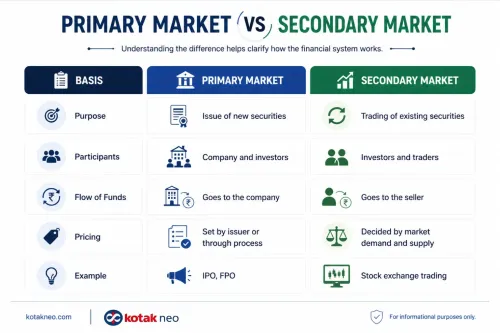
Primary Market Vs Secondary Market
Understanding primary market vs secondary market helps clarify how the financial system works.
Basis | Primary Market | Secondary Market |
|---|---|---|
Purpose | Issue of new securities | Trading of existing securities |
Participants | Company and investors | Investors and traders |
Flow of Funds | Goes to the company | Goes to the seller |
Pricing | Set by issuer or through process | Decided by market demand and supply |
Example | IPO, FPO | Stock exchange trading |
This comparison shows that both markets serve different but connected functions.
Primary Market And Secondary Market Connection
The primary market and secondary market are closely linked. Once shares are issued in the primary market, they are listed on stock exchanges.
After listing, these shares can be bought and sold in the secondary market. This provides liquidity to investors.
Without the secondary market investors may even be reluctant to invest their money in the primary market. It is a must to connect both markets for the perfect functioning of the financial system.
Benefits Of Primary Market
The primary market offers several advantages. It lets companies raise funds directly. They can tap into capital without just depending on loans.
For investors, there’s a chance to explore fresh opportunities. Sometimes, shares pop up at a price that might be lower than what they’ll be later on.
And it brings a nice level of transparency. Companies need to share details about their finances and their plans for the future. This keeps investors informed, helping them make wiser choices.
Limitations Of Primary Market
Despite its benefits, the primary market has certain limitations. One concern is uncertainty. Investors do not have past market performance to rely on, especially in IPOs.
There’s always a chance the expected returns just don’t show up. Prices after listing can move in ways nobody saw coming.
Plus, issuing securities takes time and there are regulations to deal with, that drives up costs for the companies.
Conclusion
The primary market is where companies and governments go to raise money, and it gives investors new opportunities. Through underwriting, securities are issued and made available to the public, allowing investors to participate in the early stages of a security's life cycle.
By engaging in the primary market, issuers can access funds for growth, while investors can diversify their portfolios and potentially benefit from favourable pricing. As a crucial component of the financial ecosystem, the primary market plays an essential role in fuelling economic growth and providing avenues for both issuers and investors.
Source:
Investopedia
FAQs
Investors first get securities in the primary market. It is the initial phase where companies or governments raise capital by offering stocks, bonds, or other financial instruments directly to the public.
The primary market is where new securities are born. Companies and governments issue them fresh to raise capital. The secondary market is what comes after investors buying and selling those same securities among themselves, with the original issuer out of the picture entirely.
It usually starts with a need of expansion, a new product line, paying down debt. To fund it, companies issue new stocks or bonds and sell them directly to investors. For stocks, this often means an IPO. For bonds, it's a public offering. Either way, the capital raised flows straight into the business rather than to any existing shareholder.
Yes, and it's more accessible than it sounds. Retail investors can subscribe to new securities on their own or go through a broker or financial institution. The real draw is that you're buying at the initial offering price, before the broader market gets its hands on it and prices start moving.
Investing in the primary market carries certain risks. Investors should carefully review the offering documents, prospectus, and other information the issuer provides. There can be risks associated with the issuer's financial health, market conditions, and the potential for price volatility. Conducting thorough research and understanding the risks involved is crucial before participating in the primary market.
The content in this blog is intended purely for educational purposes. Any securities or mutual funds referenced are illustrative in nature and do not constitute a recommendation or endorsement by Kotak Neo. Investors are encouraged to assess their own financial situation and seek professional advice before making any investment decisions. For compliance T&C and disclaimers, Visit https://www.kotakneo.com/disclaimer/
The content in this blog is intended purely for educational purposes. Any securities or mutual funds referenced are illustrative in nature and do not constitute a recommendation or endorsement by Kotak Neo. Investors are encouraged to assess their own financial situation and seek professional advice before making any investment decisions. For compliance T&C and disclaimers, Visit https://www.kotakneo.com/disclaimer
0 people liked this article.

Kotak Neo (Kotak Neo) is India's venerable stockbroking company with a rich legacy. It offers comprehensive investment services across asset classes, prioritising a technology-first approach for a seamless experience. Trusted by 5 million+ customers, it guides you toward financial success with ease of investment and speed of trade.
Note: The opinions expressed in this blog are personal viewpoints and should not be construed as recommendations.