Icra Says RBI Will Hold Rates For Now; Flags Fiscal Slippage Risk Of ₹1.1 Lakh Crore On High Oil Prices
 Add Preferred News Source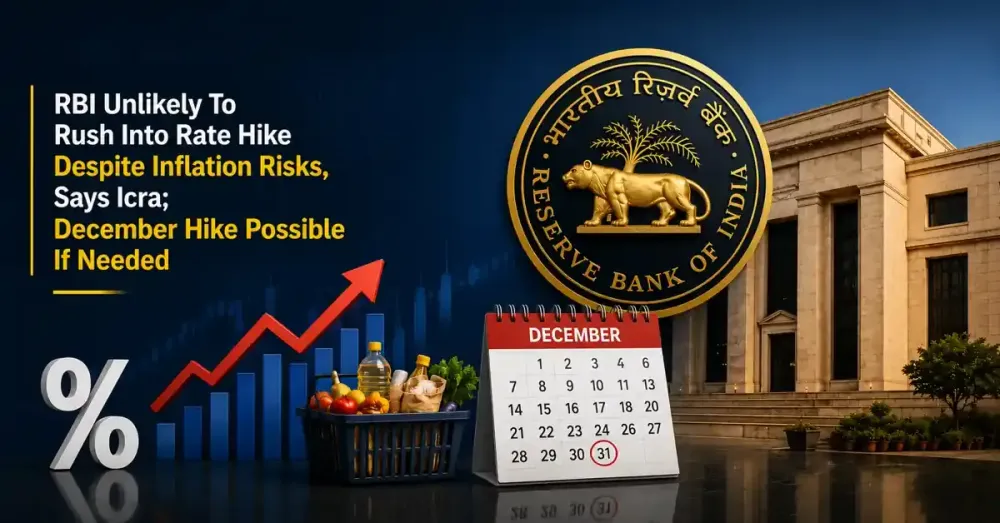
The RBI is unlikely to raise interest rates soon despite rising inflation risks from higher fuel prices and monsoon uncertainty, rating agency Icra said. A rate hike is possible only in December if price pressures persist, with the MPC expected to stay on hold through the next two policy reviews. Read ahead to know more.
The Reserve Bank of India (RBI) is unlikely to move quickly on interest rate hikes despite mounting inflation risks from elevated fuel prices and an uncertain monsoon, rating agency Icra said on Monday.
According to the agency, the current situation is a supply shock, which is fundamentally different from a combined supply and demand shock like the one seen during the Covid pandemic, and the central bank is expected to wait for clearer evidence of second-round inflationary effects before taking any action.
When A Rate Hike Could Come
Icra expects the monetary policy committee (MPC) to remain on hold through the next two policy reviews. According to the agency, the June policy meeting is too early for any action, while August would offer greater clarity on fuel price transmission and monsoon trends.
A possible stance change could come in October, with a rate hike in December only if price pressures persist. The agency currently pencils in just one rate hike in FY27, while emphasising that any policy action will remain highly data-dependent.
The RBI is expected to closely watch whether companies begin passing higher input costs on to consumers, the so-called second-round inflation effect, rather than respond solely to the initial commodity price shock.
Inflation And Growth Projections
Icra has raised its FY27 average consumer price inflation (CPI) forecast to 5%, above the RBI's medium-term target, following recent retail fuel price increases. Wholesale inflation is projected at 6.6%.
Under a baseline assumption of crude oil averaging $95 per barrel, the agency sees India's GDP growth at 6.2% in FY27. Nominal GDP growth, however, could stay elevated at around 12%, reflecting higher price levels even as real growth moderates.
The Fiscal Trade-Off
According to Icra, rising oil prices are creating a policy challenge. A further increase in retail fuel prices could push inflation higher and hurt economic growth. On the other hand, if the government chooses to absorb the impact, pressure on the fiscal position may increase.
The agency estimates that higher commodity prices could lead to an additional ₹40,000 crore fertiliser subsidy burden, ₹50,000 crore in fuel subsidies, and a ₹15,000 crore decline in dividends from oil marketing companies.
Excise duty collections could also fall by around ₹1.1 lakh crore, with direct tax revenues weakening as well. Some offset may come from higher customs duties on gold and silver and transfers from the economic stabilisation fund, but Icra expects a net fiscal slippage of around ₹1.1 lakh crore, or roughly 0.30% of GDP.
As a result, the agency now sees the Centre's fiscal deficit at 4.7% of GDP in the baseline scenario, widening to 5% if crude rises to $105 per barrel. Despite this, the government is expected to continue prioritising capital expenditure even if some discretionary spending comes under pressure in the first half of the year.
Also Read - Anand Rathi Wealth Announces 1:1 Bonus Share Issue
Monsoon And Second Half Risks
Monsoon developments and the severity of any El Nino event will remain critical variables for both inflation and growth. While healthy reservoir levels provide some near-term cushion for rural demand, August rainfall will be particularly important for irrigation needs and kharif output. Rural and urban sentiment had already worsened in March, indicating cautious consumption patterns.
Icra said the second half of FY27 will be more challenging for corporate India. Tractor manufacturers, two-wheeler manufacturers and fast-moving consumer goods (FMCG) companies are likely to have limited pricing power and lower margins. However, the agency does not see any significant credit quality issues as most companies in these sectors are cash-rich and low on leverage.
Source:
NDTV Profit
This article is for informational purposes only and should not be considered investment advice from Kotak Neo. For compliance T&C and disclaimers, Visit www.kotakneo.com/disclaimer
Right Tools, Rich Insights