US Proposes 12.5% Duty On India Over Forced Labour Gaps; Move Complicates Bilateral Trade Talks
 Add Preferred News Source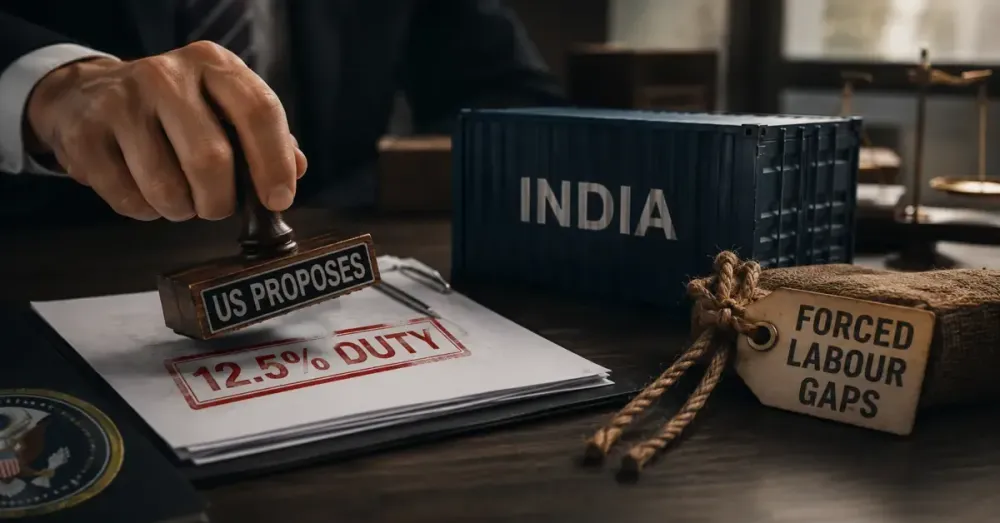
The US Trade Representative has proposed additional duties of 10% or 12.5% on imports from 60 economies, including India, citing their failure to ban goods made with forced labour. India faces the higher 12.5% rate and the move adds a new complication to ongoing India-US trade talks. Read ahead to know more.
The United States Trade Representative (USTR) has proposed fresh tariffs on goods from 60 economies, including India, after concluding that these countries have not done enough to stop imports of products made using forced labour.
The action has been initiated under Section 301 of the US Trade Act of 1974, a provision that gives American trade authorities the power to act against foreign practices deemed unfair or harmful to US commercial interests.
What Is Being Proposed
The USTR has put forward two tariff rates depending on how far an economy has gone in addressing forced labour. Countries that already have a forced labour import ban, have committed to one through a trade agreement, or have a partial regime in place face a proposed additional duty of 10%. The remaining economies, which the USTR says have taken no meaningful steps, face a 12.5% rate.
India falls in the second group. The USTR has classified India among 54 economies that have failed to impose and effectively enforce a ban on goods produced with forced labour. Others in this category include China, Japan, South Korea, Australia, Brazil, the UAE, the UK, Vietnam, Sri Lanka, Bangladesh, Turkiye and Switzerland. Countries facing the lower 10% rate include Canada, the European Union, Mexico, Pakistan, Taiwan, Malaysia and Indonesia, among others.
A textile mechanism has also been proposed that would allow a limited volume of apparel and textile imports from certain economies to enter the US at a lower Section 301 tariff rate, though the specific duties and volumes have not been disclosed.
Several product categories have been exempted from the proposed tariffs, including energy, rare earths, certain metals, beef, coffee, select fruits and vegetables, pharmaceuticals, organic chemicals and aircraft parts.
What Section 301 Means
Section 301 allows the USTR to investigate foreign government practices that it considers unreasonable or discriminatory and that restrict US commerce. It does not require the practice to violate international trade law, being considered unfair or inequitable is sufficient grounds for action. Once a practice is found actionable, the USTR can recommend tariffs or other trade restrictions to push for a change in policy.
In this case, the USTR argues that the absence of forced labour import bans in many countries allows firms using forced labour to lower their costs, distorts global market conditions, and undercuts companies that do not rely on forced labour. The investigations covered economies accounting for 99.4% of all US imports.
Public comments on the proposed tariffs will be accepted through 6 July, with a public hearing scheduled for 7 July.
Also Read - JioBlackRock To Offer Indian Investors Access To Global BlackRock ETFs Via GIFT City
Why It Matters For India
The timing adds pressure to an already active negotiation. A US delegation is in New Delhi from 1 to 4 June for trade talks with Indian officials, with both sides working toward an interim trade agreement under the broader bilateral trade framework announced in February 2026.
The USTR's move brings labour-linked supply chain compliance more squarely into the conversation, adding a new layer to discussions already covering tariffs, market access and non-tariff barriers.
Sources:
Business Standard
Reuters
This article is for informational purposes only and should not be considered investment advice from Kotak Neo. For compliance T&C and disclaimers, Visit www.kotakneo.com/disclaimer
Right Tools, Rich Insights