What is a Systematic Transfer Plan in Mutual Funds?
- Updated: 26 May 2026, 5:15 PM IST
- | 4 min read
- 1,731
 Add Preferred News Source
Interested in making a single investment? Try investing with STP. A Systematic Transfer Plan (STP) is an arrangement in which you make a fixed investment in one mutual fund scheme. It is automatically transferred to another at predetermined intervals. STPs usually involve transferring from a relatively lower-risk mutual fund, such as a liquid or debt fund, to an equity mutual fund.
This method is particularly applicable in instances where you have substantial capital to invest yet want to reduce the impact of market fluctuations. You will not be affected by short-term fluctuations because your investments will spread overtime and average out the per-unit buying cost. The best way to understand the STP process is to view it as a transfer system, in which funds remain invested but are periodically shifted to another scheme.
How Does STP Work?
Systematic Transfer Plans function through the automatic transfer of a predefined amount from one mutual fund plan to another at specified intervals. With this, you generally allocate your lump sum amount to debt or liquid funds and regularly transfer funds into equity schemes. Through this, we can say that the money remains invested, yet it shifts towards equity over time.
For each transfer, you must redeem your units from the originating scheme and reinvest an equal value into the receiving plan. The number of units to be bought will vary depending on the NAV of the receiving fund on the transfer date. Consequently, you can buy more units during periods of low prices and fewer units during high price periods.
STPs can usually be set on a daily, weekly, monthly, or quarterly basis, depending on the fund house. The transfer occurs automatically once initiated. This makes it convenient to move funds systematically without closely monitoring market movements.
Types Of STP
Systematic Transfer Plans come in various formats, offering investors options that fit their financial objectives and economic conditions.
Fixed STP
The Fixed STP is a plan where a specified sum is transferred periodically between two funds. For instance, you can transfer ₹10,000 each month from your liquid fund into an equity fund. It is the most commonly adopted form of STP.
Capital Appreciation STP
In this form of STP, the appreciation in the originating fund is transferred to the receiving fund. The principal continues to remain invested in the originating fund. Such an approach is common among investors who prefer relatively safer funds but want to reinvest the appreciation into other investment avenues.
Flexible STP
The flexible version of STP allows you to adjust the transfer size at your discretion or based on market conditions. For example, you may opt to transfer more money if the market goes down and less if the market rises.
Benefits Of STP
There are some advantages to adopting an STP approach, particularly for those who intend to invest a large corpus but do not want to take any risks.
Reducing Market Timing Risk
Making a lump sum investment in the stock market will put you at risk because you do not know where the prices will go when markets have reached their peak. The advantage of investing through STP is that it helps ensure you will not face this kind of risk, since you won’t invest all your money at once.
Rupee Cost Averaging
With periodic investment, an investment is made at a different Net Asset Value (NAV). This leads to purchasing more units at low prices and fewer units at high prices. This results in averaging the overall investment cost.
Efficient Use Of Lump Sum Investments
You should invest your excess cash in a debt or liquid fund, followed by a systematic transfer plan (STP). By doing this, you can ensure that the extra cash earns some returns while they gradually shift some of the money into a new scheme. The money continues to be invested.
Gradual Asset Allocation
The strength of STP is that it facilitates disciplined investing through automated transfers between schemes. It comes in handy, especially when the aim is to steadily build exposure to equities or rebalance the portfolio. After setting it up, the transfers happen automatically.
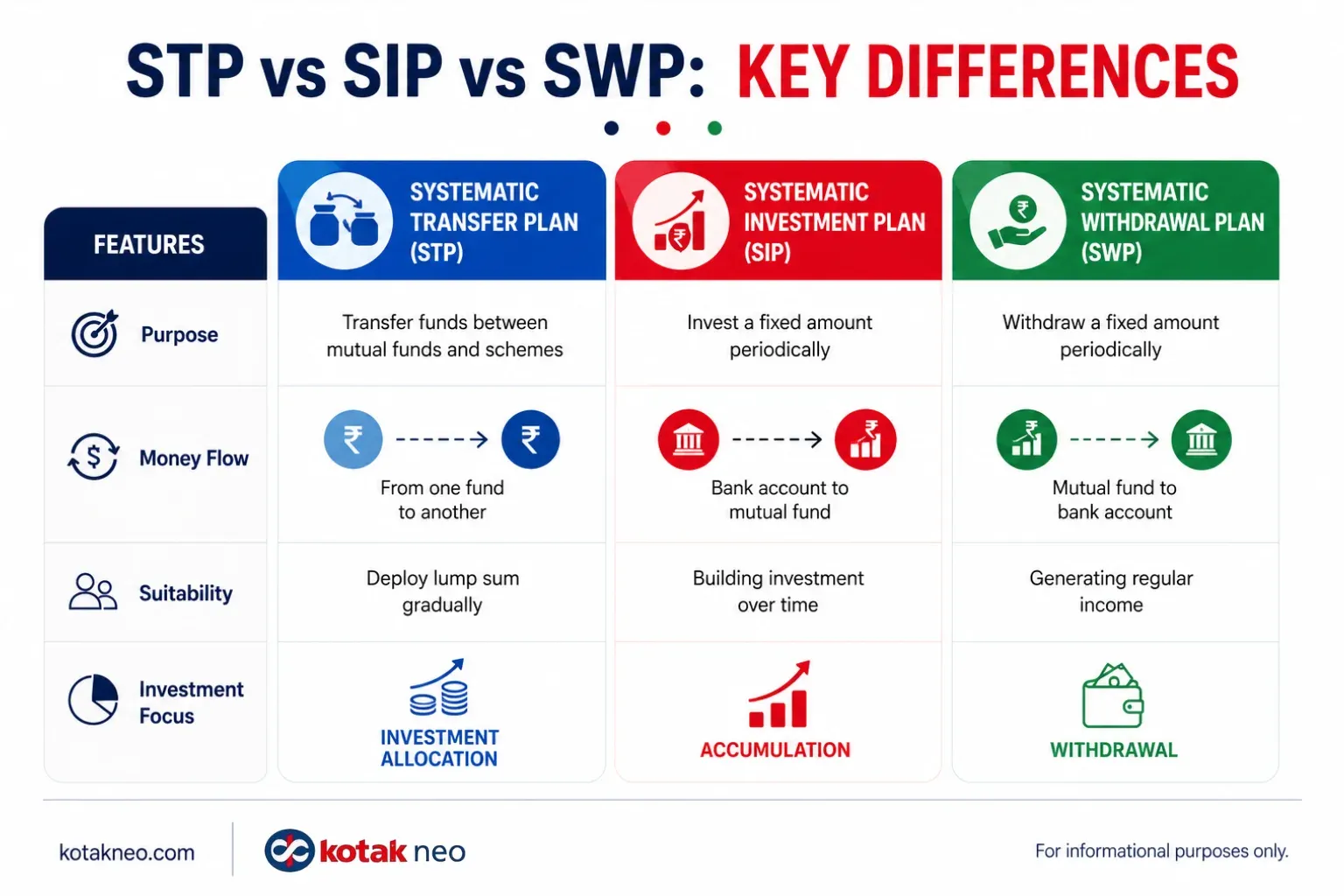
STP Vs SIP Vs SWP: Key Differences
Features | Systematic Transfer Plan | Systematic Investment Plan | Systematic Withdrawal Plan |
|---|---|---|---|
Purpose | Transfer funds between mutual fund schemes | Invest a fixed amount periodically | Withdraw a fixed amount periodically |
Money Flow | From one fund to another | Bank account to mutual fund | Mutual fund to bank account |
Suitability | Deploy lump sum gradually | Building investment over time | Generating regular income |
Investment | Allocation | Accumulation | Withdrawal |
Is STP Taxable In Mutual Funds?
STP transactions are taxable since each transfer involves a sale from the source mutual fund and purchase of the target mutual fund. The sale of units from the source scheme may be subject to capital gains tax if the mutual fund falls under specific criteria.
-
20% tax is levied in case of Short-Term Capital Gains (STCG), which applies for an investment period of less than one year
-
12.5% tax is levied beyond ₹1.25 lakh worth of gains in case of Long-Term Capital Gains (LTCG). It applies when securities are held for more than one year.
However, when the transfer is from a debt fund, the returns will be taxable under the capital gains rules for debt securities. Under the latest tax regime, all gains from debt funds are added to income and taxed at the individual's applicable slab rate.
Who Should Use STP?
The Systematic Transfer Plan is a useful strategy for individuals who have a lump-sum amount to invest but do not wish to invest in equity at once. Rather than risking your entire investment in equity by subjecting yourself to market fluctuations, you can keep your money in a relatively safe bond or liquid fund and systematically transfer it to an equity fund.
This strategy might also appeal to those who are wary of market volatility but would like to participate in future growth. With the help of STP, you can slowly build equity and thus adopt a cautious approach without investing in a volatile market in one go.
Sources
Livemint
FAQs On What Is STP In Mutual Funds
There is no fixed duration for STP. Many investors choose a 6-month to 12-month period to transfer funds gradually, but the ideal timeline depends on market conditions, risk tolerance, and investment goals.
STP is ideal for new investors who are putting a one-time investment into equities. This method helps you avoid the risks of market timing and provides a gentler introduction to the stock market.
Each transaction in the STP is considered a withdrawal from the original scheme of the mutual fund. The redeemed amount is reinvested into the target scheme.
The STP scheme can result in capital gains tax, as each transaction requires redeeming units from the originating mutual fund. The tax is based on the fund's category and the holding period of the redeemed units.
The content in this blog is intended purely for educational purposes. Any securities or mutual funds referenced are illustrative in nature and do not constitute a recommendation or endorsement by Kotak Neo. Investors are encouraged to assess their own financial situation and seek professional advice before making any investment decisions. For compliance T&C and disclaimers, Visit https://www.kotakneo.com/disclaimer/
0 people liked this article.

Kotak Neo (Kotak Neo) is India's venerable stockbroking company with a rich legacy. It offers comprehensive investment services across asset classes, prioritising a technology-first approach for a seamless experience. Trusted by 5 million+ customers, it guides you toward financial success with ease of investment and speed of trade.
Note: The opinions expressed in this blog are personal viewpoints and should not be construed as recommendations.