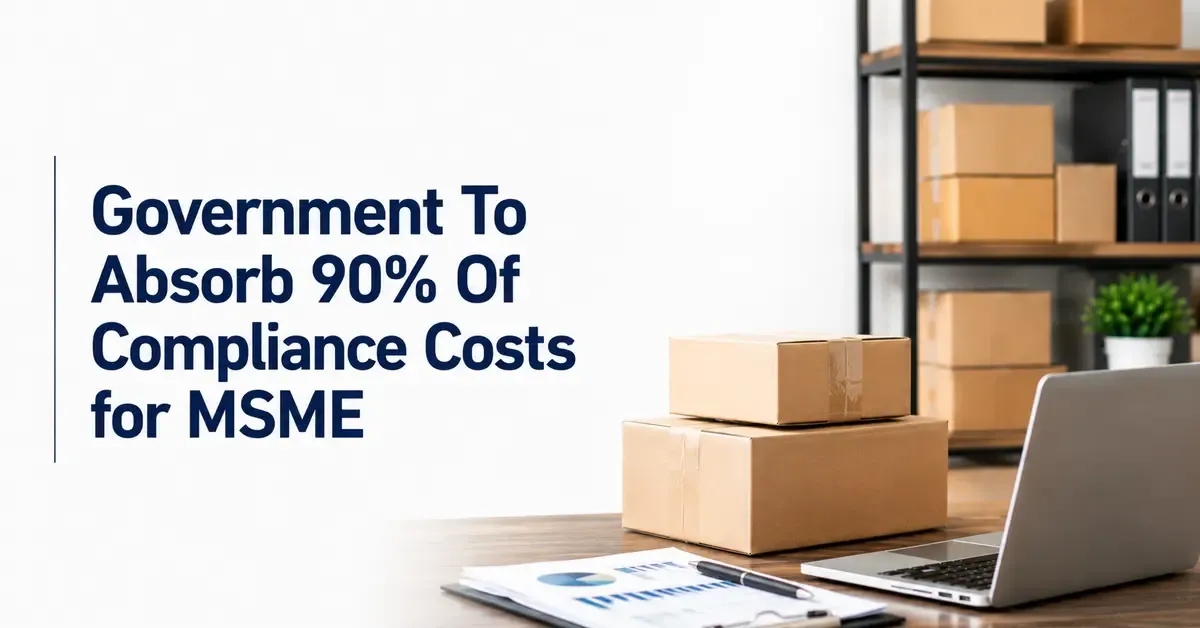
Government Plans To Cover 90% Of MSME Compliance Costs Under EU Carbon Border Tax
- By Kotak News Desk
- 29 Jun 2026 at 1:34 PM IST
- Share Market News
- 4m
Stay updated with the latest stock market developments and trends.
You can set Kotak Neo as a preferred source to receive regular market updates.

India is developing a scheme to cover 90% of MSME compliance costs under the EU Carbon Border Adjustment Mechanism after trade negotiation concessions failed. Iron and steel exports face the steepest potential decline.
India's central government is working on a scheme to absorb 90% of the compliance costs that micro, small and medium enterprises will face under the European Union's (EU) Carbon Border Adjustment Mechanism (CBAM).
The move comes after India's attempts to carve out concessions for smaller exporters during trade negotiations with developed countries did not succeed.
CBAM came into effect on 1 January 2026 and requires Indian exporters to submit certificates corresponding to the embedded carbon emissions in their goods. For large companies with dedicated compliance teams, that is a manageable requirement. For smaller exporters, it is a different problem altogether.
Why MSMEs Are Disproportionately Affected
The compliance burden under CBAM does not scale with the size of the business. Whether an MSME ships a small volume or a large one, the fixed costs of carbon accounting, third-party verification, digital reporting systems and staff training remain broadly the same. Industry sources put the compliance cost for each MSME unit at ₹15 lakh to ₹20 lakh just to meet the carbon tax reporting requirement, before any actual levy is paid.
The mechanism includes a provision that makes things worse for smaller exporters who lack the systems to measure actual emissions. When actual data cannot be provided, the EU requires importers to use default values, which carry a built-in mark-up designed to ensure emissions are not understated. Those mark-ups are set to rise significantly:
-
2026: 10% mark-up on default values
-
2027: 20% mark-up
-
2028 onwards: 30% mark-up
The escalating penalties for using defaults disproportionately affect businesses that cannot afford sophisticated emissions tracking infrastructure, which is precisely the situation most MSMEs find themselves in.
What Is At Stake For Indian Exports
An Indian Council for Research on International Economic Relations working paper released this month found that Indian exports would decline across all CBAM-covered commodity categories. The iron and steel sector faces the steepest exposure, with EU imports from India potentially falling by around 24%. Fertilisers and aluminium products are next in line, followed by other metal products.
India is the world's second-largest producer of both crude steel and primary aluminium, making the stakes in these categories particularly significant for domestic industry.
The United Kingdom has separately announced plans to introduce its own version of the mechanism from 2027, potentially adding another compliance layer for Indian exporters who sell into both markets.
Also Read - APL Apollo Tubes To Exit Real Estate Subsidiary With ₹160 Crore Divestment
The Government Response
With trade negotiation concessions off the table, the government's proposed scheme to cover 90% of compliance costs would give MSME exporters a way to stay competitive in the EU market without absorbing the full financial burden of meeting the regulation's requirements. Details of how the scheme would be structured and which sectors would be prioritised have not yet been made public.
Source:
The Indian Express
This article is for informational purposes only and should not be considered investment advice from Kotak Neo. For compliance T&C and disclaimers, visit www.kotakneo.com/disclaimer
Kotak News Desk brings you latest updates, expert insights, and market-ready ideas - helping you stay informed and invest smarter.
Connect on: Linkedin
0 people liked this article.