India’s EV Investment Trails 2030 Targets Despite ₹2.23 Lakh Crore Inflows: IEEFA Report
 Add Preferred News Source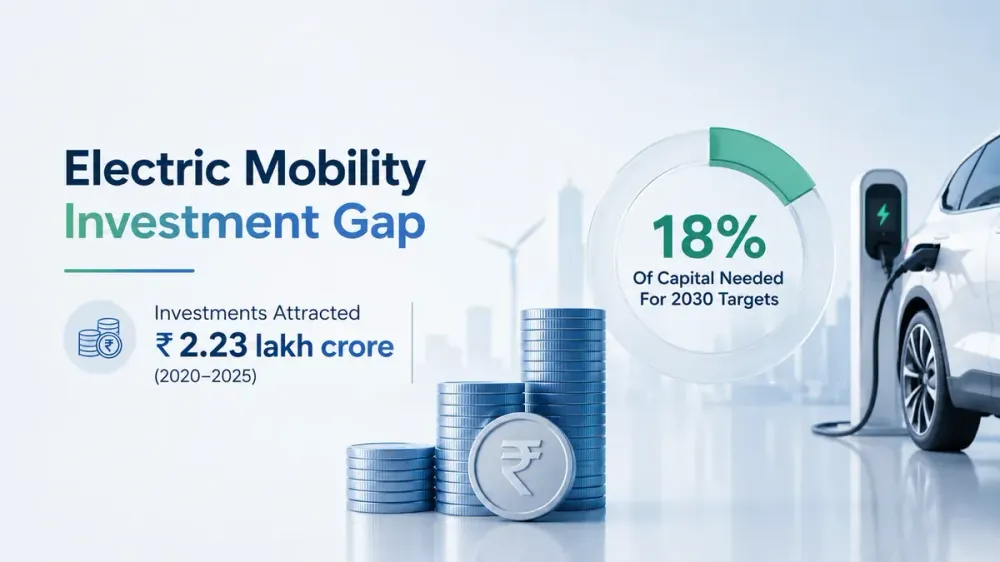
India’s electric transport sector attracted ₹2.23 lakh crore in investments between 2020 and 2025, but this represents only about 18% of the capital required to meet the country’s 2030 electric mobility targets, according to a new IEEFA report.
India’s electric transport sector has drawn sizeable capital over the past five years, but investment levels remain materially below what is required to support the country’s 2030 electric mobility targets, according to a new report by the Institute for Energy Economics and Financial Analysis (IEEFA).
Under India’s policy roadmap, electric vehicles (EV) are targeted to account for 30% of private car sales, 70% of commercial vehicles, 40% of buses and 80% of two- and three-wheelers by 2030. The report indicates that the pace of capital mobilisation so far falls well short of the scale implied by these targets.
How Much Capital Has Flowed So Far?
According to IEEFA, over ₹2.23 lakh crore is estimated to have been invested in the three pillars of the Indian electric transport system between 2020 and 2025.
Manufacturing has taken the largest share of this capital. Public subsidies and incentives come next, while charging infrastructure still forms a small part of the overall investment.
Despite the scale of mobilisation, the report estimates that the ₹2.23 lakh crore deployed so far represents only around 18% of the total ₹12.5 lakh crore, which is required by 2030. This leaves a funding requirement of roughly ₹10.2 lakh crore over the next five years.
The report flags that closing this gap would require changes in financing structures and risk-sharing mechanisms, particularly for segments with higher capital intensity and longer payback cycles. It also notes that capital mobilisation will need to broaden beyond balance-sheet funding by manufacturers.
What Does The Funding Mix Reveal?
The composition of capital flowing into EV manufacturing shows a heavy reliance on internal funding, with relatively limited participation from external capital so far.
Key funding sources for EV manufacturing include the following:
- Internal accruals: ₹1.59 lakh crore
- Debt: Over ₹36,000 crore
- Equity: Over ₹6,400 crore
Although internal funding dominates at the aggregate level, the analysis shows significant variation across vehicle categories. Electric three-wheelers received the majority of EV investments (approximately 78%) between 2020 and 2025, indicating that the segment has matured and is commercially viable.
In contrast, electric two- and four-wheelers had a considerably more diverse financing environment. The report also indicates that the investment announcements made in 2024/25 supported rising activity in the electric four-wheeler segment, as consumer demand for electric passenger vehicles increased and established manufacturers committed higher levels of capital.
Investors’ Takeaway
IEEFA reports that despite the fact that the EV industry in India has marshalled quite a significant amount of capital within the past five years, the amount of funding is materially inadequate to reach the target of 2030 adoption.
The increasing disconnect between real investments and demand highlights the need for greater financing participation, particularly in capital-intensive areas like electric vehicles and charging infrastructure, as the EV transition moves into a more capital-intensive phase.
Sources:
EconomicTimes
PV Magazine India
This article is for informational purposes only and should not be considered investment advice from Kotak Neo. For compliance T&C and disclaimers, Visit www.kotakneo.com/disclaimer
Right Tools, Rich Insights