Consolidated Fund of India Explained: How It Powers Government Spending
- 4 min read
- 1,001
- Published 17 Feb 2026
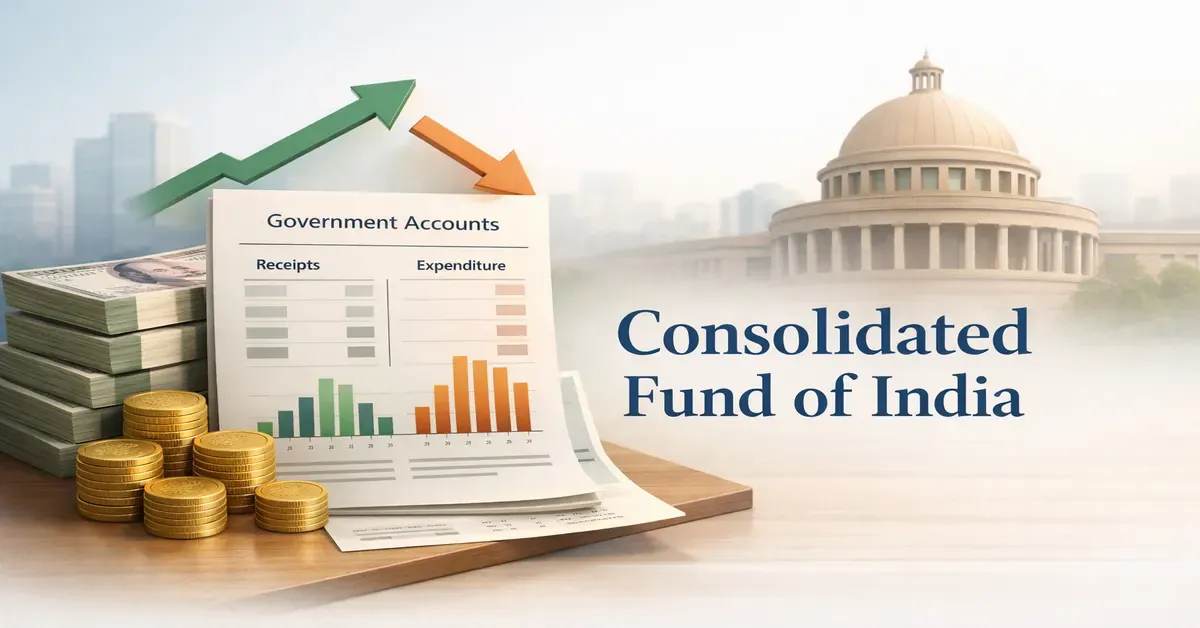
As a working professional, you might have a primary bank account where the monthly salary arrives and from which the rent gets paid.
A nation operates on a similar, but much larger, scale. This financial reservoir for the central government exists as the consolidated fund of India.
Imagine the government building a new highway in Maharashtra or paying the salary of a teacher in a central school. Where does the money for all of these developments come from? They are funded from the consolidated fund of India.
It is a single and massive account that acts as the backbone of the Indian economy, ensuring that every rupee received by the state finds its way into a transparent and structured system.
What is the Consolidated Fund of India?
For the GoI (Government of India), the consolidated fund of India is a document of importance.
The consolidated fund of India was established under Article 266(1) of the Constitution. It holds almost all that the Union government has raised.
You can understand the consolidated fund as a centralised basket including all tax revenues, non-tax revenues, and loan flows. Thus, it is a structured way to manage hundreds of crores of rupees received every year.
No money can move out of this account unless the parliament of India provides its explicit permission. The consolidated fund of India serves as a giant purse collecting every bit of income the country generates at the central level.
How does the Consolidated Fund of India Work?
There is a strict constitutional procedure pertaining to operating the consolidated fund of India. These procedures are meant to prevent arbitrary spending.
All receipts flow into the consolidated fund of India. Similarly, all expenditures flow out of it. However, the GoI cannot simply withdraw money without a reason.
Every year, the Finance Minister presents the Union Budget. It is the Annual Financial Statement, outlining how much money the GoI intends to spend from the consolidated fund of India.
After the budget is presented, the parliament then debates these proposals and passes an Appropriation Bill. After the bill becomes a law, the GoI gains the legal authority to withdraw the specified amounts.
Thus, the people's representatives maintain control over the national purse. So, if the government needs extra money during the year for unforeseen events, it needs to return to parliament for supplementary grants.
Revenue Sources of the Consolidated Fund
The strength of the consolidated fund lies in diverse income sources coming from the pockets of citizens and the operations of state-owned entities.
These sources ensure that the GoI has enough liquidity to fund national security, welfare schemes, and infrastructure. Here are the revenue sources in detail.
Direct Taxes
Direct taxes make a considerable chunk of the money that enters the consolidated fund of India.
So, when you pay income tax on their annual earnings, that money goes straight into this fund. Similarly, large corporations pay a part of their profits as corporate tax.
Indirect Taxes (GST, Customs, Excise)
Whenever you buy anything with an MRP written on it, you are contributing to the consolidated fund of India through indirect taxes.
For example, every time you buy a bottle of shampoo or a new smartphone, you are contributing to the national treasury. The GST (Goods and Services Tax) remains the largest indirect tax source.
Other examples are import customs duties on electrical goods or excise duties on items such as petroleum. The price of these taxes is paid by each consumer in the country collectively.
These duties add to the consolidated fund of India in a big way. For instance, even a modest purchase at the neighbourhood kirana (corner) shop contributes in its own way to the nation’s welfare.
Revenue from Government Services
The GoI also earns money by providing various essential services. While paying for a railway ticket or applying for a fresh passport, the fees you pay add to the non-tax revenue.
There are more such revenues, such as the frequency charges paid by telecom companies. It can also include interest received on loans that the central government provided to state governments or other nations.
These fees are the ones that fund the very services they use daily.
Profits and Dividends from PSUs
Various PSUs (Public Sector Undertakings) like the SBI (State Bank of India), IOC (Indian Oil Corporation), LIC (Life Insurance Corporation of India) make huge profits.
Some of these profits are returned to the federal government in dividends. These revenues go into the consolidated fund of India. They also reduce the need for the government to borrow more money from the markets.
These dividends act like a return on investment for the taxpayers who own these companies.
Proceeds from Disinvestment, Loan Recoveries and Debt Repayments
Sometimes, the GoI sells a part of its stake in a PSU to private investors. This process is known as disinvestment. It brings in large one-time sums.
When other entities repay the principal amount of loans they took from the centre, that money is returned to the fund. These capital receipts help fund long-term infrastructure projects.
Expenditures Charged on the Consolidated Fund
A vote in parliament is not required for all expenses from the consolidated fund.
Certain payments are "charged" on the fund to ensure the independence of major constitutional offices. Meaning, the parliament can discuss these expenses, but it does not vote on them.
Salaries and Allowances
The salaries and allowances of high-ranking officials like the President of India, the Speaker of the Lok Sabha, and the Judges of the Supreme Court are charged on the consolidated fund of India. The consolidated fund of India can help maintain the dignity and autonomy of these offices.
Pensions
The pensions of retired Supreme Court judges and the CAG (Comptroller and Auditor General) also come from this non-votable category.
The Indian Constitution safeguards the financial security of individuals who once held crucial positions of power. They take those payments off the shelf of year-end votes, insulating their post-work lives from politics.
Advantages of the Consolidated Fund of India
Having a Consolidated fund ensures that the Indian economy remains steady and open to one and all. It provides a system for the world’s most populous nation to organize its monumental financial transactions.
Transparency
A single account for all major transactions makes it easy for citizens and analysts to see where the money is coming from and where it is going. The Union Budget provides a clear picture of the state of the consolidated fund of India. This level of openness builds trust between the government and the public. Anyone with an internet connection can access budget documents and track how the state allocates its resources.
Accountability
The CAG of India audits every rupee spent from the consolidated fund of India. The CAG then submits a detailed report to parliament. So, if the GoI spends money unwisely or without proper authorisation, these audits bring the truth to light. This system holds the executive branch accountable to the taxpayers for every single paisa.
Efficiency in Public Spending
The GoI manages its cash flow more effectively by pooling all resources into one consolidated fund of India. It prioritises urgent needs, such as healthcare during a crisis or defence equipment during a border standoff, without having to wait for money to move between multiple disconnected accounts. With this centralisation, there can be better financial planning and faster response times in emergencies.
Safeguard Against Misuse
The requirement for parliamentary approval serves as a powerful shield against the misuse of public money. No minister or bureaucrat can spend from the consolidated fund of India for personal or unauthorised purposes. The fund’s strict rules ensure that the wealth of the nation serves the interests of its people.
Source
CAG Official Document
Constitution of India Web
0 people liked this article.