Difference Between Trade API And Algo Trading
- 6 min read
- 1,075
- Published 17 Feb 2026
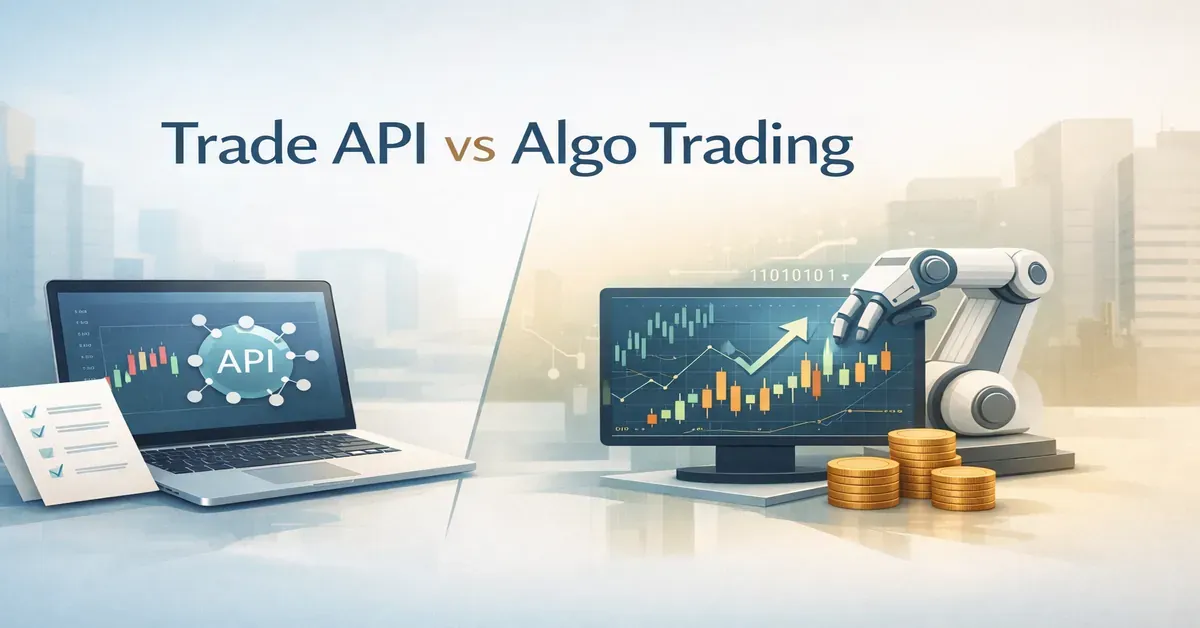
Fishing is a fairly simple concept, right? But is fishing with a rod and commercial fishing nets the same thing? Both aim to catch fish. They also operate in the same waters, target the same species, and sell their catch at the same fish market. However, there are clear differences between them. The two mainly differ in how they work. There is a similar difference between Trade API and Algo Trading, representing distinct concepts. One is the raw connection to the market, while the other is an automated logic.
- Fishing with a rod is direct and hands-on. This is how Trade API works.
- Commercial nets are automated systems. This is how algo trading works.
Let us understand these differences in more detail.
Trade API vs Algo Trading: The Tool vs The Strategy
Trade API is a digital bridge between your computer and the stockbroker’s server. However, algo trading is the brain (a computer program executing trades based on a pre-defined criteria by the user). This distinction becomes clearer when you compare their functions side-by-side.
Main Function | Connecting software systems to execute trades. | Automatically deciding when to buy or sell based on predefined criteria. |
Decision-making | Cannot make any decisions. It only executes commands given to it. | Makes decisions based on programmed logic and market conditions set by the user. |
Preset Execution Logic | Cannot have preset execution logic. Must receive explicit commands each time. | Has preset execution logic. Contains rules like "IF condition X, THEN execute trade Y." |
Dependency | Can work independently. You can use APIs for manual trading without any algorithm. | Requires an API (or similar interface) to execute its decisions in the market. |
User Role | User provides each specific command every time a trade is needed. | User sets rules/strategy upfront, then the system operates autonomously. |
Autonomy | No autonomy. Waits passively for instructions. | Operates autonomously. Continuously monitors markets and executes when conditions are met. |
Key Takeaway: Trade API is a passive executor with zero decision-making or logic. Algo Trading is an active decision-maker with built-in logic that uses APIs to execute its choices
Trade API (The Bridge)
- NO decision-making capability: It is purely an executor
- NO preset logic: It doesn't store or follow any rules
- Waits for commands: Someone/something must tell it exactly what to do each time
- Example: "Buy 100 shares of XYZ at market price" → API executes immediately, then waits for the next command Think of it like: A waiter taking your order. The waiter doesn't decide what you should eat or when you should eat, they just deliver exactly what you request to the kitchen.
Algo Trading (The Brain)
- HAS decision-making capability: Makes choices based on programmed logic
- HAS preset execution logic: Contains rules like "IF price drops 5%, THEN buy 50 shares"
- Operates autonomously: Continuously monitors and executes without human intervention
- Example: The algorithm monitors the market 24/7 and automatically executes trades when conditions match its rules Think of it like: A personal chef who knows your preferences. You've told them "I like spicy food, I'm vegetarian, and I eat dinner at 7 PM." They decide the menu and cook without asking you every time.
The Key Relationship
Algo trading uses Trade API to execute its decisions:
- The algo (brain) decides: "Time to buy!"
- The API (bridge) executes: Sends the buy order to the exchange Trade API can work WITHOUT algo trading:
- A human manually clicks "Buy" → API executes
- The API doesn't care who/what gave the command
For The Tech-Savvy: Trade API For Developers
As a programmer, you might seek a trading API for developers to build your own trading terminal. It can also help you build analysis tools.
You can use trade API without Algo trading. But as a developer, you might need a custom dashboard showing charts in a specific way. You might use the API to fetch data and display it. You might not at all automate the trading. By simply using the trade API, you can create a better manual trading experience.
What does this mean for traders? The key point here is that you can use an online trading API without doing algo trading.
You cannot use algo trading without a trade API - You can build a manual buy/sell button that can simply work faster than the standard website. But you cannot strictly do modern Algo Trading without a trade API. Your computer needs that bridge to place the orders. That is why a trade API is mandatory for algo trading.
Brain driving the bridge - The "powering" mechanism is about a continuous, millisecond-level conversation between the logic (Algo) and the connectivity (API). This interaction is used to turn a static code into a dynamic, profit-seeking machine.
Different Strategies "Driving" the API - Different strategies power the API in different ways. The nature of the strategy determines how aggressively or complexly it utilises the API’s capabilities. This nature can be different for trend following, arbitrage, mean reversion and scalping.
Trade API and Algo Trading Risks
Humans trade with their biases. They might hesitate to cut a loss. But an algorithm can use the API to enforce discipline limitlessly.
API trading risks are related to the connection and the technology infrastructure.
- Downtime - The broker’s API server might crash. From our example, if the bridge breaks, no orders can go through.
- Rate Limits - Many brokers limit how many requests you send per second. But if your code spams the trading API too fast, the broker can block you.
- Latency - A slow internet connection can delay the message. The price might change between the time you send the order and the time the API receives it. Algo trading risks are related to the logic and the strategy.
- Code Errors - A bug in the code might result in the algorithm buying 10,000 shares instead of 100.
- Over-fitting - A strategy might work perfectly on past data but fail in the live market.
- Looping Errors - A program might get stuck in a loop. It might continuously buy and sell until the account balance hits zero.
But how can trade APIs manage these risks?
Position Sizing - The algorithm checks the account balance (via the API) before sending an order. It calculates exactly how many shares to buy, keeping risk <1%.
Kill Switch - Detecting anomalous behaviour, an online trading API returns error messages. It can also inform you that the loss limit for the day is reached. In this case, it triggers a "Kill Switch." It instantly uses the API to "Cancel All Open Orders" and "Square Off All Positions." Thus, it shuts down the operation to prevent catastrophe.
To summarise, the algorithmic trading strategies are the intent, and the API provides the action. It powers the API by feeding it intelligent and calculated instructions. It can transform a static connection into a dynamic engine for wealth creation.
Conclusion
The trade API offers the infrastructure or the raw potential to interact with the markets programmatically. However, algo trading utilises that infrastructure to apply intelligence and automation.
Modern algorithmic trading cannot function without an API. You might be building a custom display using a stock market API or deploying a fully automated bot. But the knowledge of Trade API vs algo trading can help you build on a solid foundation.
Source
Investopedia NSE
This article is for informational purposes only and does not constitute financial advice. It is not produced by the desk of the Kotak Securities Research Team, nor is it a report published by the Kotak Securities Research Team. The information presented is compiled from several secondary sources available on the internet and may change over time. Investors should conduct their own research and consult with financial professionals before making any investment decisions. Read the full disclaimer here.
Investments in securities market are subject to market risks, read all the related documents carefully before investing. Brokerage will not exceed SEBI prescribed limit. The securities are quoted as an example and not as a recommendation. SEBI Registration No-INZ000200137 Member Id NSE-08081; BSE-673; MSE-1024, MCX-56285, NCDEX-1262.
0 people liked this article.