Semiconductors to Aerospace: How Budget 2026 Plans to Cut India's Most Critical Import Dependencies
- 4 min read
- 1,011
- Published 12 Feb 2026
Picture yourself buying a car that was made in India.
The brand is Indian, the factory is Indian, and the car is assembled in India. Still, many of the most important parts, such as engine components, electronics, sensors, and safety systems, come from abroad.
That gap between where a product is made and where its most essential inputs originate captures one of the quiet structural challenges in India’s growth story.
There is no doubt that India’s economy is growing fast. But beneath that growth sits a dependency that hasn’t fully gone away.
Yes, it is imports.
In FY25, merchandise imports rose 6.3% year-on-year, reaching USD 721.2 billion.
Many of the things India makes, from semiconductors and electronic parts to specialised chemicals and industrial equipment, rely on materials and components from other countries.
For a long time, that wasn’t a problem.
Global supply chains were stable, logistics were predictable, and importing critical inputs was cheaper than building them locally. Efficiency mattered more than resilience.
Then the world changed.
Pandemics, wars, export controls, shipping disruptions and geopolitical tensions all exposed the same uncomfortable truth: import-heavy manufacturing works, until it doesn’t.
Budget 2026 acknowledges this reality. And instead of incremental fixes, it signals a more structural shift.
Manufacturing Is No Longer Just About Growth
Budget 2026’s push for manufacturing covers many sectors, but the main goal is clear throughout.
The message is no longer just “grow manufacturing.” It is “de-risk manufacturing.”
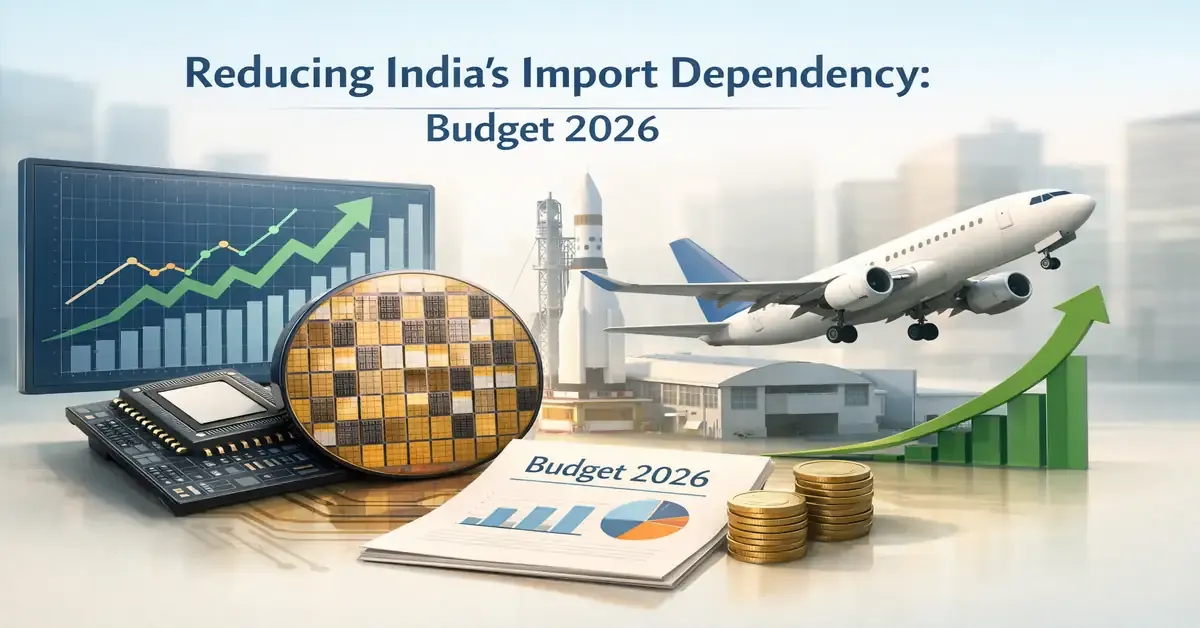
The focus is on areas where import dependence creates the biggest vulnerabilities: semiconductors, electronics components, critical minerals, healthcare, energy systems, logistics hardware and aerospace.
Let’s Talk About Semiconductors
Budget 2026 greatly increases support for electronics and semiconductors, including a ₹40,000 crore allocation for making electronic components.
For semiconductors, the focus goes beyond just making chips. It also covers materials, equipment, testing, and packaging, areas where India still relies heavily on imports.
By building up the whole semiconductor supply chain, the government wants to cut long-term dependence on imported chips and key parts used in everything from consumer electronics to industrial automation.
If semiconductors are the brain of modern manufacturing, heavy industry is its backbone.
Push for Chemicals, Capital Goods and Heavy Industry
The 2026 Budget announced three new plug-and-play Chemical Parks, Hi-Tech Tool Rooms for precision manufacturing, a dedicated scheme for advanced construction and infrastructure equipment, and a ₹10,000 crore allocation for container manufacturing.
By supporting local container manufacturing, the Budget tackles a logistics problem that adds to import costs in many industries.
These steps aim to reduce reliance not only on imported goods, but also on the imported infrastructure that supports trade.
Critical minerals are another big area where India is vulnerable to imports.
Rare Earths and Critical Materials: Closing the Input Gap
Budget 2026 continues earlier efforts by supporting rare earth corridors in Odisha, Kerala, Andhra Pradesh, and Tamil Nadu. These corridors aim to combine mining, processing, and manufacturing within India, rather than importing refined materials or finished parts.
Rare earth permanent magnets are vital for EVs, renewable energy systems, and defense equipment. Currently, India imports most of these from China, even though it has its own reserves.
By moving production closer to where resources are found, the Budget aims to lower the risk of relying on global suppliers and make sure future manufacturing growth isn’t limited by imported inputs.
Relying on imports isn’t only a problem for industry. In healthcare, it also affects how affordable treatments are.
Healthcare: Lowering Costs and Import Dependence
Healthcare imports are another pressure point, particularly in advanced therapies.
Budget 2026 removes basic customs duty on 17 cancer drugs and gives duty exemptions for medicines treating seven rare diseases. This will help reduce reliance on costly imports and make treatments more affordable.
At the same time, the government announced ₹10,000 crore under the Biopharma SHAKTI initiative to build India into a global biologics manufacturing hub.
The strategy here is two-fold.
First, the government wants to ease short-term pressure with duty exemptions. Second, it aims to build up India’s ability to make complex biologics at home, where the country still relies a lot on foreign suppliers.
Aviation, Nuclear Power and Battery Storage
Energy security also finds a strong import-reduction lens in Budget 2026.
The government has extended BCD exemptions on imports for nuclear power projects until 2035, now covering all nuclear plants. This gives long-term certainty for expanding nuclear power in India and will help localise component production over time.
At the same time, the Budget gives BCD exemptions for capital goods used to make lithium-ion cells, making it easier to start domestic battery and energy storage production. This is important for EVs and renewable energy, which now rely on imported cells and equipment.
To support local aerospace manufacturing, the Budget 2026 also exempts BCD on parts and components used to make civilian, training, and specialised aircraft. Since aircraft parts are often heavily imported, this move directly encourages making more of them in India.
Is This Budget Focused on Reducing Imports?
What sets Budget 2026 apart is not one announcement, but the overall pattern.
In areas like semiconductors, healthcare, energy, logistics, and aerospace, the government is focusing on points where imports are a big problem. Some steps lower costs right away with duty exemptions, while others invest in building up local capacity for the future.
The transition will not be instant. But the direction is clear.
India is starting to see imports as something it can reduce, not just a necessary part of growth. With Budget 2026, the country is beginning the slow process of building its own capabilities, aiming not only to save foreign exchange but also to create a manufacturing sector that can handle global challenges and compete independently.
Sources:
PIB PIB Business Standard The Hindu India Today PIB
0 people liked this article.