NSE IPO 2026: Exchange Expects 13-15% Long-Term Earnings Growth, Sees Technology Costs Staying Under Control
 Add Preferred News Source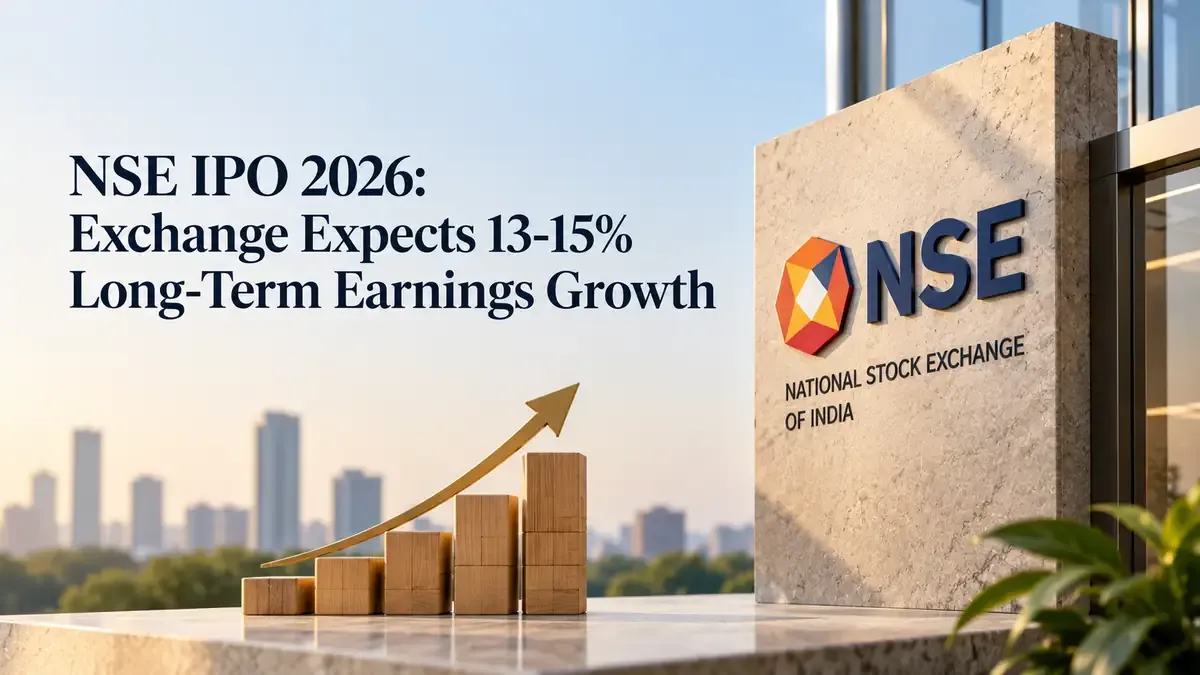
NSE expects 13-15% long-term earnings growth, with stable technology costs and continued focus on trading infrastructure and market share.
The National Stock Exchange (NSE) expects its earnings to expand at an annual rate of 13-15% over the long term, with growth expected to broadly track the pace of India's financial services industry, its senior management said as the exchange began its journey towards a public listing.
NSE Chief Business Development Officer Sriram Krishnan said the exchange's historical growth has broadly been within this range and is expected to remain aligned with the financial services sector, as reported by NDTV Profit India's financial services industry typically grows at around 13-15% when the broader economy expands by 7-7.5%, he said.
The comments come as NSE's ₹22,569 crore initial public offering (IPO) opened for subscription on Thursday, September 17. The issue, which is entirely an offer for sale, will not result in any proceeds accruing to NSE. The IPO has a price band of ₹1,700-₹1,785 per share, while investors can bid for a minimum of eight shares.
The issue is India's second-largest IPO and the biggest public offering so far in 2026. Technology remains one of the exchange's key operating expenses, with NSE spending about ₹1,300 crore on technology in FY26. However, the management expects the existing technology infrastructure to support the addition of new products without a corresponding surge in costs.
NSE Chief Financial Officer Ian Desouza said the exchange's technology platform has been developed internally and can be scaled to accommodate additional products. He added that technology expenditure has reached a relatively stable run rate and is expected to grow at a mid-teens pace rather than increase exponentially.
This would allow NSE to introduce new products and expand its operations while keeping incremental technology costs relatively contained.
NSE market share
The exchange is also focused on strengthening its trading infrastructure and improving the experience for market participants, particularly as competition and regulatory changes have affected its share in parts of the derivatives market.
Krishnan said NSE continues to command close to 100% of the market in single-stock options and monthly-expiry options. Its share in weekly index options, however, has declined following changes to the expiry framework.
The number of weekly expiry days was reduced from four to one, while Bank Nifty was moved to a monthly expiry cycle.
Rather than targeting market share as a standalone objective, NSE plans to focus on improving the efficiency and reliability of its platform. The initiatives include expanding co-location capacity, improving response times and providing traders with online visibility into position-limit utilisation.
The exchange expects improvements in these areas to make its platform more efficient for participants and support its market position over the longer term.
NSE IPO anchor book
Ahead of the public issue, NSE's ₹6,746 crore anchor book was fully subscribed, with 189 investors participating.
Foreign investors accounted for 43% of the anchor allocation, while domestic investors contributed 53%. The investor pool included mutual funds, insurance companies and existing shareholders.
According to Krishnan, the anchor book also saw participation from investors across the US, Asia-Pacific, the Middle East and Europe.
Also Read - Closing Bell, 17 September 2026: Sensex, Nifty May Close In The Green
This article is for informational purposes only and should not be considered investment advice from Kotak Neo. For compliance T&C and disclaimers, Visit www.kotakneo.com/disclaimer
Rochelle Britto has spent 8+ years decoding India's markets, businesses, and consumer economy, reporting for ET Prime and Times Internet along the way, covering the stories behind the numbers.
A Mumbai native and perpetual planner of the next holiday, she stays far, far away from the eternal question, “Where are we going next?” When she's not chasing headlines, she's chasing new cultures, open roads, and a bit of quiet in nature.
Right Tools, Rich Insights