APSEZ Incorporates Paradip Mahanadi Terminal As Wholly Owned Subsidiary To Develop Two Dry Bulk Berths
 Add Preferred News Source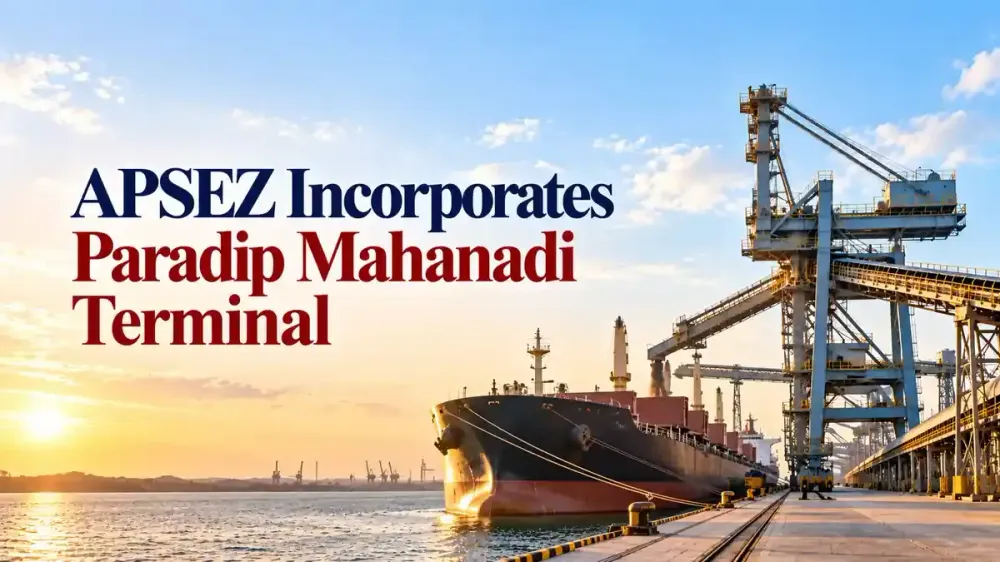
Adani Ports has incorporated Paradip Mahanadi Terminal as a wholly owned subsidiary to develop and operate two dry bulk berths at Paradip Port under its newly awarded 30-year concession.
Adani Ports and Special Economic Zone Limited (APSEZ) has incorporated a wholly owned subsidiary, Paradip Mahanadi Terminal Limited, to develop and operate two dry bulk berths at Paradip Port in Odisha.
The new entity was incorporated on 6 October 2026. With a paid-up share capital of ₹5 lakh divided into 50,000 equity shares of ₹10 each, APSEZ holds 100% of the company. The incorporation follows APSEZ’s September announcement that it had received the Letter of Award for the Paradip project.
At the close of trading on 6 October, the Adani Ports share price stood at ₹1,783.40 on the National Stock Exchange (NSE).
What Is Paradip Mahanadi Terminal Set Up For?
Paradip Mahanadi Terminal has been incorporated specifically for the development and operation of the two dry bulk berths awarded to APSEZ at Paradip Port. The subsidiary belongs to the port industry and is yet to commence business operations.
The two berths are known as CQ-I and CQ-II. The project will add 18 million metric tonnes (MMT) of mechanised dry bulk capacity to APSEZ’s domestic portfolio.
The subsidiary has been created as the dedicated entity through which APSEZ will take the Paradip project forward.
Why Is APSEZ Expanding At Paradip Port?
Paradip is an important bulk cargo gateway on India’s eastern coast and sits in a mineral-rich hinterland with major steel-producing clusters. APSEZ’s project is intended to improve its access to industrial and manufacturing markets across eastern and central India.
The two berths will be equipped with mechanised cargo-handling systems, deep-draft facilities and large-scale storage infrastructure. APSEZ has secured the project under a 30-year concession through the Public-Private Partnership (PPP) model.
The addition will increase APSEZ’s domestic port capacity from 653 MMT to 671 MMT.
How Does The Paradip Project Fit Into APSEZ’s East Coast Network?
The APSEZ Paradip Port project adds another major dry bulk facility to a network that already includes Haldia, Dhamra, Gopalpur and Gangavaram on the eastern side of the country.
Those four ports together provide 140 MMT of capacity. The Paradip concession therefore gives APSEZ a larger presence in an established bulk-cargo market while also extending its reach towards the industrial hinterland.
Paradip is expected to handle growing volumes of commodities such as coal and limestone. APSEZ has also linked the project to higher utilisation at East Coast ports, expansion in the hinterland steel industry and the government's push to increase domestic coal production.
This article is for informational purposes only and should not be considered investment advice from Kotak Neo. For compliance T&C and disclaimers, Visit www.kotakneo.com/disclaimer

Vishwa has spent 10+ years across fintech and FMCG doing what most people miss, connecting the dots, catching trends before they trend, and finding the angle nobody else thought to ask about.
At Kotak Neo, she drives content strategy for neoshorts, Kotak News Desk, and Investing Guide, turning market noise into something worth reading.
When she's not decoding markets, she trades charts for canvases, chasing art, painting, and architecture across cities she's yet to explore.
Right Tools, Rich Insights