UPI MDR From October 15: 0.4% Charge, Exemptions and What Users Need to Know
 Add Preferred News Source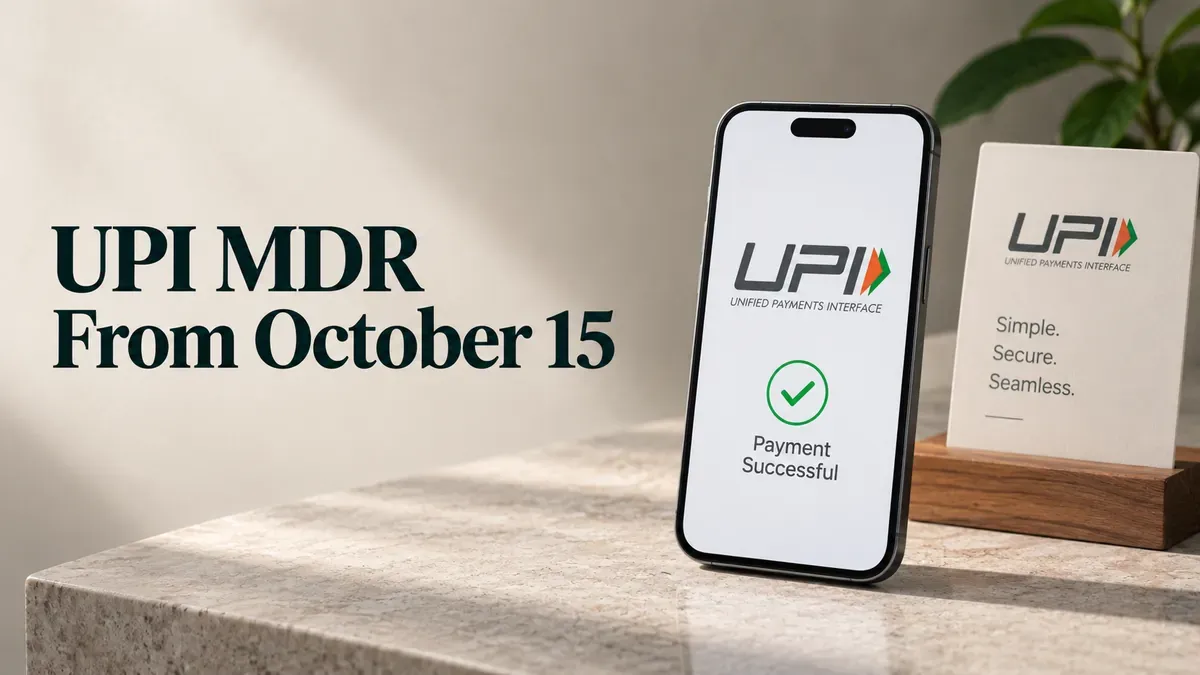
UPI will introduce a structured merchant discount rate from October 15, with a 0.4% charge on eligible P2M transactions above Rs 2,000, capped at Rs 300. Consumers will not pay MDR directly, while P2P transfers, payments up to Rs 2,000 and eligible small merchants remain outside the new framework.
India's Unified Payments Interface will introduce its first structured merchant discount rate regime from October 15, 2026, although the new framework will apply to a relatively narrow portion of UPI transactions. Person-to-person transfers will remain free, while merchant payments of up to Rs 2,000 will stay outside the MDR structure. Consumers, meanwhile, will not be charged the fee directly.
The National Payments Corporation of India has based the framework largely on transaction value. Eligible person-to-merchant payments above Rs 2,000 will attract MDR, while smaller transactions and P2P transfers will continue under the existing zero-cost model. The government has said the vast majority of UPI transactions will remain outside the new charge structure.
Consumers will not bear the MDR
MDR is levied on the merchant side of a transaction rather than being charged to the person making the payment. Banks have been advised to ensure that merchants do not pass the cost on to customers, so the amount displayed at checkout will remain unchanged for eligible UPI payments.
There is also no free-transaction quota or monthly limit being introduced for individual UPI users. Transfers to family and friends, as well as payments between a user's own accounts, will continue to remain free irrespective of the amount involved.
How the new MDR will work
For standard P2M transactions above Rs 2,000, MDR will be charged at 0.4% of the transaction value. A Rs 3,000 payment would therefore generate an MDR of Rs 12, while the charge on a Rs 50,000 transaction would be Rs 200.
The framework also puts a ceiling on the amount that can be charged. For transactions of Rs 75,000 and above, MDR will be capped at Rs 300. As a result, a Rs 1 lakh merchant payment would attract Rs 300 rather than Rs 400 under the standard 0.4% calculation.
Smaller payments and merchants remain exempt
P2M transactions of up to Rs 2,000 will not attract MDR. NPCI expects more than 95% of P2M transactions to remain unaffected by the new framework.
Small merchants will receive a separate exemption. Businesses classified under the P2PM category will continue to pay zero MDR on UPI QR transactions as long as their monthly collections remain below Rs 1 lakh.
Existing QR infrastructure will continue to operate. A merchant can move into the regular P2M category if its UPI collections exceed Rs 1 lakh a month for three consecutive months.
Some sectors will pay a flat Rs 5
The standard 0.4% rate will not apply to all merchant categories. Specified sectors including railways, telecom, insurance and fuel will attract a flat MDR of Rs 5 on qualifying payments above Rs 2,000.
For a Rs 20,000 fuel transaction, for example, the MDR would be Rs 5 rather than Rs 80 under the standard rate.
Capital-market transactions have also been assigned a separate rate. Payments involving mutual funds, securities, stockbrokers and dealers will attract MDR of 0.02%, subject to a maximum charge of Rs 300.
Why UPI is introducing MDR
The new fee structure comes as UPI has expanded rapidly in both transaction volumes and value, raising the need for a revenue model to support the payments ecosystem. UPI processed 2,451 crore transactions worth Rs 29.9 lakh crore in August 2026 alone, according to figures cited in the government's FAQ on the framework.
The MDR is not a government tax. Revenue generated under the framework will be distributed among participants in the payments ecosystem and is intended to support payment infrastructure, cybersecurity, fraud prevention and innovation.
The framework also provides for 5% of total MDR collections to be directed to a dedicated fund for expanding UPI acceptance and digital-payment infrastructure among small merchants, particularly in smaller cities and rural areas.
Also Read - ITC Shares Gain As Cigarette Price Revisions Raise Earnings And Margin Hopes
This article is for informational purposes only and should not be considered investment advice from Kotak Neo. For compliance T&C and disclaimers, Visit www.kotakneo.com/disclaimer

Rochelle Britto has spent 8+ years decoding India's markets, businesses, and consumer economy, reporting for ET Prime and Times Internet along the way, covering the stories behind the numbers.
A Mumbai native and perpetual planner of the next holiday, she stays far, far away from the eternal question, “Where are we going next?” When she's not chasing headlines, she's chasing new cultures, open roads, and a bit of quiet in nature.
Right Tools, Rich Insights