UPI Beyond Payments: How India’s Digital Payment System Is Expanding Into IPOs, Credit And More
 Add Preferred News Source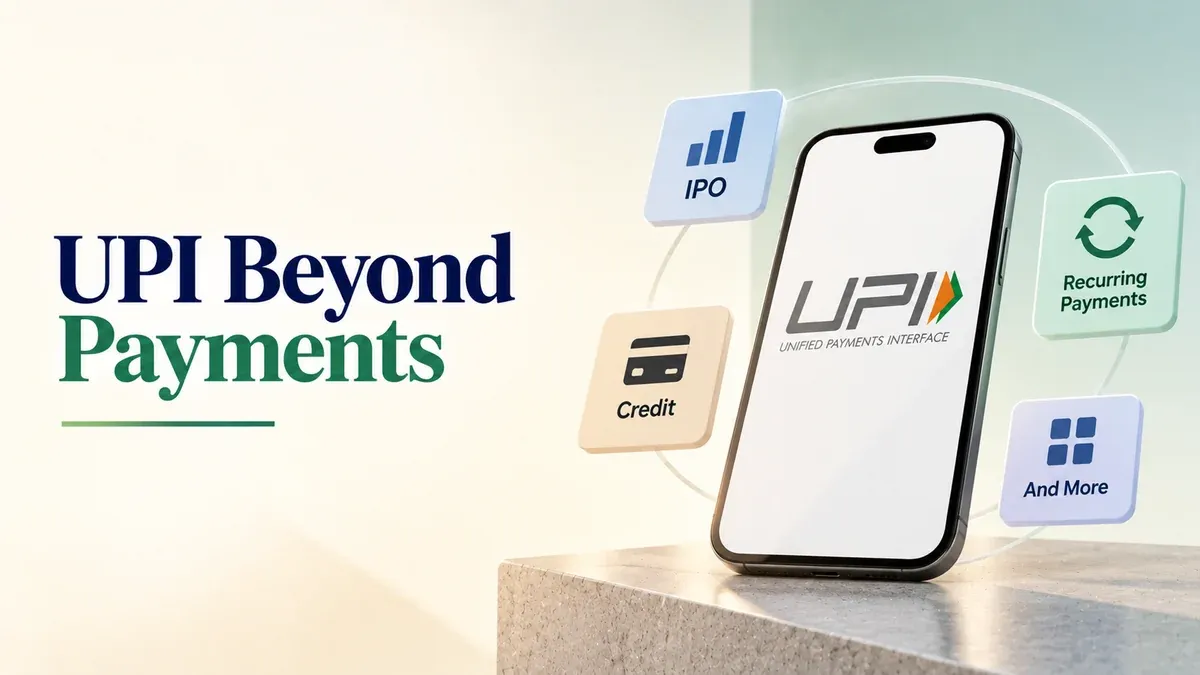
UPI has evolved from a simple digital payment mechanism into a broader financial infrastructure, with its use expanding across everyday transactions, IPO applications, credit and recurring payments as India's digital finance ecosystem continues to deepen.
India's Unified Payments Interface (UPI) has evolved from a bank-to-bank payment mechanism into one of the country's most widely used pieces of financial infrastructure, with its reach extending from routine merchant payments to IPO applications, recurring transactions and credit. In August 2026, UPI processed 24.51 billion transactions worth ₹29.82 lakh crore, according to data from the National Payments Corporation of India (NPCI), highlighting the scale at which the system has become embedded in the country's financial ecosystem.
The significance of that growth is not just the number of transactions being processed. The nature of transactions taking place through the network has also broadened. Consumers can use UPI to pay merchants, settle utility bills, automate recurring payments, authorise IPO applications and, in eligible cases, make payments through credit-linked products. This has gradually transformed UPI from a payment option into a common interface through which consumers access multiple financial services.
How UPI Became Embedded In Everyday Payments
UPI's initial proposition was relatively straightforward: enable instant bank-account-to-bank-account transfers through a mobile device without requiring consumers to share bank details with the recipient. Its adoption accelerated as merchants, banks and fintech platforms integrated QR-code payments into everyday commerce, making UPI particularly useful for low-value transactions where cash had traditionally dominated.
The system's utility has since expanded beyond merchant payments. UPI can now be used for electricity and other utility bills, insurance premiums, loan repayments and subscriptions, while UPI AutoPay allows users to approve recurring payments through a mandate rather than authorising every transaction separately. NPCI has also introduced products such as UPI Lite for smaller-value payments and UPI 123PAY to extend access to users of feature phones.
This expansion has increased the number of occasions on which a consumer interacts with UPI. A payment made at a shop may be the most visible use case, but the same infrastructure can also sit behind a monthly bill, a subscription or a financial mandate. In effect, UPI has become less dependent on the physical point of sale and more integrated into routine financial activity.
The scale is important for another reason. UPI had 752 banks live on the network in August, according to NPCI data. At that level of participation, its role is no longer confined to individual payment applications. It has become a common layer connecting banks, merchants, payment-service providers and consumers.
Why IPO Applications Are An Important UPI Use Case
The expansion of UPI into the capital markets illustrates how the network is moving beyond conventional payments. Retail investors applying for an IPO can provide their UPI ID as the payment mechanism, after which a mandate request is sent to their UPI application. Once approved, the application amount is blocked in the investor's bank account rather than immediately transferred.
The amount corresponding to the shares allotted is subsequently debited, while the remaining blocked amount is released if the investor receives no allotment or is allotted fewer shares than applied for. The mechanism, therefore, uses UPI not merely to transfer funds but to authenticate the investor and facilitate the blocking and subsequent release of money during the IPO process.
This has reduced the need for a separate payment workflow for retail IPO applications. An investor can use the same banking or UPI application used for everyday transactions to approve a public-issue mandate. NPCI's UPI IPO framework is designed to connect the investor's bank account, UPI application and intermediary handling the IPO application within the same process.
The significance goes beyond convenience. As retail participation in capital markets has increased, integrating payments with investment platforms has helped make the payment component of an IPO application more familiar to individual investors. UPI has consequently become part of the infrastructure supporting not just consumption but also participation in financial markets.
Also Read - HDFC Bank Shares Advances As RBI Seeks Feedback On Anup Bagchi For MD And CEO Post
This article is for informational purposes only and should not be considered investment advice from Kotak Neo. For compliance T&C and disclaimers, Visit www.kotakneo.com/disclaimer

Rochelle Britto has spent 8+ years decoding India's markets, businesses, and consumer economy, reporting for ET Prime and Times Internet along the way, covering the stories behind the numbers.
A Mumbai native and perpetual planner of the next holiday, she stays far, far away from the eternal question, “Where are we going next?” When she's not chasing headlines, she's chasing new cultures, open roads, and a bit of quiet in nature.
Right Tools, Rich Insights