BHEL vs NTPC: What the divergence in share price performance says about India’s power sector
 Add Preferred News Source
According to Kotak Neo, NTPC’s weaker performance cannot be attributed primarily to the recent fall in NTPC Green Energy, as the subsidiary has limited weight in the parent company’s overall valuation.
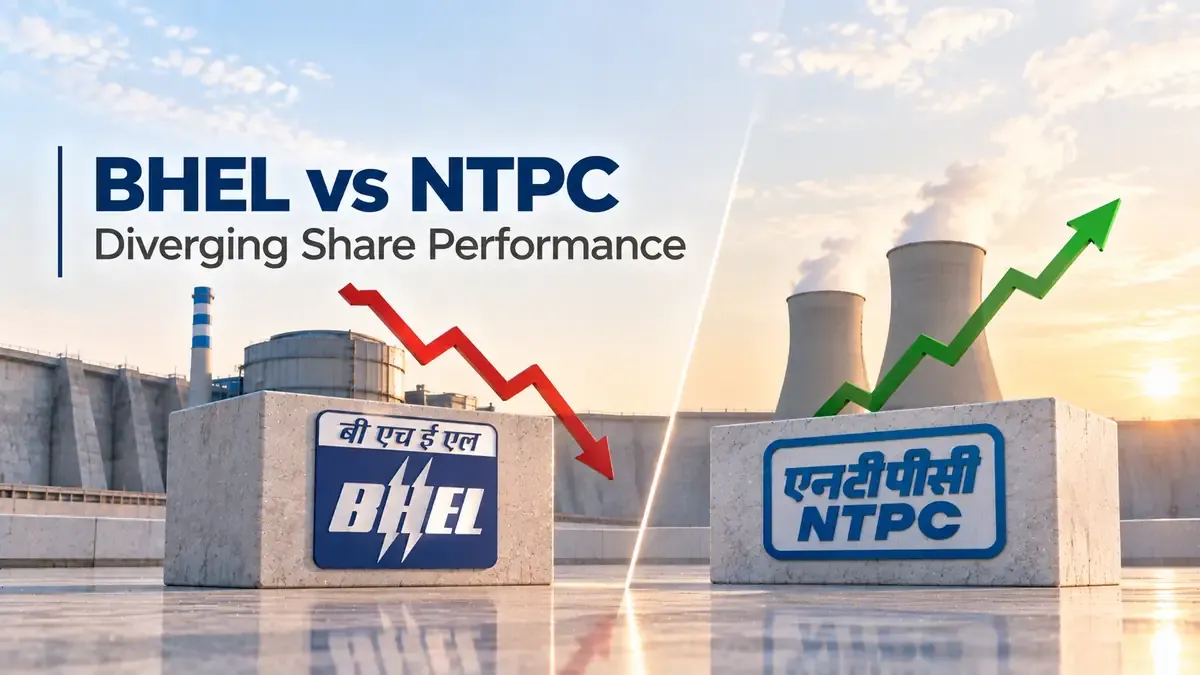
Bharat Heavy Electricals (BHEL) has raced ahead of NTPC this year, with the gap in their stock performance widening to around 80 percentage points since April 1. BHEL has gained 46% in 2026, while NTPC has slipped towards its 52-week low, reflecting a growing difference in how the market views the prospects for thermal power and the businesses that supply it.
BHEL shares were trading 0.9% higher at Rs 425.20 on Tuesday, while NTPC was down 0.6% at Rs 330. Kotak Neo's reverse valuation exercise, however, suggests the rally in BHEL has taken the stock's implied thermal equipment opportunity well beyond the level of capacity addition currently expected in India.
Why is BHEL outperforming NTPC?
BHEL's market capitalisation is now around Rs 1.5 lakh crore. After assigning 25% of that value to its non-thermal businesses, Kotak Neo arrives at a valuation of roughly Rs 1.13 lakh crore for its thermal equipment business.
At a 10% PAT margin, that valuation would require around 150 GW of lifetime thermal equipment sales. If margins settle at 7.5%, the required sales rise to about 200 GW. That compares with Kotak Neo's estimate of around 100 GW of aggregate thermal capacity additions in India, before taking into account the time value of future cash flows.
The gap matters because BHEL's earnings from its thermal business ultimately depend on the number of projects that get built, the orders it wins and the margins it can retain. The current valuation therefore leaves the company needing a sizeable share of a thermal equipment market that is still some distance away from the scale implied by the stock price.
What is driving the BHEL-NTPC divergence?
The backdrop for thermal power has changed sharply in the past few years. India added just 2 GW of thermal capacity in the first five months of FY27, after 7 GW in FY26, 4 GW in FY25 and 6 GW in FY24. At the same time, utility-scale and rooftop solar capacity rose to 133 GW in FY26 from 103 GW a year earlier and 81 GW in FY24.
Kotak Neo expects the gap between the two sources of capacity to widen further. Renewable capacity is projected to rise from 187 GW in FY26 to 310 GW by FY30, while coal-based capacity is expected to increase only from 231 GW to 242 GW. Recent auctions have also seen six hours of solar with 12 hours of storage priced at around Rs 5.4 per kWh, improving the economics of renewable power even as electricity demand continues to grow.
That is a more direct concern for NTPC, where slower thermal additions could limit the pace of earnings growth from its conventional power business. For BHEL, the impact is different: the question is how much of the thermal equipment opportunity that does emerge will flow to the company.
Kotak Neo said the recent correction in NTPC Green Energy is unlikely to explain much of NTPC's underperformance because the subsidiary accounts for a relatively small portion of the parent's sum-of-the-parts valuation.
What do BHEL and NTPC valuations imply?
NTPC's current valuation implies a much smaller thermal expansion requirement under Kotak Neo's reverse valuation framework. At a 1.5-times price-to-book multiple for regulated equity, the implied incremental thermal capacity is around 42 GW.
The number changes sharply with the valuation multiple. At 1.25 times book, the implied capacity rises to 128 GW, while at 1.75 times it falls to just 13 GW.
The Central Electricity Authority expects 86 GW of thermal capacity additions between FY27 and FY36. Private-sector companies are also likely to take a share of that market; Adani, for instance, is targeting around 4 GW of annual capacity additions during FY27-32.
The comparison shows why the market's expectations for BHEL and NTPC have moved in different directions. BHEL needs a large and profitable equipment order pipeline to support its valuation, while NTPC's challenge is to maintain growth as the country's power mix gradually shifts towards renewables.
Kotak Neo estimates that 100 GW of new thermal capacity would create an undiscounted profit pool of Rs 50,000 crore to Rs 1 lakh crore for equipment manufacturers. The estimate assumes equipment realisation of Rs 10 crore per MW and a 10% net profit margin.
If BHEL were to capture 75% of that market, its revenue opportunity would be around Rs 75,000 crore. At a 5% margin, the corresponding cumulative PAT would be Rs 37,500 crore; at 7.5%, it would be Rs 56,300 crore, and at 10%, Rs 75,000 crore.
BHEL's historical cash generation provides some context to the valuation. The company generated aggregate free cash flow of Rs 20,100 crore between FY2007 and FY26, including Rs 5,300 crore in FY26.
The numbers underline the scale of expectations now built into BHEL's market value. Even if thermal capacity additions reach the estimated 100 GW, BHEL's ability to capture orders and convert them into profits will determine how much of that opportunity ultimately accrues to shareholders.
BHEL, NTPC share price performance
BHEL has gained 46% so far in 2026, with the stock at Rs 425.20 on Tuesday. NTPC, on the other hand, was trading at Rs 330, down 0.6% on the day and close to its 52-week low of Rs 315.
The 80-percentage-point gap since April captures the market's sharply different expectations for the two companies. For BHEL, the focus is increasingly on the size, timing and profitability of its future thermal equipment orders; for NTPC, the pace at which thermal capacity is added alongside the country's fast-growing renewable fleet remains the bigger issue.
Also Read - ICICI Lombard Faces ₹1 Crore IRDAI Penalty Over Outsourcing And Compliance Lapses
This article is for informational purposes only and should not be considered investment advice from Kotak Neo. For compliance T&C and disclaimers, Visit www.kotakneo.com/disclaimer

Rochelle Britto has spent 8+ years decoding India's markets, businesses, and consumer economy, reporting for ET Prime and Times Internet along the way, covering the stories behind the numbers.
A Mumbai native and perpetual planner of the next holiday, she stays far, far away from the eternal question, “Where are we going next?” When she's not chasing headlines, she's chasing new cultures, open roads, and a bit of quiet in nature.
Right Tools, Rich Insights