Adani Green Expands Khavda Project With 3.37 GWh Battery Storage System
 Add Preferred News Source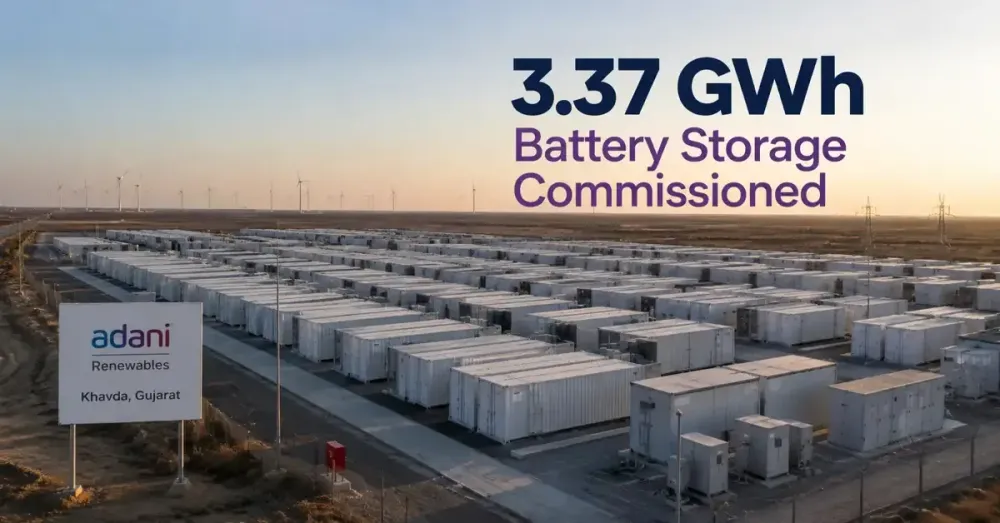
Adani Green has commissioned a 3.37 GWh battery storage system at Khavda, Gujarat, strengthening renewable power integration and grid stability. Read more about the company’s expansion plans and clean energy roadmap.
Adani Green Energy Limited (AGEL) on Tuesday said it has commissioned a 3.37 gigawatt-hour (GWh) Battery Energy Storage System (BESS) at its Khavda renewable energy site in Gujarat, strengthening India’s push toward large-scale clean energy integration.
The project, completed within 10 months of construction starting, is being described by the company as the world’s largest single-location battery storage deployment outside China. The development comes as India accelerates investments in renewable infrastructure to support its net-zero emissions target for 2070.
Adani Green Energy Limited shares jumped 2.19% on Tuesday at 2:46 PM, as investors tracked the company’s expansion in storage-backed renewable power projects.
The Khavda site has already emerged as one of the country’s biggest clean energy hubs, with 9.9 GW of renewable capacity operational under AGEL’s larger 30 GW project spread across 538 square kilometres in Gujarat.
Why Is Battery Storage Becoming Important?
Battery energy storage systems are increasingly seen as critical for managing renewable power generated from solar and wind projects. Since renewable generation depends on weather conditions, storage systems help hold excess electricity and release it during periods of high demand.
AGEL said the newly commissioned system can store enough clean energy to power nearly one million homes for a full day. The company also claimed that the project can support peak electricity demand equivalent to cities such as Indore and Chandigarh, or even the entire state of Goa.
The storage system uses lithium-ion battery technology integrated with advanced energy management systems. According to the company, the project will help improve grid reliability while enabling round-the-clock renewable energy supply at scale.
Khavda Remains Central To AGEL’s Expansion
The Khavda project has become a key part of AGEL’s long-term renewable energy strategy. The company had operationalised its first 1,000 MW of solar capacity at the site in March 2024, less than a year after construction work began.
AGEL said it had earlier added 1.37 GWh of battery storage capacity in March 2026, taking the site’s total operational storage capacity to 3.37 GWh.
Sagar Adani, Executive Director of AGEL, said large-scale energy storage would play a defining role in India’s clean energy transition. He added that investments in battery infrastructure reflect the company’s long-term commitment to building resilient and flexible energy systems.
Also Read - BP To Help ONGC Boost Western Offshore Output By 24% Over Ten Years Under New TSP Deal
The company has also outlined aggressive expansion plans. AGEL aims to add more than 10 GWh of battery storage capacity in FY27 and scale its overall storage portfolio to 50 GWh over the next five years.
Sources:
The Economic Times
ANI
This article is for informational purposes only and should not be considered investment advice from Kotak Neo. For compliance T&C and disclaimers, Visit www.kotakneo.com/disclaimer
Right Tools, Rich Insights