Zerodha Gets SEBI Clearance For Merchant Banking Licence
 Add Preferred News Source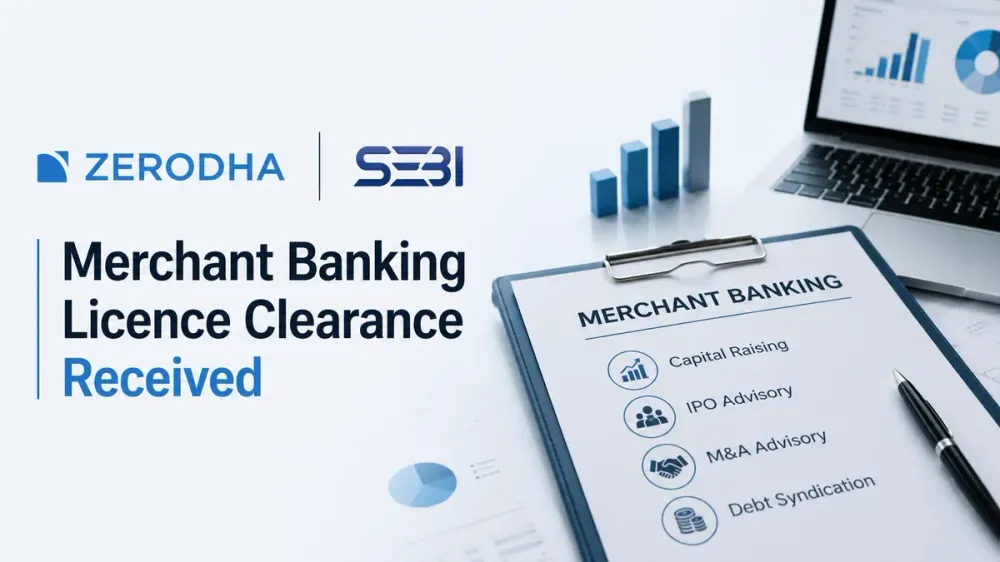
Zerodha has received SEBI clearance for its merchant banking application. This brings it closer to entering IPOs, FPOs, rights issues and other capital-market transactions.
Zerodha’s application for a merchant banking licence has been cleared by the Securities and Exchange Board of India (SEBI), according to sources. The formal registration is still pending.
The application was filed by Zerodha Corporate Advisors on 27 April 2026. The company had earlier confirmed that it applied for the licence and would share more details about its plans after receiving regulatory approval.
If the registration is completed, Zerodha can take up assignments such as initial public offerings (IPOs), follow-on public offers (FPOs), rights issues and other fundraising transactions.
Why Is Zerodha Moving Into Investment Banking?
The licence would allow Zerodha to expand beyond its core broking business. The company has already expanded into areas including asset management, lending through Zerodha Capital and proprietary investments.
It is also registered with the International Financial Services Centres Authority (IFSCA) as a broker-dealer in GIFT City, where it can facilitate overseas investments for Indian investors.
A merchant banking business would give the group another way to participate in India’s capital-raising market and put it in competition with established investment banks.
Is The IPO Market Supporting Zerodha’s Entry?
The timing comes as activity in India’s primary market has picked up after a slower first half of 2026. Several companies had postponed IPO plans amid market volatility and geopolitical uncertainty.
July and August together accounted for nearly 69% of the capital raised through IPOs in 2026 so far. Improving investor sentiment, more realistic valuations and fundraising needs across sectors such as infrastructure and manufacturing have helped bring activity back.
What Are The New SEBI Capital Requirements?
SEBI raised the capital requirements for merchant bankers. Category I merchant bankers now need a minimum net worth of ₹50 crore, compared with ₹5 crore earlier, while Category II entities need at least ₹10 crore.
Category I entities can manage main-board public issues, while Category II merchant bankers cannot. The revised framework also includes liquid net-worth requirements and limits aggregate underwriting obligations to 20 times liquid net worth.
Before it can begin offering merchant banking services, Zerodha’s next step will be to complete the registration process.
Also Read - Technocraft Ventures Ltd. Q1 FY27 Results: PAT Up 14.56% To ₹10.70 Crore
This article is for informational purposes only and should not be considered investment advice from Kotak Neo. For compliance T&C and disclaimers, Visit www.kotakneo.com/disclaimer

Vishwa has spent 10+ years across fintech and FMCG doing what most people miss, connecting the dots, catching trends before they trend, and finding the angle nobody else thought to ask about.
At Kotak Neo, she drives content strategy for neoshorts, Kotak News Desk, and Investing Guide, turning market noise into something worth reading.
When she's not decoding markets, she trades charts for canvases, chasing art, painting, and architecture across cities she's yet to explore.
Right Tools, Rich Insights