 Add Preferred News Source
1,097 Views| 25 Oct 2026
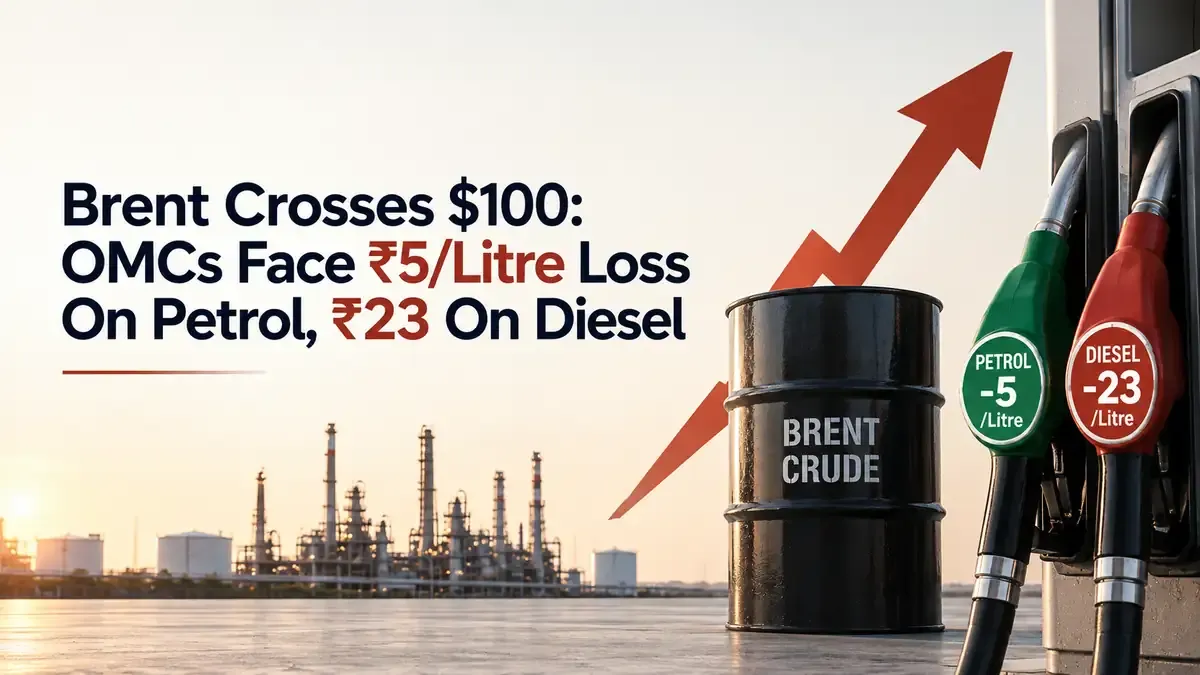
Brent Crosses $100: OMCs Face ₹5/Litre Loss on Petrol, ₹23 on Diesel
Summary
Brent crude has crossed $100 a barrel as US-Iran tensions disrupt oil supplies. Indian OMCs are now estimated to be losing ₹5 per litre on petrol and ₹23 per litre on diesel, while LPG under-recoveries have reached ₹200 per cylinder. The surge threatens margins, inflation and India’s oil import bill.
India’s oil marketing companies (OMCs) are facing a sharp squeeze on fuel marketing margins as Brent crude climbs above $100 per barrel. Petrol is currently estimated to be generating a negative margin of ₹5 per litre, while the loss on diesel has widened to ₹23 per litre.
The jump in crude prices comes as tensions between the US and Iran intensify, disrupting oil flows and lifting the geopolitical risk premium. Brent had been trading around $70–75 per barrel before the conflict began at the end of February.
The Indian crude basket has risen to about $109 a barrel, according to Investment Information and Credit Rating Agency (ICRA). Domestic fuel prices, however, have remained unchanged despite the sharp increase in international crude costs. The government had raised petrol prices by ₹7.35 per litre and diesel by ₹7.53 per litre in May, through four instalments.
ONGC, Oil India Shares Rise
Shares of upstream oil companies gained in morning trade on September 10 as crude prices remained above $100. Oil and Natural Gas Company (ONGC) rose 1.8% to ₹238.15, while Oil India climbed 2.25% to ₹510.20 at 10:25 am. However, both stocks pared some of their gains later in the session and were trading up by less than 1% at 01:09 pm IST.
The divergence between upstream and downstream businesses reflects the impact of higher crude prices. Producers can benefit from stronger realisations, while fuel retailers face margin pressure when pump prices do not move in line with crude.
Why Crude Prices Are Rising
Brent futures were at $97.16 a barrel, down 0.062%, while US West Texas Intermediate (WTI) stood at $96.2, up 0.16%, at 01:11 pm IST.
Oil markets remain tight because supplies through the Strait of Hormuz are well below pre-conflict levels. The waterway previously handled roughly one-fifth of global oil and gas supplies.
Key factors supporting crude prices include:
-
Disruption to Middle Eastern oil flows
-
Lower global inventories
-
Increased purchases by countries such as China
-
Shipping disruptions around the Persian Gulf and Red Sea
-
Uncertainty over volumes moving through Hormuz
India’s Import Bill Under Pressure
Higher crude prices are particularly significant for India, which imports nearly 90% of its crude oil requirements and about half of its natural gas needs.
India’s crude oil import bill rose 56.5% to $63.4 billion during April-July of FY27, even though imports were broadly unchanged at 81.9 million tonnes.
The higher oil bill could add to inflation and weigh on economic growth. Oil-sensitive sectors such as aviation, paints, tyres, chemicals, logistics and FMCG are also likely to face higher costs.
OMC Margins Could Stay Under Strain
ICRA estimates that petrol and diesel marketing margins were negative at ₹5 and ₹23 per litre, respectively, based on the average crude price for September so far. Domestic LPG is also facing an under-recovery of about ₹200 per cylinder.
If geopolitical tensions persist, crude prices could rise further. Refiners are therefore looking to diversify supplies, including through greater reliance on Russia, Brazil and selected African producers.
For OMCs, the key pressure point remains the gap between international crude costs and domestic pump prices. A prolonged period above $100 could significantly weaken their profitability unless retail fuel prices or other operating economics adjust.
Also Read - Molbio Diagnostics Hits 20% Upper Circuit As Shares Surge 87% From IPO Price
This article is for informational purposes only and should not be considered investment advice from Kotak Neo. For compliance T&C and disclaimers, Visit www.kotakneo.com/disclaimer
About the Author

Vishwa Ved
Vishwa has spent 10+ years across fintech and FMCG doing what most people miss, connecting the dots, catching trends before they trend, and finding the angle nobody else thought to ask about.
At Kotak Neo, she drives content strategy for neoshorts, Kotak News Desk, and Investing Guide, turning market noise into something worth reading.
When she's not decoding markets, she trades charts for canvases, chasing art, painting, and architecture across cities she's yet to explore.
Right Tools, Rich Insights

Latest News
- 1,071 Views| 25 Oct 2026
- 1,054 Views| 25 Oct 2026
- 1,089 Views| 25 Oct 2026
- 1,010 Views| 25 Oct 2026
- 1,019 Views| 24 Oct 2026
- 1,041 Views| 24 Oct 2026
- 1,051 Views| 24 Oct 2026
- 1,032 Views| 24 Oct 2026
- 1,012 Views| 24 Oct 2026