 Add Preferred News Source
1,017 Views| 24 Oct 2026
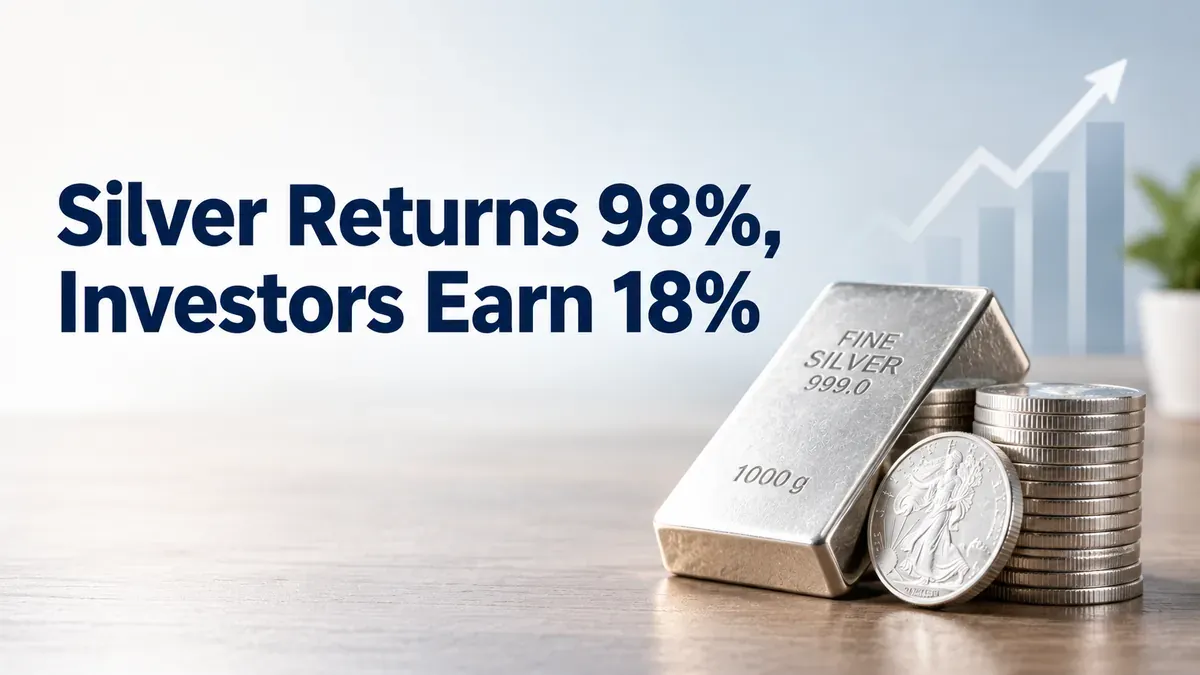
Silver Returns 98% In One Year, But Investors Made Just 18%: Here’s Why
Summary
Silver delivered a 98% return over one year, but the average investor earned only 18%, with 56% of investments in silver ETFs showing losses by the end of July.
Silver delivered a 98% return in the one-year period ended 31 July 2026, but the average investor earned only 18% on a money-weighted basis, according to a DSP Mutual Fund report.
The gap was largely about timing. While silver was already climbing, investor money flowed in much more aggressively after the rally had picked up pace. As a result, many investors missed the full rise.
Why Did Investors Earn So Little?
The 98% figure represents silver’s performance over the entire one-year period. An investor’s actual return depends on when they put money into silver and how much they invested at different points.
According to the report, silver exchange-traded funds (ETFs) received ₹11,761 crore of inflows in January 2026, when silver prices were close to their peak. The monthly inflow was equivalent to the cumulative inflows recorded between September 2024 and August 2025, when silver prices were below ₹1.41 lakh.
This meant a large amount of money entered the market after a substantial part of the rally had already taken place.
How Did FOMO Affect Silver ETF Investment?
Fear of Missing Out (FOMO) was yet another cause. The data suggests that the investment pattern was pro-cyclical, with higher silver prices attracting investors to invest more money. 56% of the funds put into silver ETFs in the 12 months up to July 2026 had fallen in value as of 31 July.
The report's analysis highlights the difference between an asset’s return and the return actually earned by investors. A strong past return can attract fresh money, but investors entering later start from a much higher price.
What Does The Silver Rally Tell Investors?
The silver price rally shows why headline returns do not always translate into similar investor returns. Someone invested before the sharp rise had more of the rally to capture, while those who entered after prices had already climbed had less room to benefit.
The data also show the risk of investing based mainly on recent performance. A 98% gain over the previous year does not mean the same return can be expected from the next year.
The key takeaway is simple: when an asset has already rallied sharply, the timing of fresh investment can make a major difference to the return investors actually earn.
Also Read - Bank Of Baroda To Offload Up To 35% Of Its NSE Holding Through Proposed IPO
This article is for informational purposes only and should not be considered investment advice from Kotak Neo. For compliance T&C and disclaimers, Visit www.kotakneo.com/disclaimer
About the Author

Vishwa Ved
Vishwa has spent 10+ years across fintech and FMCG doing what most people miss, connecting the dots, catching trends before they trend, and finding the angle nobody else thought to ask about.
At Kotak Neo, she drives content strategy for neoshorts, Kotak News Desk, and Investing Guide, turning market noise into something worth reading.
When she's not decoding markets, she trades charts for canvases, chasing art, painting, and architecture across cities she's yet to explore.
Right Tools, Rich Insights

Latest News
- 1,065 Views| 24 Oct 2026
- 1,022 Views| 24 Oct 2026
- 1,038 Views| 23 Oct 2026
- 1,071 Views| 23 Oct 2026
- 1,084 Views| 23 Oct 2026
- 1,058 Views| 23 Oct 2026
- 1,058 Views| 23 Oct 2026
- 1,067 Views| 23 Oct 2026
- Paras Healthcare IPO Allotment Status: Check Online on MUFG Intime India, NSE & BSE for Live Updates
 1,085 Views| 23 Oct 2026