Indian Oil Ramps Up LPG Output By 30% Amid Hormuz Disruption
 Add Preferred News Source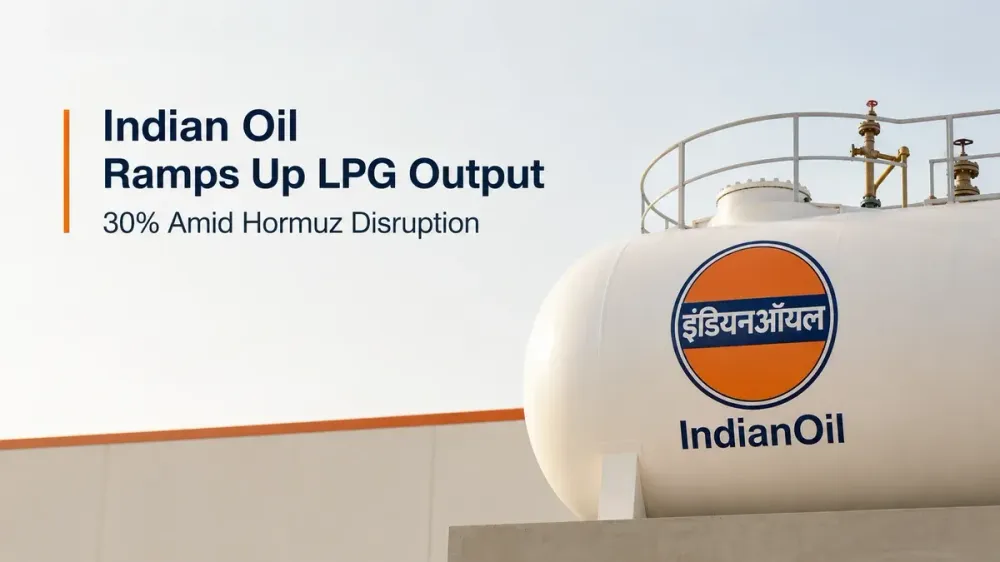
The supply chains are now worried about the disturbance of the Strait of Hormuz because India depends on imported crude and LPG. Indian Oil is responding through higher refinery utilisation, alternative crude sourcing and operational changes.
Indian Oil Corporation (IOC) has stepped up efforts to protect domestic fuel supplies as disruption to maritime trade through the Strait of Hormuz puts pressure on India’s energy security.
The state-owned refiner has increased LPG production by around 30% and kept its refineries running above full capacity, while also changing its crude sourcing strategy.
Why Strait Of Hormuz Is Critical For India
The disruption is particularly significant for India because of its heavy dependence on imports. More than 88% of the country’s crude oil requirement is imported, while about 45% of crude imports and nearly 90% of LPG imports are linked to the Strait of Hormuz, according to IOC chairman Arvinder Singh Sahney.
This leaves refiners exposed to any prolonged disruption in the waterway, which is a key route for energy shipments into Asia.
Indian Oil Changes Sourcing And Refinery Operations
IOC has responded by diversifying its crude purchases and moving significantly away from Middle Eastern crude grades. The company has also flexed refinery operations to process different crude varieties and secure supplies from alternative geographies.
Its refineries are running over full capacity for the time being to help keep the domestic availability of fuel despite the disruption. The company has also tightened supply-chain monitoring, including round-the-clock control rooms and daily reviews of market conditions and cargo movements.
Record Refining Performance Supports Supply Push
The latest measures come after IOC delivered a record operating performance in FY26. The company processed 75.45 million tonnes of crude during the year, while domestic petroleum-product sales reached 88.97 million tonnes.
The strong run continued into the June quarter, with crude throughput reaching 19.17 million tonnes, equivalent to 109.4% of installed capacity. Pipeline throughput also touched a quarterly record of 28.55 million tonnes.
Refining Expansion, Diversification Remain In Focus
IOC is also expanding its longer-term capacity. Projects at its Panipat, Gujarat and Barauni refinery complexes are expected to take its group refining capacity from 80.75 million tonnes a year to around 98 million tonnes.
Beyond refining, the company is increasing investments across petrochemicals, natural gas, renewables, biofuels, green hydrogen and sustainable aviation fuel. These efforts could help diversify its energy portfolio in the long run, while the current Hormuz disruption shows the importance of flexible sourcing and refining capabilities.
Also Read - Kalyan Jewellers, Titan Fall As PM Modi Urges Gold Buying Restraint
This article is for informational purposes only and should not be considered investment advice from Kotak Neo. For compliance T&C and disclaimers, Visit www.kotakneo.com/disclaimer

Vishwa has spent 10+ years across fintech and FMCG doing what most people miss, connecting the dots, catching trends before they trend, and finding the angle nobody else thought to ask about.
At Kotak Neo, she drives content strategy for neoshorts, Kotak News Desk, and Investing Guide, turning market noise into something worth reading.
When she's not decoding markets, she trades charts for canvases, chasing art, painting, and architecture across cities she's yet to explore.
Right Tools, Rich Insights