Asian Stock Markets Crash As KOSPI Plunges 7.7%, Nikkei Falls Over 5% On US Inflation and Fed Rate Hike Fears
 Add Preferred News Source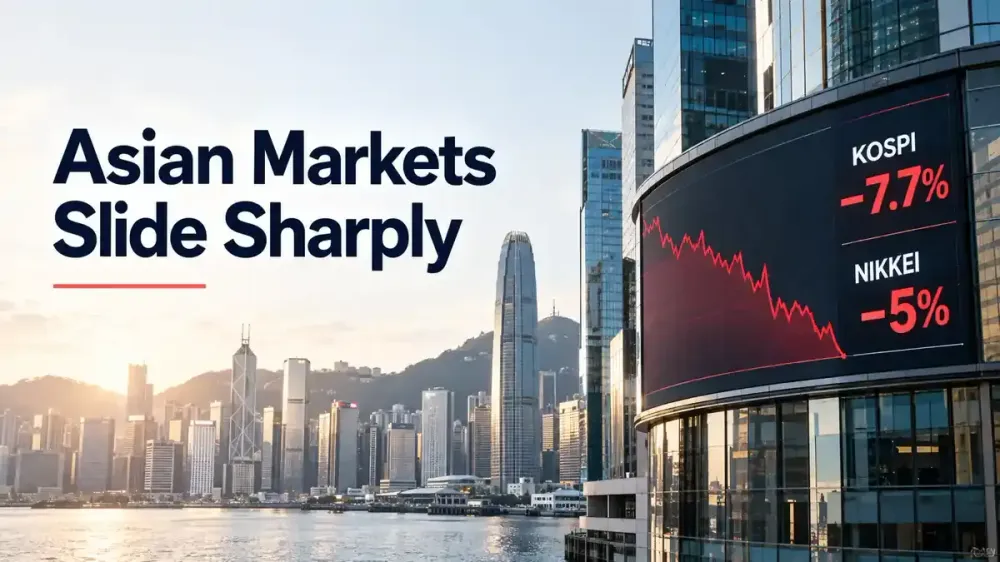
Asian stock markets tumbled on Thursday as hotter-than-expected US inflation revived fears of further Federal Reserve rate hikes. South Korea’s KOSPI suffered a steep decline, while Japan’s Nikkei 225 also slumped. Semiconductor and artificial intelligence (AI)-linked stocks led the selloff, extending Wall Street’s losses as investors reassessed technology valuations, borrowing costs and the sustainability of AI investment.
Asian equities came under heavy selling pressure on Thursday as rising US inflation heightened concerns about tighter monetary policy. South Korea’s KOSPI plunged 7.7%, putting it on course for its steepest fall since April, while Japan’s Nikkei 225 dropped more than 5%.
The selloff spread across the region as investors reduced exposure to technology stocks that had powered this year’s AI-driven rally. The MSCI Asia Pacific index fell 2.9%, heading towards its lowest close since July. Hong Kong’s Hang Seng declined 1%, while China’s Shanghai Composite shed 1.5%.
The weakness followed another session of losses on Wall Street, where technology shares bore the brunt of concerns over inflation, interest rates and elevated valuations. US equity futures also pointed to further pressure on markets.
Asian Stock Market Crash: Key Index Movements Summary
Index | Movement |
|---|---|
South Korea’s KOSPI | −7.7% |
Japan’s Nikkei 225 | More than −5% |
MSCI Asia Pacific | −2.9% |
China’s Shanghai Composite | −1.5% |
Hong Kong’s Hang Seng | −1.0% |
Semiconductor Stocks Lead The Selloff
Chipmakers suffered some of the sharpest losses as concerns over AI spending and financing costs intensified. Samsung Electronics and SK Hynix each plunged more than 9%, while Japanese semiconductor-related companies Ibiden and Kioxia Holdings also ranked among the major losers.
SK Hynix, a major beneficiary of the global AI investment boom, has lost 57% of its market value from its peak four months earlier. The reversal highlights how quickly sentiment can change towards companies whose valuations depend heavily on sustained investment in AI infrastructure.
US Inflation Revives Federal Reserve Rate Hike Fears
September’s US consumer price data showed inflation rising faster than economists had anticipated, prompting investors to reassess the Federal Reserve’s policy outlook.
According to CME Group’s FedWatch tool, the implied probability of a 25-basis-point rate increase at the Fed’s 28 October meeting rose to 31.6%, from 22.1% a day earlier.
Higher borrowing costs can weigh on growth-oriented technology companies by reducing the present value of expected future earnings. Demand for safer assets also supported US Treasury securities, while the dollar weakened.
Wall Street Losses Add To Global Market Pressure
US markets extended their declines for a third consecutive session on Wednesday. The Nasdaq Composite fell 1.88% to 26,692.87, marking its steepest daily drop since 23 July.
The S&P 500 declined 1.11% to 7,718.94, while the Dow Jones Industrial Average slipped 0.09% to 51,621.48.
Selling pressure persisted in early Asian trading, with Nasdaq 100 futures down 1% and S&P 500 futures lower by 0.5% as of noon in Tokyo. The latest moves reflect growing unease over the combination of persistent inflation, potentially higher interest rates and uncertainty surrounding the returns on substantial AI investments.
Source
NSE
Also Read - IPOs Open For Subscription Today: 4 Issues Worth Over ₹8,800 Crore Hit Market; Check Price Bands, Lot Sizes
This article is for informational purposes only and should not be considered investment advice from Kotak Neo. For compliance T&C and disclaimers, Visit www.kotakneo.com/disclaimer

Vishwa has spent 10+ years across fintech and FMCG doing what most people miss, connecting the dots, catching trends before they trend, and finding the angle nobody else thought to ask about.
At Kotak Neo, she drives content strategy for neoshorts, Kotak News Desk, and Investing Guide, turning market noise into something worth reading.
When she's not decoding markets, she trades charts for canvases, chasing art, painting, and architecture across cities she's yet to explore.
Right Tools, Rich Insights