Nestlé India, Britannia, ITC, HUL Shares In Focus After FSSAI Red Label Proposal
 Add Preferred News Source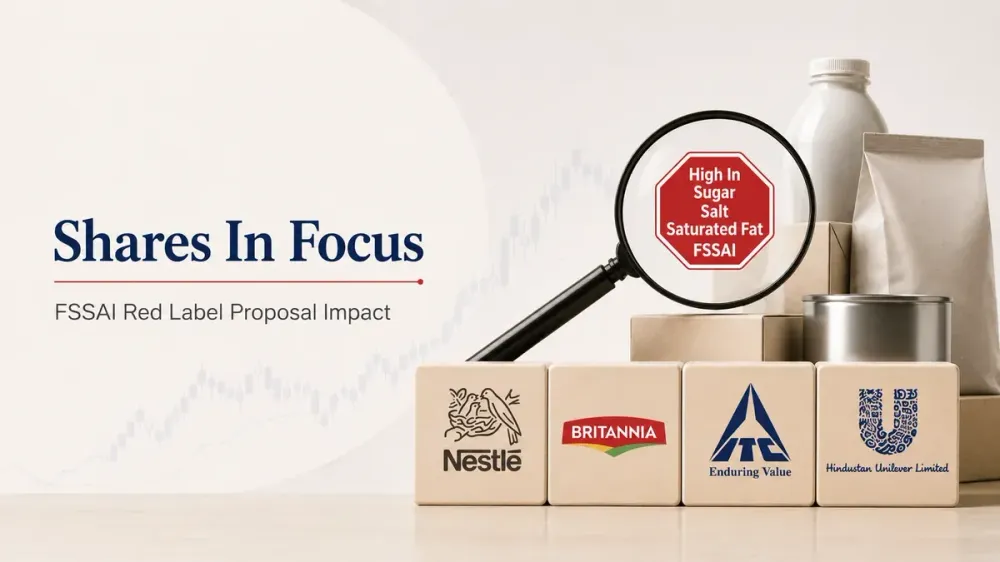
Nestlé India, Britannia, ITC, HUL and Varun Beverages are in focus after FSSAI proposed red warning labels for high-sugar, salt and fat foods.
Packaged-food and beverage stocks came under pressure in early trade on Monday, August 31, after a proposed front-of-pack warning system from India's food regulator brought products high in sugar, salt and saturated fat into focus.
Nestlé India, Britannia Industries, ITC, Tata Consumer Products and Varun Beverages were among the stocks trading lower during the morning session. Hindustan Unilever, however, moved higher.
The market reaction came after the Food Safety and Standards Authority of India (FSSAI) told the Supreme Court that it has proposed a red-coloured warning label for certain packaged food and beverage products.
How Are Nestlé India, Britannia, ITC Shares Trading?
At 10:17 am, Nestlé India shares were down 0.65% at ₹1,445.20 on the NSE. ITC declined 0.41% to ₹264.90, while Tata Consumer Products was trading 0.97% lower at ₹1,030.60.
Britannia Industries fell 1% to ₹5,255.50 and Varun Beverages declined 0.81% to ₹410.65.
Hindustan Unilever was an outlier, with the stock trading more than 1% higher at ₹1,988.50.
The moves suggest that the proposed regulation is being assessed differently across the FMCG universe, depending on individual companies' product portfolios and their exposure to categories that could fall under the proposed labelling system.
What Is The FSSAI Red Warning Label Proposal?
The proposed framework would place a prominent red hexagonal warning on packaged food products that are high in specified nutrients of concern.
FSSAI has proposed applying the warning where a product is high in any two or more of added saturated fat, added sugar and salt.
The proposed label could carry one or more declarations, including “High Fat”, “High Sugar”, “High Salt” and “Highly Sweetened Beverage”.
The nutrient thresholds would be based on the Dietary Guidelines for Indians, 2024, issued by the Indian Council of Medical Research-National Institute of Nutrition (ICMR-NIN).
According to the regulator's compliance affidavit, the objective is to give consumers a warning that is prominent, simple and easy to understand when purchasing packaged products.
Why Has The FSSAI Proposal Come Up Now?
The proposal comes against the backdrop of proceedings before the Supreme Court over front-of-package warning labels.
The FSSAI filed its compliance affidavit after the apex court's August 13 order in a petition brought by public charitable trust 3S and Our Health Society. The petitioner, represented by advocate Rajiv Shankar Dvivedi, has sought mandatory front-of-package warning labels for packaged foods across the Centre, states and Union territories.
During the hearing, a bench comprising Justices J B Pardiwala and K Vinod Chandran questioned the regulator over the delay in introducing such warnings and asked whether the government “does not want its people to be healthy”.
The latest filing therefore provides details of the warning-label approach being proposed by the food regulator.
Which FMCG Stocks Could See An Impact?
The potential effect will vary significantly across companies because the proposed labels would apply to individual products rather than automatically to an entire company's portfolio.
Nestlé India could remain in focus because its portfolio includes noodles, chocolates, confectionery and other packaged foods. Products crossing the prescribed thresholds could require the proposed warnings and, depending on the final rules, could potentially prompt changes to formulations.
Britannia Industries has substantial exposure to biscuits and bakery products. The company's eventual exposure would depend on how the nutrient thresholds are applied to its products.
For ITC, the impact needs to be viewed against its broader business mix. Its packaged-food portfolio includes biscuits, snacks and other food products, meaning the proposed rules could affect specific categories rather than the company as a whole.
Tata Consumer Products also has exposure to both packaged foods and beverages. The final product-level thresholds will be important in determining how much of its portfolio falls within the proposed framework.
Varun Beverages could attract particular attention because the proposal includes a specific “Highly Sweetened Beverage” declaration. Any eventual requirement affecting sugary beverages could therefore be relevant to the company.
Hindustan Unilever also has a packaged-food and beverage presence, although its broader portfolio is more diversified. The stock's Monday move was positive despite the regulatory development.
Bikaji Foods, with its focus on packaged snacks, is another name that could be sensitive to the final scope of the rules, particularly if a wider range of high-salt or high-fat snack products comes under the framework.
What Could The FSSAI Rules Mean For FMCG Companies?
There is no immediate earnings impact to factor in at this stage because the proposal has not yet been implemented.
The more important issue for companies will be what the final regulations require. If products fall above the prescribed thresholds, manufacturers may need to modify packaging and could potentially look at reformulating products to reduce the levels of nutrients covered by the rules.
The changes could bring additional compliance costs and may also affect product positioning. Consumer response will be another variable, particularly if prominent warnings influence purchasing decisions.
For the stock market, the focus is therefore likely to shift towards the final nutrient thresholds, the products covered and the timeline for implementation rather than the proposal itself.
Until those details are settled, the development remains primarily a sector sentiment trigger, with the potential impact varying from one FMCG company to another.
Also Read - Gold, Silver ETFs Slide Up To 4% As Fed Rate-Hike Bets Hit Precious Metals
This article is for informational purposes only and should not be considered investment advice from Kotak Neo. For compliance T&C and disclaimers, Visit www.kotakneo.com/disclaimer

Rochelle Britto has spent 8+ years decoding India's markets, businesses, and consumer economy, reporting for ET Prime and Times Internet along the way, covering the stories behind the numbers.
A Mumbai native and perpetual planner of the next holiday, she stays far, far away from the eternal question, “Where are we going next?” When she's not chasing headlines, she's chasing new cultures, open roads, and a bit of quiet in nature.
Right Tools, Rich Insights